When we think about rising carbon dioxide levels, the discussion usually centres on warming temperatures, melting ice and extreme weather.
But CO₂ also has a direct effect on plants.
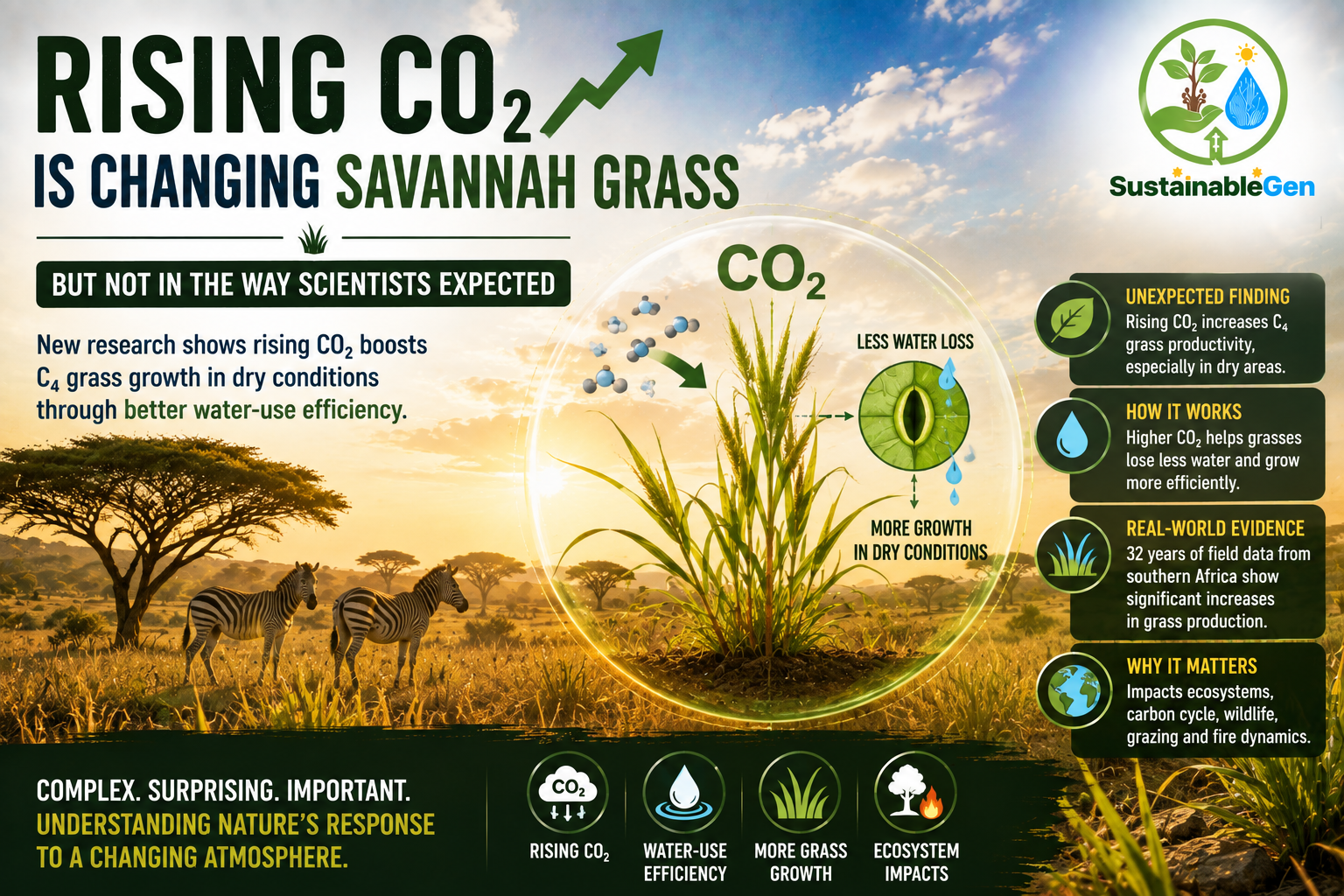
New research published in Nature has found that rising atmospheric CO₂ can significantly increase the growth of wild C₄ grasses in dry conditions—a finding that challenges a long-standing assumption about how these important ecosystems respond to a changing atmosphere.
The discovery matters because tropical and subtropical savannahs cover large areas of the planet and play important roles in carbon cycling, wildlife habitat, grazing and fire dynamics.
A Surprising Response From C₄ Grasses
Plants use CO₂ during photosynthesis to produce energy and grow.
Scientists have long expected C₄ plants—a group that includes many savannah grasses—to show relatively limited direct benefits from increasing CO₂ because their specialised photosynthetic system already concentrates CO₂ inside their leaves.
The new research challenges that assumption.
Researchers analysed 70 CO₂-enrichment experiments and combined them with 32 years of field observations from southern Africa. They found consistent evidence that higher CO₂ increased the above-ground production of wild C₄ grasses, particularly where water was limited.
Why Does More CO₂ Help When Water Is Scarce?
The answer is not simply that plants are absorbing more carbon.
One important mechanism involves the plants’ stomata—tiny openings on leaves that control gas exchange.
When atmospheric CO₂ increases, plants can partially close these openings while still obtaining enough CO₂ for photosynthesis.
That reduces water loss.
In dry environments, this improved water-use efficiency can allow grasses to maintain photosynthesis and growth for longer.
The researchers found that this effect was particularly strong under water-limited conditions.
In simple terms:
More CO₂ → less water lost through leaves → improved water status → greater grass production in dry conditions.
What Did the Long-Term Field Data Show?
The researchers examined 32 years of observations from 533 plots in Kruger National Park, South Africa.
Grass production increased over that period.
After accounting for other factors, the researchers estimated that annual grass production increased by approximately 28%, with a CO₂-associated increase of about 75.1 grams of carbon per square metre of annual production.
This is significant because it connects controlled experiments with what has actually been observed in a real savannah ecosystem.
But it does not mean that rising CO₂ is making climate change beneficial.
That distinction is crucial.
More Grass Does Not Automatically Mean More Carbon Storage
An increase in plant growth does not necessarily translate into permanent carbon sequestration.
Savannah grasses interact with fire, grazing animals, soil processes and woody vegetation.
Much of the above-ground grass biomass can be consumed or burned.
The researchers therefore caution that the ultimate fate of the additional carbon remains uncertain.
There could also be changes in forage quality, plant competition and the balance between grasses and trees.
This makes the ecological consequences considerably more complicated than simply saying:
“More CO₂ means more grass.”
Could This Change Savannah Ecosystems?
Potentially.
Savannahs are ecosystems where grasses and woody plants compete and coexist.
Changes in grass productivity can influence:
- Fire behaviour
- Grazing resources
- Soil carbon inputs
- Wildlife habitat
- Competition between grasses and trees
- Water use by vegetation
The researchers note that stronger CO₂ fertilisation in drier savannahs could potentially influence the dynamics of woody plant encroachment, although the overall outcome remains uncertain.
This is one reason the finding is important for sustainability research.
A change that appears beneficial at the level of one plant can create very different consequences at the ecosystem level.
What Happens as Climate Change Intensifies?
The team also used a global vegetation model to examine future conditions.
Their simulations suggest that CO₂ fertilisation of C₄ grasses could continue into the future.
However, higher temperatures and changing rainfall patterns can suppress productivity, meaning the CO₂ benefit does not cancel out the broader effects of climate change.
Under the modelled scenarios, CO₂ fertilisation remained present but was reduced by climate stress.
This reinforces an important point:
Plants can respond positively to one aspect of environmental change while still being exposed to serious risks from others.
Why This Research Matters
Savannahs account for a substantial share of global terrestrial productivity and support millions of people and animals.
Understanding how these ecosystems respond to increasing CO₂ is therefore important for climate models, land management and biodiversity conservation.
The study also demonstrates why long-term ecological monitoring matters.
Without decades of field observations, the changing behaviour of C₄ grasses could have remained largely overlooked.
What Comes Next?
More research will be needed to determine what the additional grass growth means for long-term soil carbon, fire regimes, livestock and wildlife, and the balance between grasses and trees.
Researchers will also need to examine whether similar patterns occur across different savannah regions, since the field observations in this study were concentrated in southern Africa.
The result is an important piece of the climate puzzle—but not the whole picture.
Key Takeaway
Rising CO₂ is not affecting every plant in the same way.
New evidence shows that wild C₄ grasses can respond strongly to higher CO₂, especially when water is limited, partly because they become more efficient at conserving water.
But this does not make rising CO₂ a climate solution.
Instead, it reveals how complex Earth’s ecosystems are—and why understanding those biological responses is essential for predicting how landscapes will change in a warming world.
Sometimes, the most important sustainability discoveries are the ones that challenge what we thought we already knew.
Leave a Reply