
A bruised or overripe apple can look perfectly healthy from the outside.
That creates a costly problem for growers and exporters. Fruit can spend weeks or months in storage before an internal defect becomes obvious—sometimes when it is already too late to save the crop.
New Zealand is now backing a technology that could give the fresh-produce industry a much earlier warning.
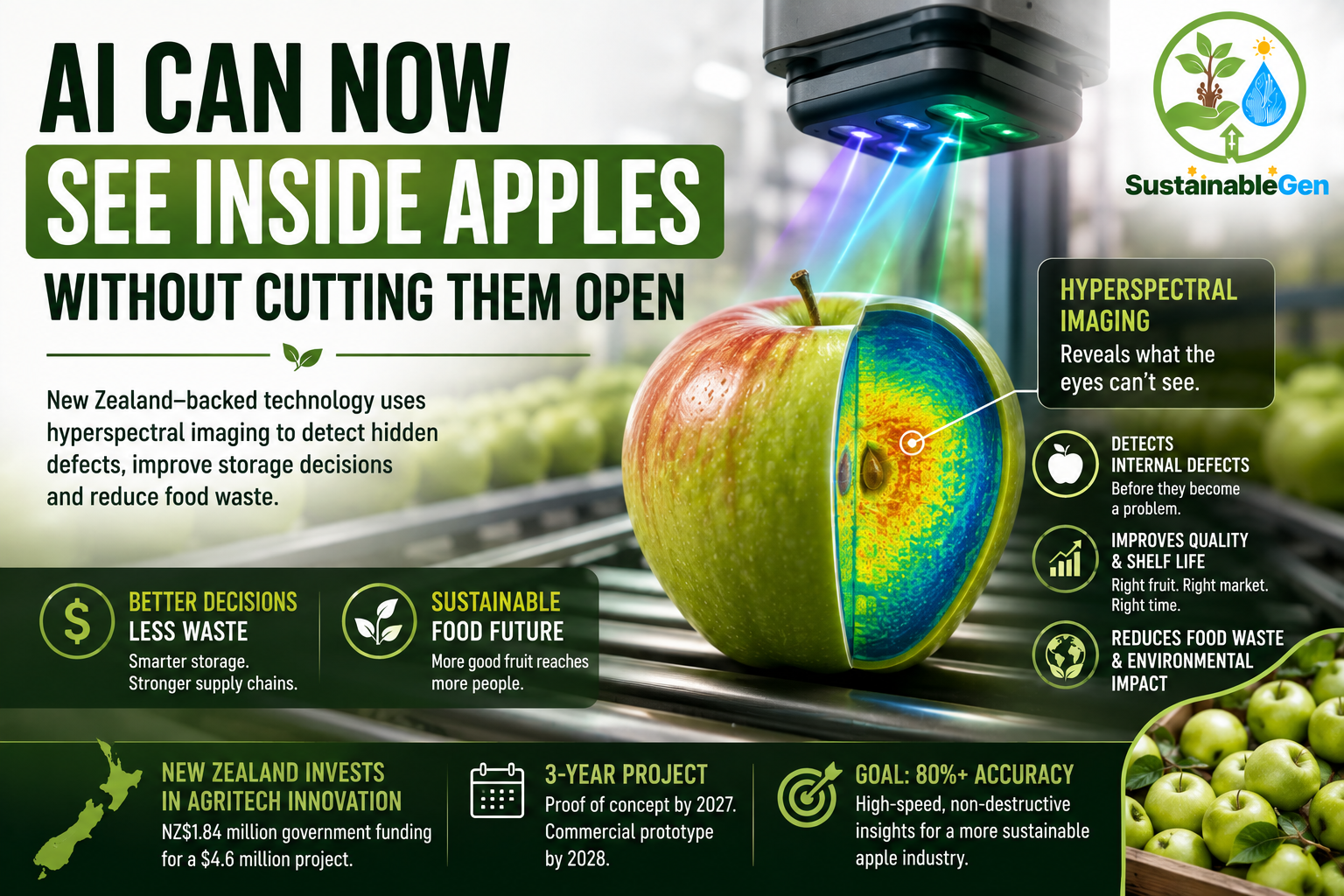
The government has committed NZ$1.84 million to a three-year research programme led by Auckland agritech company Hectre, which will develop hyperspectral imaging to examine the inside of apples without cutting them open. The full project is worth NZ$4.6 million.
The technology could eventually help packhouses decide which fruit to store, where to send it and when to ship it—before hidden problems turn into food waste.
The Problem Happens After the Apple Leaves the Orchard
Fresh fruit can face a surprisingly long journey between harvest and the consumer.
An apple may enter storage, travel overseas and sit in a distribution chain for weeks before someone discovers that its quality has deteriorated.
Traditional testing can identify some internal characteristics, but it usually requires workers to cut open and sample fruit.
That approach takes time, destroys the sampled fruit and only examines a small portion of a much larger batch.
For an industry handling millions of apples, that leaves a significant information gap.
Hyperspectral Imaging Could Look Beneath the Skin
Hectre wants to close that gap with hyperspectral imaging.
Unlike an ordinary camera, a hyperspectral imaging system captures information across multiple wavelengths of light. Different materials absorb and reflect light differently, allowing specialised algorithms to identify characteristics that a normal photograph cannot reveal.
In this project, researchers will use those signals to investigate properties such as maturity, starch content, firmness and internal defects.
The important part is that the system aims to perform this assessment without cutting the fruit open.
That could allow a packhouse to inspect large volumes of apples while they move through the normal processing line.
From Sampling a Few Apples to Understanding the Whole Batch
This could change how fruit companies make decisions.
Imagine a storage facility receiving thousands of apples from an orchard.
Instead of cutting open a small sample and assuming that sample represents the entire batch, a high-speed imaging system could eventually examine much larger quantities and identify patterns across the shipment.
The packhouse could then make more informed decisions about which fruit should enter long-term storage, which fruit should move quickly to market and which batches require closer attention.
That matters because better information can prevent waste before it happens.
The Sustainability Story Is Bigger Than Apples
Food waste often begins long before food reaches a supermarket bin.
If farmers grow high-value fruit successfully but lose part of the harvest because storage decisions relied on incomplete information, the resources used to produce that fruit also go to waste.
Every wasted apple represents land, water, energy, labour, packaging and transportation that produced something nobody ultimately eats.
Hectre’s technology therefore tackles a less visible part of food waste: information failure inside the supply chain.
The University of Auckland previously highlighted the scale of the problem through Hectre’s work, noting an example in which approximately 50 million apples stored in one facility eventually turned to juice after internal quality problems went undetected.
That example illustrates why earlier information could have enormous value.
Hectre Already Uses AI on Fruit
This isn’t Hectre’s first attempt to bring computer vision into horticulture.
The company already uses AI and computer vision to measure fruit size and colour. Its technology has collected data representing billions of pieces of fruit, and the company now operates across 22 export markets, according to New Zealand agricultural innovation organisation AGMARDT.
The new project takes the idea further.
Instead of asking a camera:
“What does this apple look like?”
the researchers want the technology to ask:
“What is happening inside this apple?”
That distinction could prove much more valuable for storage and supply-chain decisions.
The Technology Still Has to Prove Itself
This is an important point.
The project has not yet produced a commercially validated system that can reliably detect every internal defect in apples.
The research team aims to develop a proof-of-concept algorithm with at least 80% detection accuracy by June 2027. It then aims to validate a packhouse prototype under commercial conditions by June 2028.
So this remains a development project rather than a finished solution.
The technology will need to work at commercial processing speeds, maintain accuracy across different apple varieties and growing conditions, and justify its cost to growers and packhouses.
What Could Change If It Works?
If the project succeeds, fruit companies could make storage and marketing decisions based on much richer information.
That could reduce the number of apples that unexpectedly deteriorate in storage.
It could also help exporters match fruit to markets more intelligently, improve inventory planning and reduce unnecessary movement of fruit that will not survive a long supply chain.
The impact could eventually extend beyond apples.
Hectre already works with other fruits, including pears, cherries and citrus, and its existing technology has expanded across major fruit-producing regions.
A successful hyperspectral system could therefore become part of a broader effort to make fresh-produce supply chains more predictable and less wasteful.
A Different Kind of Agricultural Innovation
Agricultural technology often attracts attention when it involves robots, drones or autonomous machinery.
This project offers a quieter example of innovation.
There is no dramatic machine replacing a farmer.
Instead, researchers are trying to give the supply chain better information at the moment when a decision matters.
That may sound less futuristic, but it could have a very practical environmental benefit.
Because sometimes the most effective way to reduce waste is not to produce more.
It is to stop losing what we already produced.
Key Takeaway
New Zealand’s apple industry is testing whether light and AI can reveal problems hidden beneath an apple’s skin.
If researchers can make hyperspectral imaging accurate, fast and affordable enough for commercial packhouses, the technology could help growers and exporters make smarter storage decisions and prevent valuable fruit from becoming waste.
The project is still in development, but its underlying idea reaches far beyond apples:
The future of sustainable agriculture may depend as much on better information as it does on better production.
Leave a Reply