

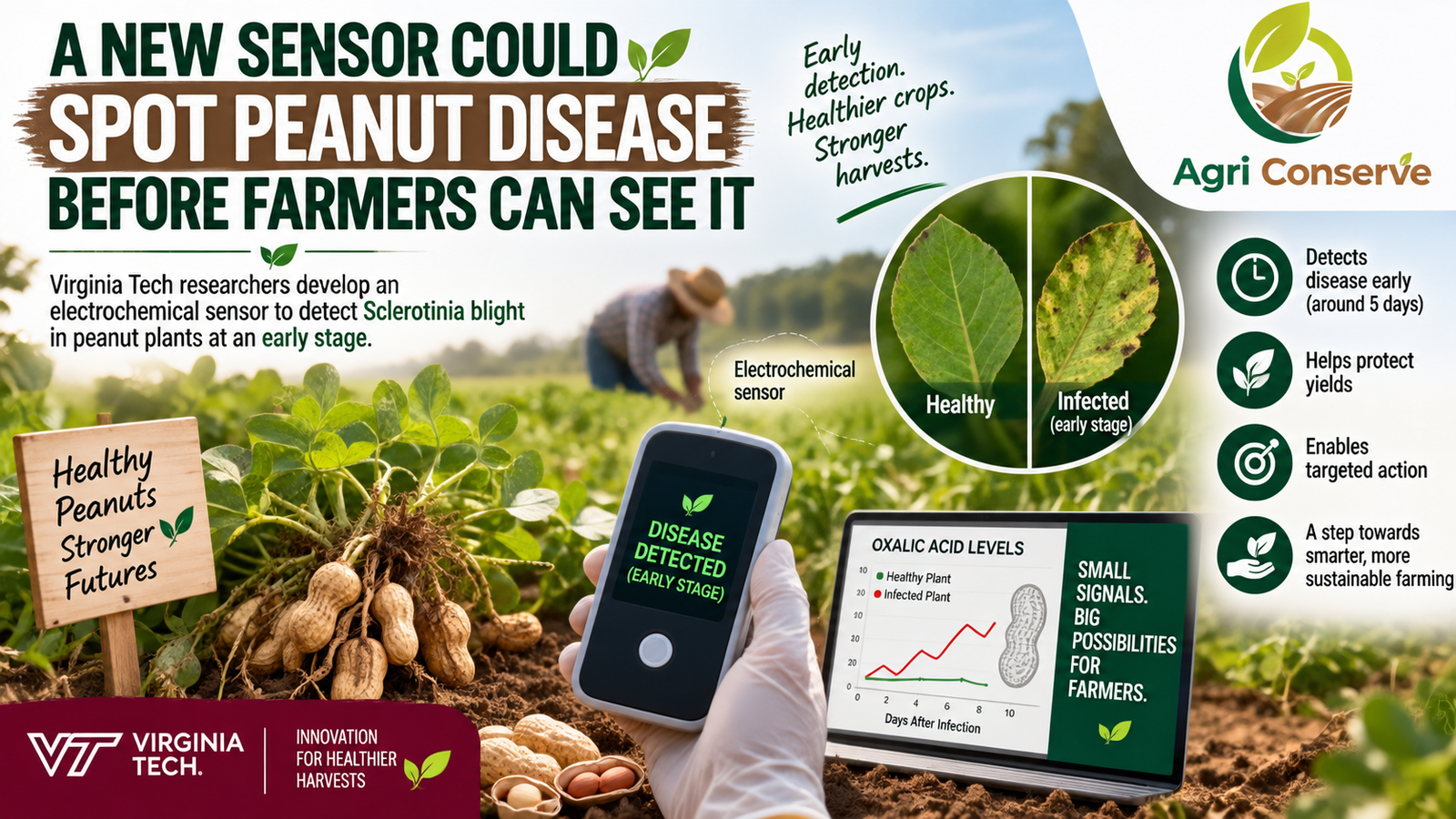
A fungal disease can move through a peanut field long before its damage becomes obvious.
That is why a new development from researchers at Virginia Tech is attracting attention. Scientists have developed an electrochemical sensor designed to detect Sclerotinia blight, a serious fungal disease of peanuts, at an earlier stage than traditional visual inspection. The research was reported by Virginia Tech on August 31, 2026.
The Problem With Waiting for Symptoms
Sclerotinia blight is caused by Sclerotinia minor and can cause severe yield losses during serious outbreaks. The challenge is that farmers generally need to see visible symptoms before they know the disease is present, when infection may already be established.
Researchers found a different warning signal inside the plant.
When infected with the pathogen, peanut plants produce higher levels of oxalic acid. The team used this biochemical response as the basis for an electrochemical sensor.
A Sensor Looking for the Early Warning
The device uses a 3D-printed structure with a nanostructured platinum electrode to measure oxalic acid in plant material.
In greenhouse testing, researchers were able to detect infection at around five days, potentially giving farmers a much earlier warning than waiting for obvious disease symptoms.
That difference could matter considerably.
Early detection creates an opportunity to investigate affected plants, monitor the field more closely and make management decisions before a disease spreads further. It also moves crop protection toward a more targeted approach rather than relying primarily on reacting after visible damage appears.
Why This Matters Beyond Peanuts
The bigger idea here is not just a new tool for peanut growers.
Agriculture is increasingly moving toward early detection. Instead of asking farmers to identify a problem after it becomes visible, sensors can look for biological signals that appear before the crop visibly deteriorates.
That could eventually mean fewer unnecessary treatments, faster intervention and better protection of yields.
The Virginia Tech research has been published in ACS Agricultural Science & Technology, adding peer-reviewed research behind the sensor’s development.
The Future of Crop Protection May Be Invisible
A healthy-looking crop does not necessarily mean a disease-free crop.
Technologies that can detect what is happening inside plants could give farmers a new layer of information, much like soil sensors, satellite imagery and weather systems already provide information about conditions outside the plant.
The next challenge will be taking technologies like this beyond controlled experiments and making them affordable, reliable and practical for use in real fields.
The future of crop protection may not always begin with what farmers can see. Sometimes, it may begin with what a sensor can detect before the human eye notices anything at all.
Leave a Reply