

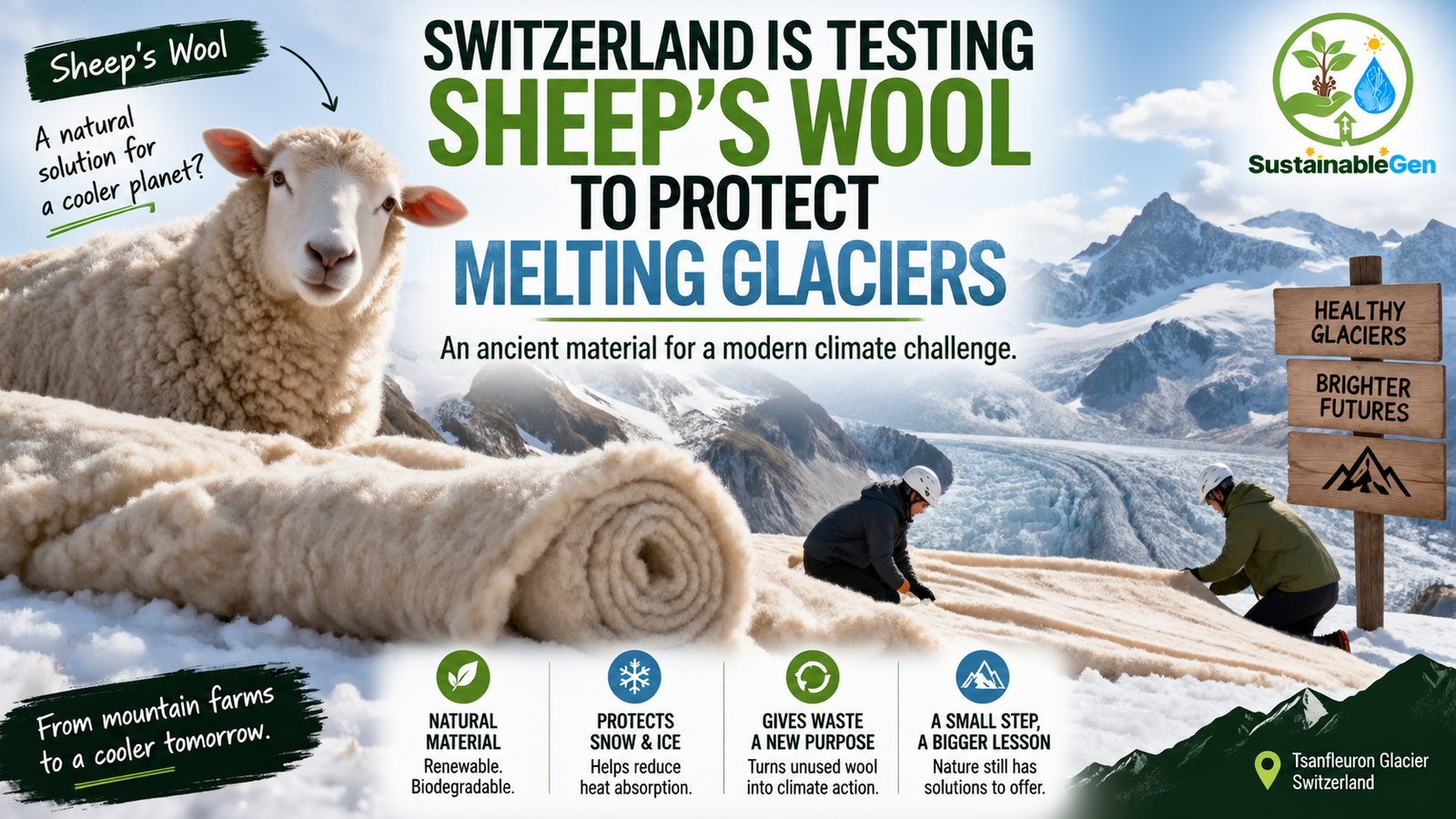
High in the Swiss Alps, researchers are testing an unusual material against one of the most visible effects of climate change: melting ice.
The material is sheep’s wool.
The “Keep It Wool” project has placed wool covers on the Tsanfleuron Glacier at Glacier 3000 in Les Diablerets, Switzerland. Researchers want to know whether wool can protect snow and ice from the sun as effectively as the synthetic geotextiles already used on some glaciers.
The idea sounds simple, but it addresses two environmental problems at once: glacier melt and the underuse of locally produced wool.
Why Are Glaciers Covered in the First Place?
Some Alpine glaciers use large protective sheets during the warmer months. These covers reflect sunlight and reduce the amount of heat reaching the snow and ice underneath.
The approach works, but conventional geotextiles often rely on synthetic, petroleum based materials. Over time, these materials can shed tiny synthetic particles into the environment.
That has encouraged researchers to look for materials that can perform the same job without creating another environmental burden.
This is where wool comes in.
From Sheep Farms to Glacier Protection
In June 2026, the project team installed two wool covers measuring 10 metres by 10 metres on the glacier. Each used a different thickness of wool. A synthetic geotextile of the same size was placed nearby to provide a comparison.
Researchers then monitored the different covers throughout the summer.
The early results have been encouraging. The wool covers showed a protective effect comparable to the synthetic material, while also holding up better than researchers initially expected under harsh mountain conditions.
That does not mean wool can save glaciers on its own. It cannot.
The experiment focuses on protecting small areas of snow and ice. The researchers themselves stress that reducing greenhouse gas emissions remains the fundamental solution to long term glacier loss.
There Is Another Sustainability Problem Behind the Experiment
The project also gives attention to an overlooked agricultural resource.
A large share of sheep wool produced in Switzerland has little commercial value and can end up being discarded, composted or burned. A Swiss government research project describes the challenge as an opportunity to develop biodegradable wool based covers for Alpine glaciers.
That creates an interesting circular economy connection.
Instead of treating unwanted wool as waste, researchers are exploring whether it can become a useful material for environmental protection.
The same principle appears across sustainability research today: sometimes the solution to one environmental problem can come from a material that society has already been throwing away.
Why This Experiment Matters
The most interesting part of the project is not simply that wool can cover ice.
It shows how natural and locally available materials can be reconsidered for modern environmental challenges.
Wool is renewable, biodegradable and already produced through agriculture. If researchers can demonstrate that it performs reliably in difficult mountain conditions, it could offer a more environmentally compatible alternative for the limited situations where glacier covers make sense.
The project also highlights an important distinction.
Protective covers can slow melting in specific locations, but they cannot reverse the broader effects of a warming climate. In Switzerland, only around 0.02% of glacier surface is covered, so this remains a highly localized intervention.
A Small Experiment With a Bigger Lesson
Climate solutions do not always begin with futuristic machines or complex technologies.
Sometimes they begin by looking differently at something we already have.
In this case, researchers are taking an agricultural byproduct, testing its physical properties, comparing it with an existing material and asking whether it can perform a useful environmental job.
The answer is not final yet. More testing will determine how durable wool remains over time and whether the material can realistically compete with conventional covers.
But the experiment offers a valuable lesson for the wider sustainability movement: circular thinking means looking for value in materials we have learned to overlook.
And sometimes, that search can lead all the way from a sheep farm to a glacier.
Leave a Reply