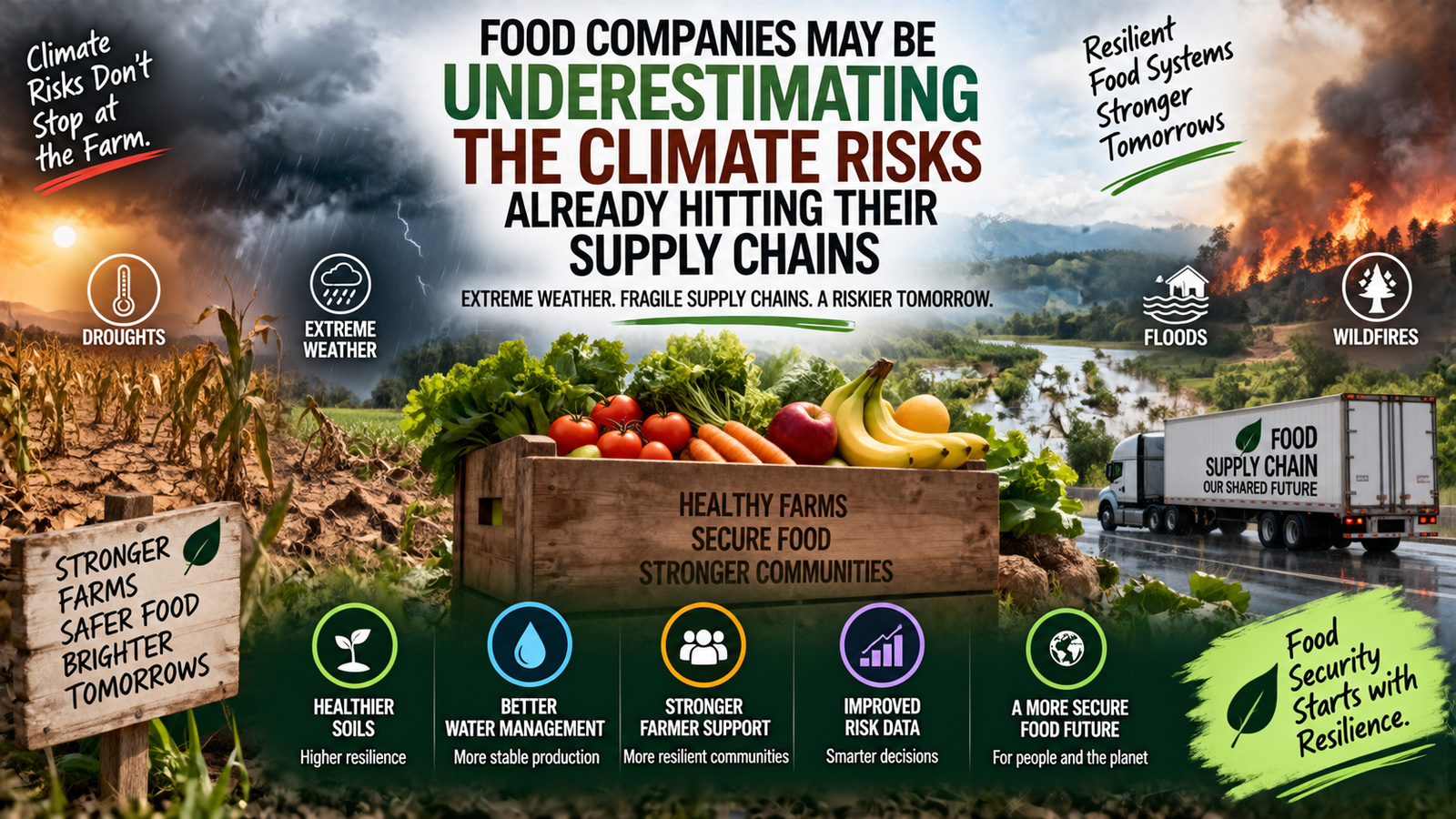
The biggest threat to the global food system may not be a shortage of climate solutions. It may be that companies are still planning for a version of the future that is less risky than the one farmers are already experiencing.
A new warning from the Food and Land Use Coalition (FOLU) argues that businesses and investors are underestimating the effects of extreme weather on food production and supply chains. The concern is not limited to individual droughts or heatwaves. Companies also need to prepare for multiple shocks happening together and cascading through global markets.
The warning arrives as Europe and other agricultural regions face growing pressure from heat, drought, floods and wildfires.
The Risk Models May Be Missing the Bigger Picture
Many companies use climate risk models to estimate how future weather could affect farms and agricultural production.
But FOLU argues that these models can miss compound risks.
A drought in one major producing country is already a problem. A drought affecting several major suppliers at the same time can become a supply chain crisis.
The same applies when a heatwave is followed by water shortages, or when extreme weather damages crops and then disrupts transportation, processing and food prices.
FOLU says current physical risk assessments often fail to capture these connections, as well as nature-related risks such as pollinator decline, soil degradation and the relationship between deforestation and rainfall.
That creates a difficult situation for food companies.
If their models underestimate the risk, their investment decisions may also underestimate the amount of resilience they need.
Europe Is Already Paying a Heavy Price
The warning comes with a significant number attached to it.
FOLU says European agriculture faces around €28 billion in average annual weather-related losses, with roughly 70% to 80% currently uninsured.
That means climate risk is not simply something businesses need to prepare for decades from now.
It is already creating economic losses.
The challenge is that agricultural resilience can be difficult to finance because the benefits often spread across an entire region rather than staying with the company that pays for the improvement.
A food company might invest in better irrigation, soil restoration or cover crops on farms that supply it. Those improvements could strengthen the wider farming landscape, but the company may not capture the full financial benefit through its own supply contract.
Farmers Need More Than Climate Forecasts
Better climate information is important, but information alone does not create resilience.
Farmers need practical options.
That could include better irrigation, soil-cover systems, diversified crops, improved water management, stronger seed systems and landscape restoration.
The Food and Agriculture Organization has similarly identified climate extremes as a major driver of disruption in agrifood systems and has called for greater investment in sustainable and resilient food production.
The challenge is connecting those solutions with reliable financing.
The Missing Piece Could Be Better Risk Data
One of the most interesting ideas emerging from FOLU’s work is the creation of a shared data infrastructure for climate and food-system risk.
Instead of every company building its own risk model, governments, researchers, insurers, investors and businesses could contribute to trusted datasets that show what is actually happening across agricultural landscapes.
Such a system could combine weather observations, crop information, soil conditions, satellite data, biodiversity indicators and supply-chain information.
That would give companies a clearer picture of where their most vulnerable suppliers are and what interventions could reduce the risk.
It could also help governments decide where preventive investment would produce the greatest benefit.
Insurance Alone Cannot Solve the Problem
Insurance can protect farmers and companies financially after a disaster, but it does not prevent the disaster.
That distinction is becoming increasingly important.
If extreme weather repeatedly damages the same agricultural region, simply paying compensation after each event does not make the underlying production system more resilient.
Prevention therefore needs to become part of the financial equation.
Investments in soil health, watershed restoration, diversified production and efficient irrigation may not produce dramatic results overnight. But they can reduce vulnerability over time.
The difficult question is how to make those benefits financially attractive to farmers, companies and investors.
Food Companies Have a New Responsibility
For major food manufacturers and retailers, climate resilience is increasingly becoming a supply-chain issue rather than simply a corporate sustainability issue.
A company that depends heavily on one crop, one region or a small number of suppliers can become vulnerable when climate shocks strike.
Diversifying sourcing can help. So can investing in the resilience of farming communities.
This is where sustainability and business strategy begin to overlap.
A healthier watershed can protect farms.
Healthier soils can improve agricultural resilience.
Better data can improve investment decisions.
And stronger farmer incomes can make sustainable practices easier to maintain.
The Next Climate Strategy May Be About Preparing Before the Shock
The food industry has spent years measuring carbon emissions and setting sustainability targets.
The next major question may be more practical:
Can food companies keep their supply chains functioning when climate shocks arrive?
That requires a shift from simply predicting future risk to actively reducing vulnerability today.
The technology already exists in many forms. Satellites can monitor crops and water. Weather systems can provide increasingly detailed forecasts. Soil and farm data can guide decisions. Financial tools can distribute risk.
What remains difficult is bringing these pieces together and directing investment toward the places where resilience matters most.
Climate change is already testing food systems. The companies that prepare early may not only reduce environmental damage. They may also protect farmers, consumers and the long-term stability of the food supply.
Leave a Reply