
For years, the circular economy has often sounded like a simple environmental idea: use products longer, reuse materials, reduce waste and recycle what remains.
But the challenge is no longer explaining the idea. The harder question is how to make circular systems work at the scale of modern economies.
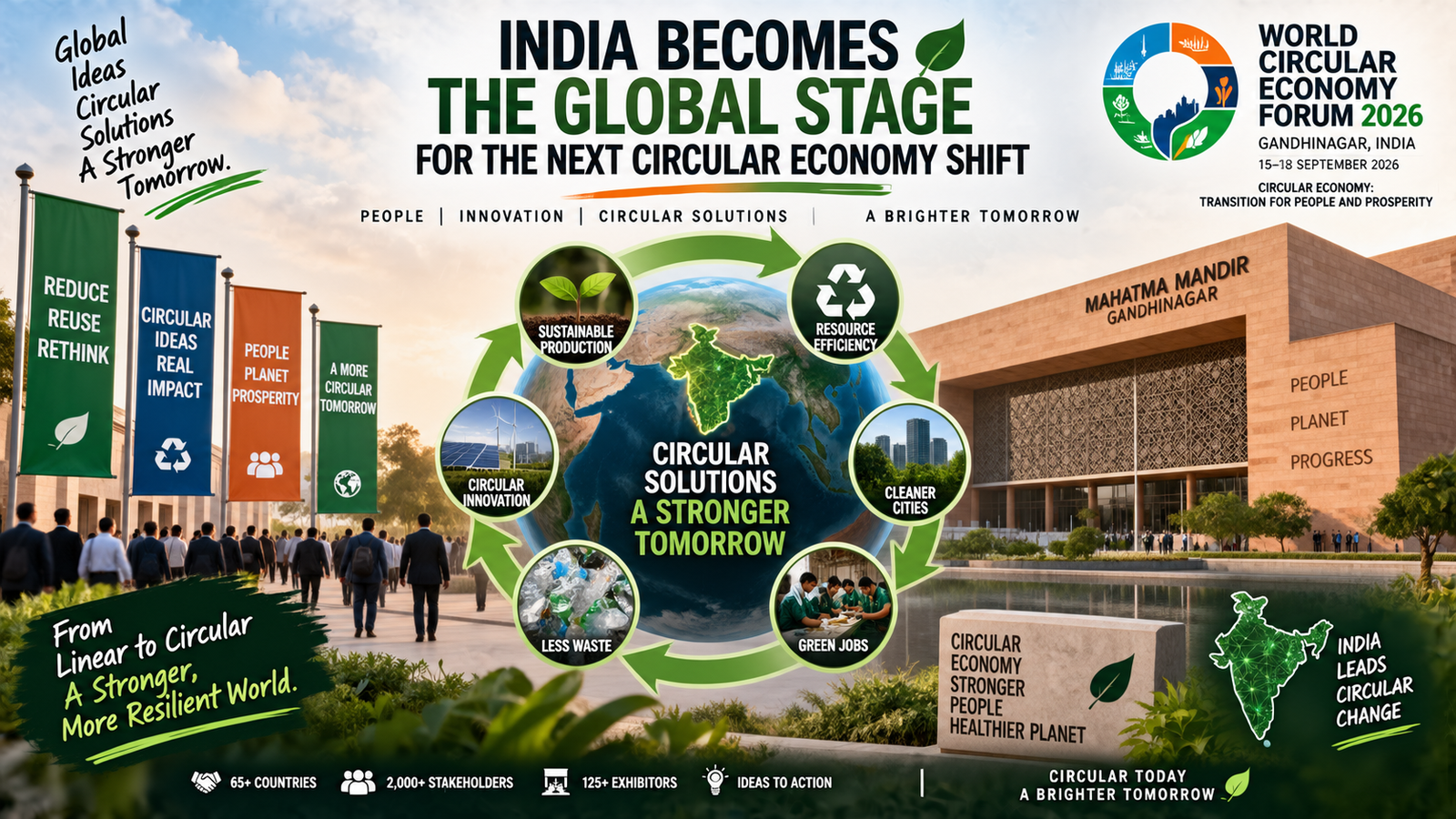
That question is taking centre stage today in Gandhinagar, Gujarat, where the World Circular Economy Forum 2026 opens on September 15. For the first time, the global forum is being held in South Asia, bringing together more than 2,000 stakeholders from over 65 countries.
The timing matters. Countries and businesses face rising pressure over waste, resource use, supply chain security, climate risks and the growing demand for raw materials. Circularity is increasingly moving from an environmental ambition into a question of economic resilience.
From Waste Management to Economic Strategy
A circular economy aims to keep materials and products in use for as long as possible rather than following the traditional pattern of extracting resources, making products, using them and throwing them away.
That shift can involve repairing products, redesigning materials, reusing components, recycling valuable resources and creating production systems that generate less waste.
The World Circular Economy Forum is putting a much broader question on the table: How can these approaches become commercially viable and scalable?
The 2026 forum, organised jointly by the Finnish Innovation Fund Sitra and India’s Central Pollution Control Board, is built around the theme “Circular Economy: Transition for People and Prosperity.”
Why India Is an Important Place for This Conversation
India’s role as host is significant because the country is simultaneously dealing with rapid industrial growth, rising consumption, urbanisation and major resource challenges.
That creates a huge testing ground for circular solutions.
The forum’s programme covers areas including artificial intelligence, sustainable products, energy, finance, governance, industrial solutions, employment and startups. More than 125 exhibitors are also expected to showcase circular economy solutions and technologies.
This makes the event more than a policy conference. It is also a showcase of technologies and business models attempting to move circularity from theory into practice.
The Next Challenge Is Circular Finance
One of the biggest barriers to circularity is not necessarily technology.
It is money.
A company may know how to recover materials from waste, redesign packaging or build a repair and reuse system, but scaling those systems requires investment. Traditional financial models often favour established linear businesses because their revenues and supply chains are easier to understand.
WCEF is therefore putting finance directly into the circular economy discussion.
An event led by the World Bank Group and IFC on September 15 is focusing on how private capital can be mobilised for circular businesses. The organisers argue that circularity increasingly matters for competitiveness, resource security and resilience, not only environmental performance.
That could become one of the most important shifts in the conversation.
If investors begin treating resource efficiency and material recovery as strategic economic opportunities, circular businesses may find it easier to move beyond small pilot projects.
Technology Could Make Circularity More Measurable
Digital technology is also becoming part of the circular economy equation.
At WCEF2026, discussions will examine how artificial intelligence and digitalisation can support circular systems.
This could mean better tracking of materials, improved waste sorting, more efficient industrial processes, predictive maintenance, product traceability and smarter decisions about when materials should be repaired, reused or recovered.
The value of these technologies will ultimately depend on whether they solve real resource problems rather than simply adding another layer of digital infrastructure.
Circularity Needs to Reach Everyday Businesses
Large industrial companies often receive attention when circular economy strategies are discussed, but the transition will also depend on smaller businesses.
Repair shops, recycling enterprises, material innovators, sustainable manufacturers, startups and local waste-management businesses can all become important parts of circular supply chains.
That is particularly relevant for emerging economies, where informal and small-scale businesses already recover significant amounts of material that might otherwise become waste.
The challenge is to connect these activities with better infrastructure, finance, technology and formal markets.
A Different Way to Think About Growth
The most important idea emerging from the circular economy movement is not simply “recycle more.”
It is to question whether economic growth always needs to depend on consuming more new resources.
A circular model tries to create value while keeping materials productive for longer and reducing pressure on nature.
That could mean a phone designed for repair rather than replacement, buildings designed for material recovery, industrial waste becoming a useful input for another company, food by-products becoming new products, or packaging systems built around repeated use.
None of these changes will happen automatically.
They require better product design, supportive policies, investment, reliable markets and consumers willing to participate.
The Circular Economy Is Entering Its Implementation Phase
The World Circular Economy Forum arrives at an important moment.
The world has spent years discussing the need to reduce waste and use resources more efficiently. The next stage is much more practical: Can circular solutions compete, scale and become part of normal economic activity?
The answer will not come from one technology or one conference.
But events such as WCEF can connect governments, businesses, investors, researchers and innovators that need to solve different parts of the same problem.
If that collaboration succeeds, circularity could evolve from a sustainability concept into a fundamental part of how economies produce, consume and grow.
And with India hosting the conversation for the first time in South Asia, Gandhinagar is becoming an important meeting point for that transition.
Leave a Reply