
For millions of farmers, the future of agriculture may depend on something that is becoming increasingly abundant but still difficult to use effectively: data.
Weather information, satellite images, soil conditions, crop observations and market signals can help farmers make better decisions. But turning all that information into something useful at farm level remains a major challenge, especially for smallholders.
That is why a new agricultural cooperation initiative emerging from the 2026 BRICS summit deserves attention.
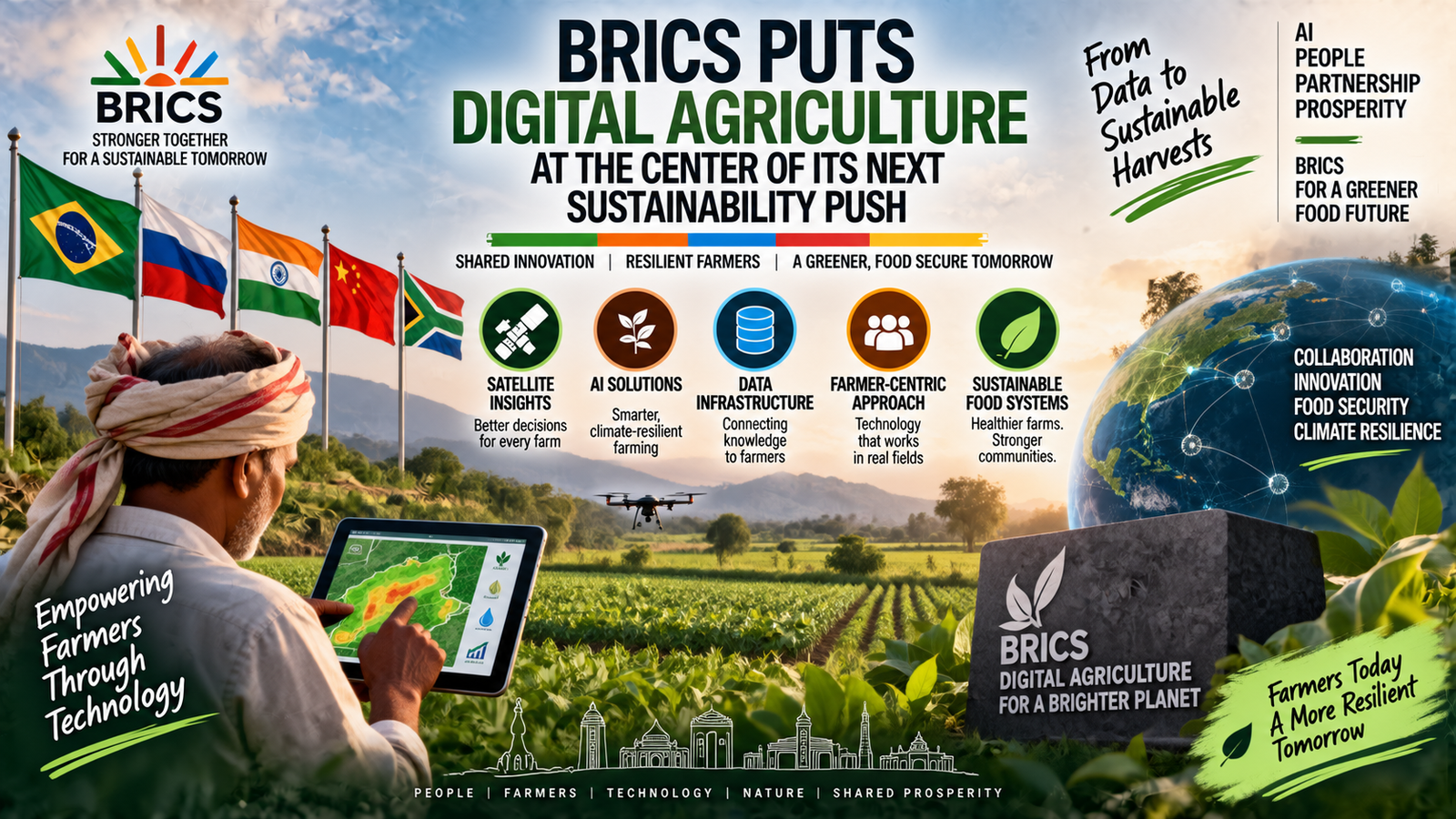
The BRICS Network on Digital Agriculture has now been formally welcomed by BRICS leaders, with the network designed to strengthen cooperation around artificial intelligence, geospatial technology, digital public infrastructure and data-driven agricultural solutions.
It is an early stage initiative, not an operating global digital farming system yet. But it could become an important platform for sharing agricultural technologies and adapting them across very different farming regions.
Why Agriculture Needs Better Digital Tools
Farmers already make hundreds of decisions during a growing season.
When should a field be irrigated?
Is a crop showing signs of stress?
Will rainfall arrive in time?
Which areas of a farm need attention?
Could a pest outbreak be developing?
Traditionally, many of these decisions have depended on farmers’ experience, local knowledge and periodic visits from agricultural experts.
Digital agriculture adds another layer.
Satellite imagery can reveal changes across large areas. Sensors can monitor field conditions. Weather systems can provide forecasts. AI can analyse large datasets and identify patterns that may be difficult to detect manually.
The challenge is connecting these technologies to the farmer’s actual needs.
That is exactly where the new BRICS network is intended to focus.
From AI to the Farm
India’s Prime Minister Narendra Modi described the new BRICS Digital Agriculture Network as a way to connect AI, geospatial technology and Digital Public Infrastructure with farmers’ real needs.
The idea is important because digital agriculture should not simply mean putting more technology into farming.
A useful system might combine satellite data with local weather information and then provide a farmer with a practical recommendation.
For example, instead of showing a farmer a complicated satellite map, the system could potentially identify areas experiencing crop stress and help determine whether irrigation or another intervention is needed.
The technology becomes valuable when the information leads to a better decision.
India Will Coordinate the Digital Agriculture Network
India has already identified institutions that will help coordinate the new agricultural cooperation platforms.
The Indian Institute of Technology Delhi will initially coordinate the BRICS Network on Digital Agriculture, according to the Indian government’s agriculture ministry. The network is expected to support cooperation in AI, geospatial technologies, digital public infrastructure and data-based agricultural solutions.
That creates an opportunity for BRICS countries to share technologies and experiences rather than developing every solution independently.
A crop-monitoring system developed for one climate, for example, could provide useful lessons for another country after local adaptation.
But adaptation will be critical.
A technology designed for large commercial farms may not work economically for small farms. A crop model trained using one region’s data may not perform equally well in another region.
The network will therefore need to focus on practical transfer, not simply technology sharing.
Digital Agriculture Is Only One Part of the New Push
The BRICS declaration connects digital agriculture with another newly strengthened area: agroecology and regenerative agriculture.
BRICS countries agreed to establish a Network of Centres of Excellence on Agroecology and Regenerative Agriculture for climate resilience and productivity. They also agreed to establish BRICS AGRIN, a voluntary, farmer-centric framework covering agricultural inputs, genetic resources and information.
That combination is particularly interesting.
One initiative focuses on modern digital tools.
Another focuses on farming systems and ecological practices.
A third focuses on seeds, genetic resources and agricultural inputs.
Together, they point toward a broader idea of agricultural resilience: farmers may need both better technology and better farming systems.
Traditional Knowledge Has a Place Too
Digital agriculture does not mean replacing farmers’ knowledge with algorithms.
The BRICS declaration also recognises the importance of traditional knowledge and farmers’ role in food systems. The summit welcomed a Global Forum on Farmers’ Rights in Seed Systems to address shared challenges and support the documentation and exchange of traditional agricultural knowledge.
This matters because technology can become less useful when it ignores local conditions.
Farmers understand their land in ways that a satellite or AI model cannot fully capture.
The strongest digital agriculture systems may therefore be the ones that combine machine-generated information with local knowledge rather than treating one as a replacement for the other.
The Biggest Test Will Be Access
The announcement sounds promising, but there is a major question that cannot be ignored.
Who actually gets to use these technologies?
Large farms can invest in sensors, software and specialist services. Smallholder farmers often cannot.
Connectivity, smartphone access, digital literacy, cost and language can all affect whether a technology reaches the people it was designed to help.
The Indian government has described the BRICS digital agriculture initiative as farmer-centric, but the real measure of success will come later.
If farmers can use these systems to reduce water use, detect crop problems earlier, improve productivity or adapt to changing weather, the network could produce meaningful results.
If the technology remains concentrated among research institutions and large agricultural companies, its sustainability impact will be much smaller.
What Happens Next?
The network is still being established, so it is too early to claim measurable environmental benefits.
Its immediate opportunity is to create stronger cooperation between agricultural researchers, technology institutions, governments and farmers across BRICS countries.
The Indian government’s earlier agriculture ministerial process had already outlined cooperation around AI, geospatial technology, digital public infrastructure and data-driven solutions. The September summit has now brought those ideas into the wider BRICS leaders’ declaration.
The next challenge is implementation.
The technology exists.
The data exists.
The farming knowledge exists.
Now the difficult part is connecting all three in ways that farmers can actually afford and use.
The Bigger Picture
Agriculture is entering a period where climate resilience and digital transformation are becoming increasingly connected.
Farmers will need to produce food under more uncertain weather conditions while managing water, soil, inputs and costs.
Digital tools cannot eliminate those challenges.
But they can potentially help farmers see problems earlier, use resources more precisely and make better decisions.
The new BRICS initiative is therefore worth watching not because it has already transformed agriculture, but because it is attempting to build something larger: a shared digital agriculture ecosystem across some of the world’s major emerging agricultural economies.
If that ecosystem eventually connects advanced technology with farmers’ everyday realities, the impact could extend far beyond the countries that created it.
Leave a Reply