
Agricultural innovation often faces a frustrating gap. Researchers can develop promising technologies, farmers can provide real-world testing environments, and investors can provide capital, yet these pieces do not always meet at the same time.
A new initiative launched in Singapore is trying to close that gap.
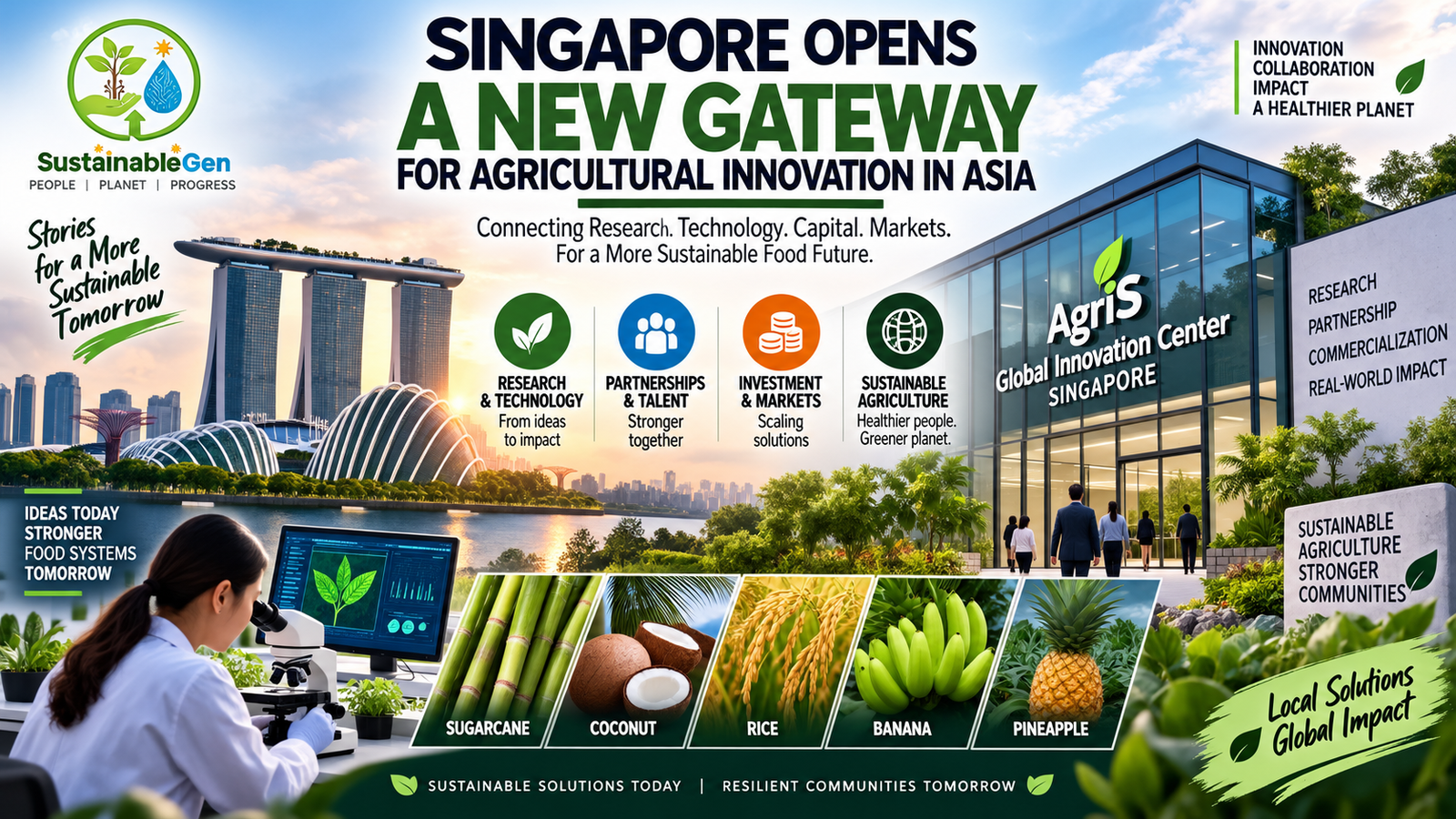
On September 16, Vietnamese agricultural company AgriS officially launched the AgriS Global Innovation Center in Singapore. The centre is designed to connect agricultural research, technology, production, investment and international markets so that promising ideas can move more quickly from laboratories into real-world applications.
This is not simply another agricultural research facility. Its bigger ambition is to create a bridge between innovation and commercialization.
The Problem With Agricultural Innovation
Developing a new agricultural technology is only the beginning.
A promising biological solution still needs to work under real farm conditions. A digital farming tool needs to fit into existing operations. A new crop technology needs field validation. And even a successful technology needs financing, manufacturing capacity and customers before it can reach meaningful scale.
This transition from research to commercial deployment can take years.
AgriS is attempting to shorten that journey by bringing different parts of the innovation ecosystem together through one international hub.
What the New Center Will Do
The Global Innovation Center will act as a permanent hub connecting science, technology, data and market information with AgriS’s agricultural operations and supply chains.
The company says the centre will focus on four areas: accelerating agricultural innovation and commercialization, connecting research and development with industry and international markets, integrating supply chains, and supporting international expansion.
The idea is straightforward.
Instead of developing a technology first and figuring out its commercial application later, researchers and technology partners can work with production teams and market specialists earlier in the process.
That could help identify whether an innovation is practical before significant resources are invested in scaling it.
From Laboratory to Actual Farms
One of the more interesting elements is the connection between research and AgriS’s existing agricultural operations.
The company currently manages nearly 90,000 hectares of growing areas across Vietnam, Laos, Cambodia and Australia and operates 11 AgTech Hubs. It also has around 9,000 hectares of research farms across Vietnam, Laos, Cambodia, Australia and Indonesia.
That gives researchers potential real-world environments in which to test and refine technologies.
For example, a technology developed in Singapore could potentially be tested under actual agricultural conditions elsewhere in the company’s network.
This matters because agriculture rarely behaves the same way in a laboratory.
Soil, rainfall, temperature, crop varieties, labour practices and local markets can all change how a technology performs.
Why Singapore?
Singapore does not have the agricultural land of countries such as Vietnam, Indonesia or India.
Its advantage lies elsewhere.
The city-state has built a strong ecosystem around technology, finance, research institutions and international business.
That makes it an interesting location for a company trying to connect agricultural production in Southeast Asia with international technology and investment.
Singapore’s Economic Development Board welcomed the centre, describing it as an opportunity for AgriS to strengthen R&D capabilities while using Singapore’s agri-food and innovation ecosystem to accelerate the development and commercialization of agricultural solutions.
The centre is also supported by JTC Corporation, a Singapore government agency responsible for developing industrial estates and supporting business innovation.
A New Partnership With NTU Singapore
The launch also brought another development into focus.
AgriS and Nanyang Technological University, Singapore, through Global Mind Agriculture, announced their intention to further develop a proposed AgriS-NTU Joint Lab for Resilient Bioinnovation.
The proposed laboratory would connect research in Singapore with AgriS’s field-validation, production and commercialization capabilities across tropical agricultural markets.
The partnership remains a proposed development rather than an already operational laboratory.
That distinction is important.
But if established, such a model could create a direct pathway between university research and agricultural testing environments.
Beyond a Single Crop
AgriS operates across several agricultural areas, including sugarcane, coconut, rice, banana and pineapple, along with nature-derived nutritional products. Its portfolio currently includes nearly 200 food and agricultural products, according to the company’s announcement.
This creates an opportunity to test different technologies across different crops rather than designing innovation around a single agricultural system.
For Southeast Asia, that could become particularly relevant.
The region has enormous agricultural potential, but it also faces climate pressures, changing consumer demand, resource constraints and increasing expectations for more sustainable production.
Technologies that improve productivity while reducing resource use could become increasingly valuable.
The Bigger Shift: Innovation Needs a Route to Market
The most interesting part of this development is not the building itself.
It is the model behind it.
Agriculture has no shortage of research. Universities, startups and companies around the world are developing biological products, digital farming systems, automation, improved crop varieties and resource-efficient production methods.
The difficult part often comes afterward.
Can the technology be tested?
Can farmers use it?
Can it compete economically?
Can it be integrated into existing supply chains?
Can investors finance expansion?
Can it reach international markets?
A successful innovation ecosystem needs answers to all of these questions.
AgriS is positioning its Singapore centre around precisely that connection between research, field validation, capital and markets.
What Comes Next
The centre is new, so it is too early to judge its environmental or agricultural impact.
Its success will depend on what technologies actually emerge from the partnerships and whether those technologies reach commercial scale.
The proposed partnership with NTU Singapore, collaborations with technology companies and access to AgriS’s agricultural operations could provide the foundation for that process.
If the model works, Singapore could become more than a financial and technology hub for agricultural companies. It could become a place where agricultural ideas from Southeast Asia are tested, financed and prepared for international markets.
That could be an important shift for sustainable agriculture.
The future of farming will not depend only on discovering better technologies. It will also depend on building better pathways for those technologies to reach farms.
And that is exactly the gap AgriS is now trying to close.
Leave a Reply