Grass is usually thought of as animal feed. But researchers in Sweden are exploring a much bigger role for it.
A new research focus from Chalmers University of Technology is examining how grass and clover can be grown as part of crop rotations, then processed in green biorefineries to produce protein, energy and potentially new bio based materials.
The idea is simple but powerful: instead of treating grass as just another crop, use almost every part of it and allow the crop itself to improve the farmland where it grows.
Chalmers researchers published their latest overview of this work on September 17, highlighting how grass and clover could help reduce dependence on imported soy, improve soil resilience and create new sources of bio based raw materials.
The Grass Is Doing More Than Growing
In cereal dominated farming systems, grass and clover are often less common because farmers need a reliable market for what they produce.
That is where the green biorefinery concept becomes interesting.
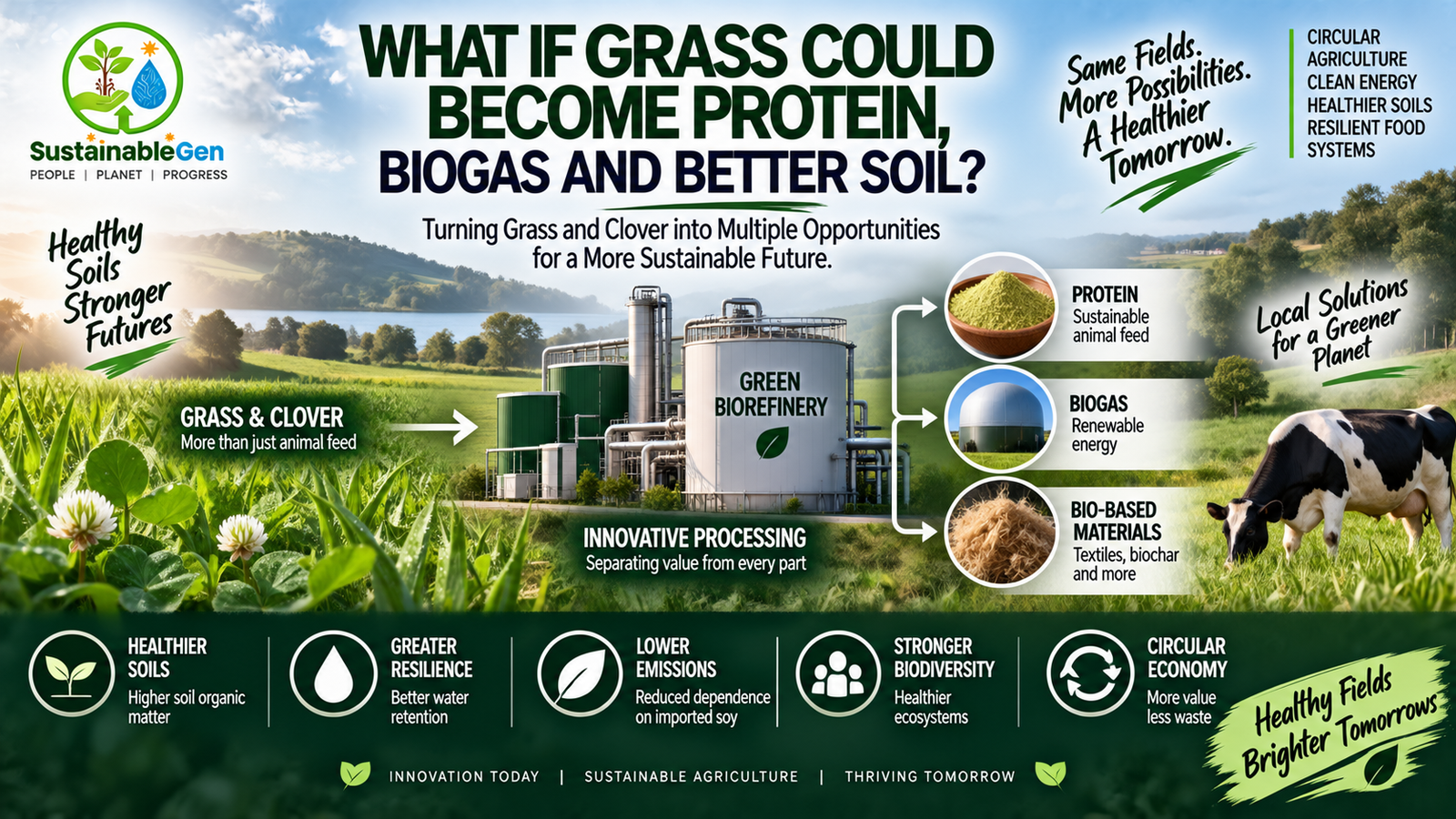
Freshly harvested grass and clover can be pressed and separated into different streams. One of those streams contains protein that can potentially be used as animal feed.
The remaining fibre rich material can then be used for other purposes, including biogas and potentially biochar, textiles and other bio based products.
Instead of producing one agricultural product, the system attempts to create several.
That changes the economics of the crop.
Could Grass Reduce Europe’s Soy Dependence?
Europe imports large quantities of protein feed, including soy.
Researchers are investigating whether protein extracted from locally grown grass and clover could replace part of that imported supply.
According to Chalmers, replacing some soy with locally produced grass protein could bring several environmental benefits, including reduced pesticide impacts, more circular nutrient flows, maintained soil fertility and better conditions for biodiversity.
This does not mean grass protein can simply replace soy everywhere.
The nutritional characteristics, processing requirements, cost and suitability for different animals all need to be considered.
But the concept creates an intriguing possibility: produce more of the protein needed by agriculture within the same landscapes that produce it.
The Soil Gets Something Back
The most interesting part may actually happen before the grass enters the biorefinery.
Grass and clover can be included in crop rotations rather than growing cereals continuously.
Long term research indicates that introducing these perennial crops can increase soil organic matter and improve the soil’s ability to hold water. That could help farmland cope better with periods of drought.
This is particularly relevant after Europe’s difficult 2026 summer.
The European Commission’s Joint Research Centre reported severe heat and water deficits across parts of western and central Europe, with grassland productivity and pasture availability also declining.
A farming system that improves soil resilience while also creating another source of farm income deserves serious attention.
One Crop, Several Possible Products
The biorefinery concept goes further than protein.
The researchers are investigating how the fibre remaining after protein extraction can be used.
Some of it can already be directed toward biogas production. Other possibilities under investigation include biochar, textiles and carbon related applications. Chalmers stresses that several of these applications still require further development.
That creates a circular model:
Grass and clover → protein → animal feed
Residual biomass → biogas or other materials
Crop rotation → healthier soil
Healthier soil → greater resilience
The goal is not zero waste. It is to keep finding productive uses for material that would otherwise have lower value.
The Numbers Are Interesting
Earlier modelling by researchers from Chalmers and other European institutions examined the potential for widespread grass cultivation across more than 81,000 European sub watersheds.
The study estimated that combining soil carbon sequestration with the displacement of natural gas through grass based biogas could produce annual greenhouse gas savings equivalent to 13% to 48% of current agricultural emissions in Europe, depending on the deployment scenario.
That is a modelling result, not a prediction that Europe can immediately achieve those reductions.
The study also identified potential benefits for erosion, nitrogen losses, flood mitigation and soil carbon.
The message is that perennial crops could provide several environmental services at the same time.
Why Hasn’t This Taken Off Everywhere?
There is a catch.
Building a green biorefinery is complicated.
Farmers need somewhere relatively close to process the biomass. Transport matters because grass contains substantial amounts of water. Processing equipment requires investment. Markets must exist for the protein and other products.
And farmers need confidence that those markets will remain strong enough to justify changing their production systems.
Chalmers researchers point directly to investment costs, business models and long term policy conditions as major challenges.
This is an important lesson for sustainable agriculture.
A technology can be environmentally attractive and still struggle to scale if the economics do not work.
Sweden Is Building the Next Chapter
Research is continuing.
The Swedish University of Agricultural Sciences is involved in GBR ACT, a 2026 to 2028 project focused on scaling green biorefineries and creating new circular business opportunities around grass based biomass.
Other research is examining how grass and clover protein and residual fibre can be used in animal feed and other applications.
The goal is gradually shifting from proving that grass can be processed into useful products toward answering a harder question:
Can the entire system make economic sense for farmers, processors and consumers?
The Bigger Idea
This story is not really about grass.
It is about changing how we think about agricultural land.
A field does not necessarily need to produce only one valuable product.
With the right crop rotation and processing infrastructure, the same landscape could produce animal feed, renewable energy, biomaterials and healthier soils.
That is a very different vision of sustainable agriculture.
Instead of asking farmers to produce less in order to reduce environmental pressure, the challenge becomes finding ways to make every hectare more productive in ecological and economic terms at the same time.
Green biorefineries are still developing, and they face real technical and financial barriers.
But if those barriers can be overcome, an ordinary field of grass and clover could become something much more valuable than it first appears.
Leave a Reply