
What if farmers could improve crop performance without changing the plant’s genes, adding new machinery or completely changing the way they farm?
A new technology announced this week is attempting something quite different.
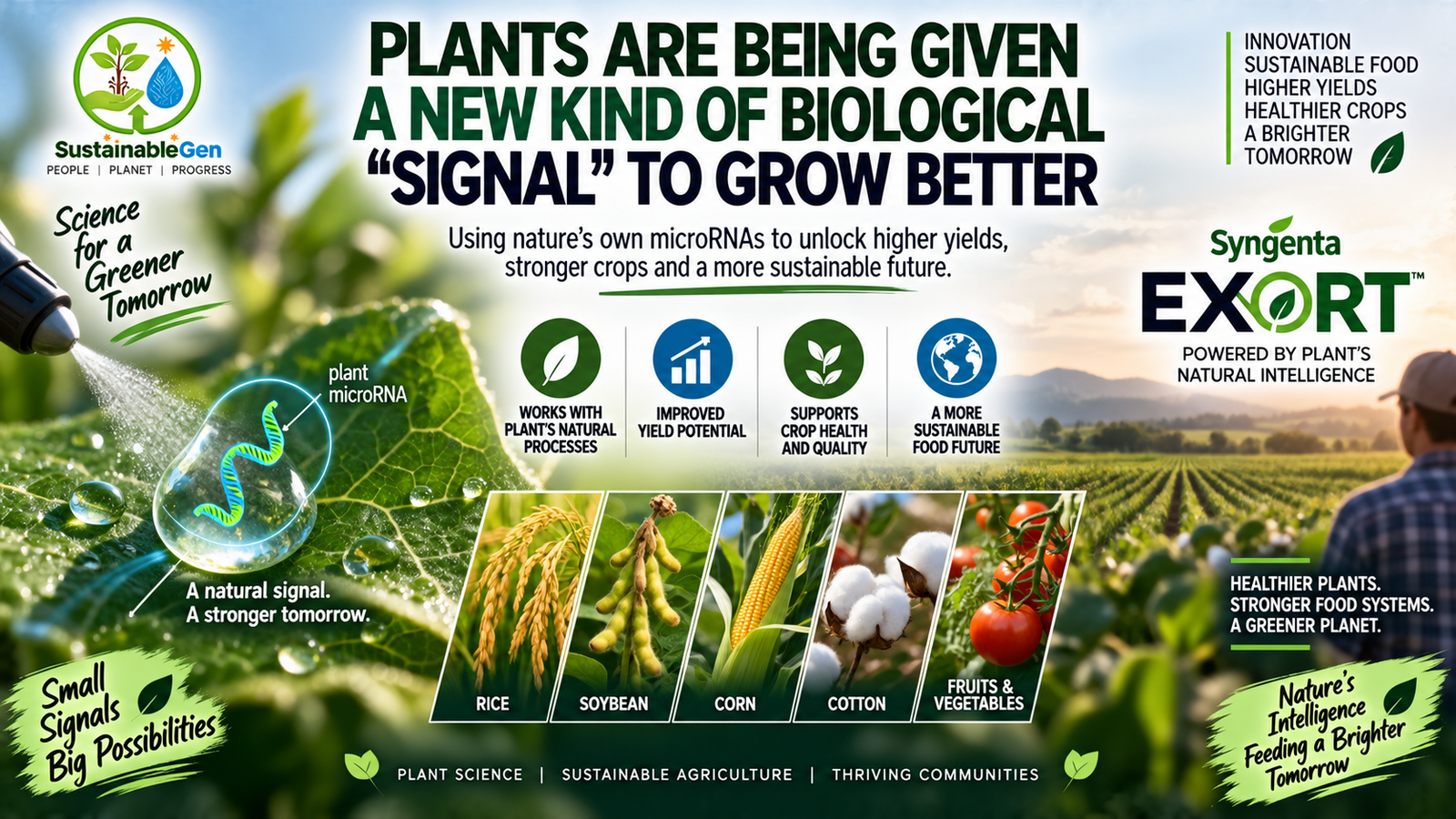
On September 22, Syngenta unveiled EXORT™, a biological technology based on naturally occurring molecules inside plants called microRNAs. The company says the technology could help crops make better use of their own biological processes and improve yield and quality.
The first EXORT based products are planned for commercial launch from 2027, beginning with Latin America and followed by a gradual rollout across about 20 countries.
The idea is fascinating because the technology is not trying to force a plant to behave differently through genetic modification.
It is trying to work with a biological language the plant already uses.
The Tiny Molecules Behind the Idea
MicroRNAs are extremely small RNA molecules that naturally occur in plants.
They help regulate how genetic instructions are used inside cells, influencing processes involved in plant growth, development and responses to changing conditions.
Scientists have studied these molecules for years, but their importance became even more prominent after the discovery of their role in gene regulation was recognised by the 2024 Nobel Prize in Physiology or Medicine.
EXORT takes that fundamental biological mechanism and attempts to turn it into something farmers can use.
Syngenta says it identifies naturally occurring plant microRNAs associated with desirable biological effects, extracts them from plant based raw materials and formulates them for agricultural application.
The Plant’s Own Biology Becomes the Tool
The technology is designed to be applied to crop leaves in very small quantities.
Rather than supplying the plant with a completely foreign mechanism, the selected microRNAs are intended to interact with biological signalling processes that already exist within the plant.
Think of it less like installing a new engine and more like adjusting the controls on an engine that is already running.
That is what makes the approach particularly interesting.
The technology sits somewhere between traditional crop protection and newer biological agriculture.
It does not rely on genetic modification, and it is not simply a conventional fertiliser.
Instead, it attempts to influence how the plant uses its existing biological machinery.
What Has Syngenta Actually Seen?
This is where an important distinction is needed.
Syngenta says EXORT delivered 5% to 10% yield improvements compared with untreated crops across a field testing programme conducted between 2022 and 2025.
The company says the programme included 240 trials across more than 15 countries, covering rice, soybean, corn, cotton, vegetables and fruit.
Those are company reported results, so they should not yet be treated as independently established performance figures for farmers everywhere.
Agricultural performance can change significantly with climate, soil, crop variety and management practices.
Still, testing across multiple crops and geographic locations makes the development worth watching.
Rice, Soybean and Corn Are Among the Crops Being Tested
The potential application is not limited to one crop.
Syngenta says EXORT has been evaluated across several major agricultural crops, including rice, soybean and corn, as well as cotton, fruits and vegetables.
That broad range matters.
A technology that works only under one narrow crop condition has limited commercial reach.
A biological platform that can be adapted to different crops could become much more significant.
The company is positioning EXORT as a platform technology, meaning future products could use the same underlying approach for different crops and biological objectives.
Why This Could Matter for Sustainable Agriculture
Agriculture faces a difficult equation.
Farmers need to produce more food, but land and resources remain limited. At the same time, agriculture needs to reduce environmental pressure.
Increasing productivity on existing farmland can therefore have an important sustainability dimension.
If farmers can obtain more output from the same area without proportionally increasing resource use, the pressure to expand agricultural land could potentially decline.
That does not automatically make a technology sustainable.
The full environmental picture will depend on how EXORT based products perform in real farming systems, their production footprint, their effects on surrounding ecosystems, their cost and how farmers use them.
Those questions will become clearer once commercial products enter the market.
The Interesting Part Is What EXORT Is Not
The agricultural biotechnology conversation often focuses on genetically modified or genome edited crops.
EXORT represents a different direction.
The technology does not seek to permanently alter the plant’s DNA.
Instead, it uses naturally occurring biological signalling molecules to influence processes during plant growth.
That could make the approach attractive in markets where farmers or consumers remain cautious about genetic modification.
However, the regulatory pathway will still depend on individual countries and how authorities classify these products.
Syngenta says products will be registered as biostimulants in markets where appropriate regulatory frameworks exist.
From Nobel Prize Science to Agricultural Fields
There is a bigger story here.
The discovery of microRNAs was fundamental biological research.
Years later, researchers are exploring how that knowledge can become a practical agricultural technology.
This is one of the most interesting patterns in modern agriculture.
Breakthroughs do not always arrive as giant machines or futuristic robots.
Sometimes they begin with an extremely small biological mechanism that scientists only recently learned to understand.
The challenge is then to move from laboratory knowledge to something that works consistently, economically and safely across millions of hectares.
EXORT is now entering that transition.
Commercialisation Will Be the Real Test
Syngenta expects its first EXORT based products to launch in 2027, with Latin America planned as the initial market. The company then expects a phased introduction across additional countries and crops.
That means the most interesting phase is still ahead.
Field trials can demonstrate potential.
Commercial farming has to demonstrate reliability.
Farmers will ultimately ask much simpler questions:
Does it improve my crop?
Does it work consistently?
What does it cost?
Does it fit into my existing farming system?
And does the additional yield justify using it?
If the answers are positive, EXORT could become an interesting example of how advanced plant science is moving into mainstream agriculture.
The Bigger Picture
Agricultural innovation is increasingly moving beyond the idea of simply adding more inputs.
Researchers are looking deeper into the biology of crops themselves.
Microbiomes, RNA molecules, genetics, plant signalling and biological interactions are opening new possibilities for influencing crop performance.
EXORT is one early example of that direction.
It is still a commercial technology in development, and the company’s reported results require broader independent validation.
But the underlying idea is compelling:
Instead of forcing plants to work differently, can agriculture learn to communicate with the biological systems plants already use?
If that question leads to reliable products that help farmers produce more with fewer resources, it could mark an important step in the next generation of sustainable agriculture.
Leave a Reply