

Artificial intelligence can recognise faces, read documents and analyse satellite images.
But put an AI model in front of a microscope and ask it to identify a tiny plant pathogen, and the results can change dramatically.
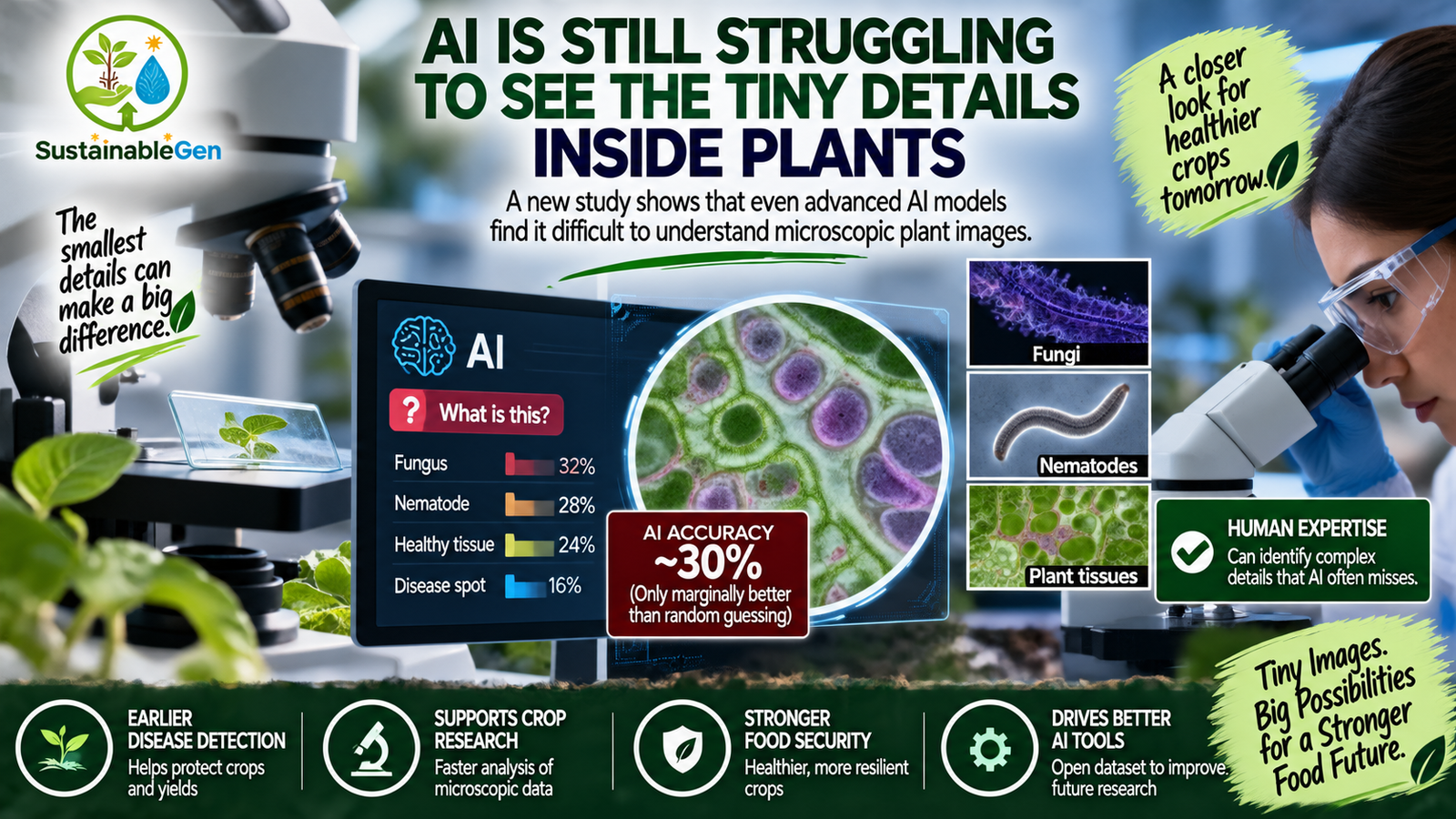
Researchers at The University of Queensland (UQ) have discovered that even advanced vision-language models struggle to reliably understand microscopic plant images. Their new PlantMicro benchmarking system is designed to show exactly where AI fails and give developers a way to improve it. The research was presented at the European Conference on Computer Vision 2026, and UQ announced the work on September 30.
For agriculture, this matters more than it might first appear.
The ability to recognise plant diseases, parasites and cellular changes could eventually help researchers develop better crops, diagnose problems earlier and understand how plants respond to environmental stress.
But first, AI has to learn how to actually see the plant.
The Microscopic World Is a Blind Spot for AI
Today’s vision-language models are becoming remarkably good at interpreting ordinary photographs.
A picture of a field can contain thousands of visible details, and AI can often identify objects, describe scenes and answer questions about them.
Microscopic plant images are different.
The important information can be hidden inside a tiny section of tissue.
A pathogen might appear as a barely visible structure.
A nematode may occupy only a small part of an image.
A disease may alter cells in ways that are difficult even for a human without specialist training to recognise.
UQ researchers wanted to find out just how well today’s AI systems could handle that challenge.
The answer was not encouraging.
PlantMicro Put AI to the Test
UQ PhD researcher Tianqi Wei and collaborators developed PlantMicro, a benchmarking dataset containing thousands of microscopic plant images.
The system tests whether AI models can perform tasks such as identifying, sorting and counting microscopic features associated with plants and plant diseases. The images include material captured through conventional and electron microscopy.
The dataset includes examples involving plant-parasitic nematodes, fungi and plant tissues.
Instead of simply asking an AI model whether an image looks like a particular disease, the researchers are trying to measure where its understanding breaks down.
That distinction is important.
If scientists know what the AI gets wrong, they have a much better chance of improving it.
The Results Were Surprisingly Poor
The researchers tested both closed-source and open-source vision-language models.
For identifying plant hosts and diseases from microscopic evidence, the models achieved average accuracy of only about 30%. UQ researchers describe this as only marginally better than random guessing for the tested tasks.
That is a striking result.
AI has made enormous progress in image recognition, but microscopic plant science remains a difficult environment for it.
The problem is not simply that the models need more computing power.
They also need better specialised data and better ways of evaluating their performance.
Why This Matters to Agriculture
Plant disease can cost farmers enormous amounts of money.
A disease that spreads unnoticed through a crop can reduce yields, increase production costs and threaten food supplies.
Researchers therefore spend considerable time examining plant tissues and identifying pathogens.
If AI eventually becomes reliable at analysing microscopic images, it could help researchers process enormous quantities of biological information much faster.
Imagine a research laboratory where thousands of microscope images are generated during a crop disease study.
Instead of requiring specialists to manually examine every image, an AI system could potentially screen them, identify unusual patterns and highlight the images that deserve closer examination.
The human researcher would still make the important scientific judgement.
AI could help handle the volume.
But There Is a Long Way to Go
The current research does not mean AI is ready to diagnose plant diseases independently.
Quite the opposite.
The 30% average accuracy demonstrates why researchers need to be cautious.
A system that confidently misidentifies a pathogen could lead researchers in the wrong direction.
That makes benchmarking particularly important.
Before agricultural AI can become a dependable research tool, scientists need reliable tests that reveal whether it actually understands the biological information in an image.
PlantMicro is designed to provide exactly that kind of test.
The Interesting Part Is That the Dataset Is Open
The researchers have made PlantMicro available as a resource for further development.
That creates an opportunity for AI researchers outside UQ to test their own models against the same microscopic plant challenges.
It also gives developers something they often lack when building general-purpose AI systems: specialised agricultural evaluation data.
The research was developed with UQ’s School of Agriculture and Food Sustainability and received support through Analytics for the Australian Grains Industry, a partnership involving the Grains Research and Development Corporation, UQ, Curtin University and the University of Adelaide.
That connection to the grains industry is significant.
The technology is not being developed purely as an academic computer-vision exercise.
There is a clear agricultural application behind it.
AI Could Eventually Look Much Deeper Into Crops
Most agricultural AI applications today work with information that farmers can see or measure relatively easily.
Satellite imagery.
Drone photographs.
Field cameras.
Weather data.
Soil sensors.
PlantMicro points toward a different level of agricultural intelligence.
The microscopic level.
That could eventually allow AI to help researchers investigate questions that are invisible from above the field.
How does a pathogen enter plant tissue?
How does a crop respond at the cellular level to drought?
What changes occur inside a plant before visible disease symptoms appear?
Which varieties show microscopic characteristics associated with greater resistance?
These are the kinds of questions where better AI-assisted microscopy could become useful.
The Bigger Story Is Not About Replacing Scientists
It is tempting to frame this as another story about AI taking over scientific work.
That is not what the researchers are proposing.
The immediate goal is much more practical.
Make AI reliable enough to become another research instrument.
Microscopes already allow scientists to see things the human eye cannot.
AI could eventually help interpret those images at a scale that would be difficult for humans to manage alone.
But that only works if the models understand what they are looking at.
PlantMicro is essentially helping scientists build the measuring stick needed to find out.
Agriculture May Need AI That Can See Beyond the Field
The next major agricultural AI breakthrough may not come from another drone flying over a farm.
It could come from a microscope sitting inside a laboratory.
If researchers can teach AI to understand microscopic plant structures reliably, they could gain a powerful new tool for studying disease, crop biology and food security.
For now, however, the message from UQ is clear.
AI may be impressive when looking at the world from above.
When it comes to the tiny world inside a plant, it still has a lot to learn.
Leave a Reply