
Artificial intelligence in agriculture is usually presented as a way to analyse crops.
But there is a problem that comes before analysis.
What happens when the data itself is bad?
A blurry crop photograph, a damaged image, the wrong crop, an incorrectly labelled disease or a photograph taken in unsuitable conditions can all teach an AI system the wrong lesson.
That problem is now being tackled by an agricultural AI initiative at IIT Ropar.
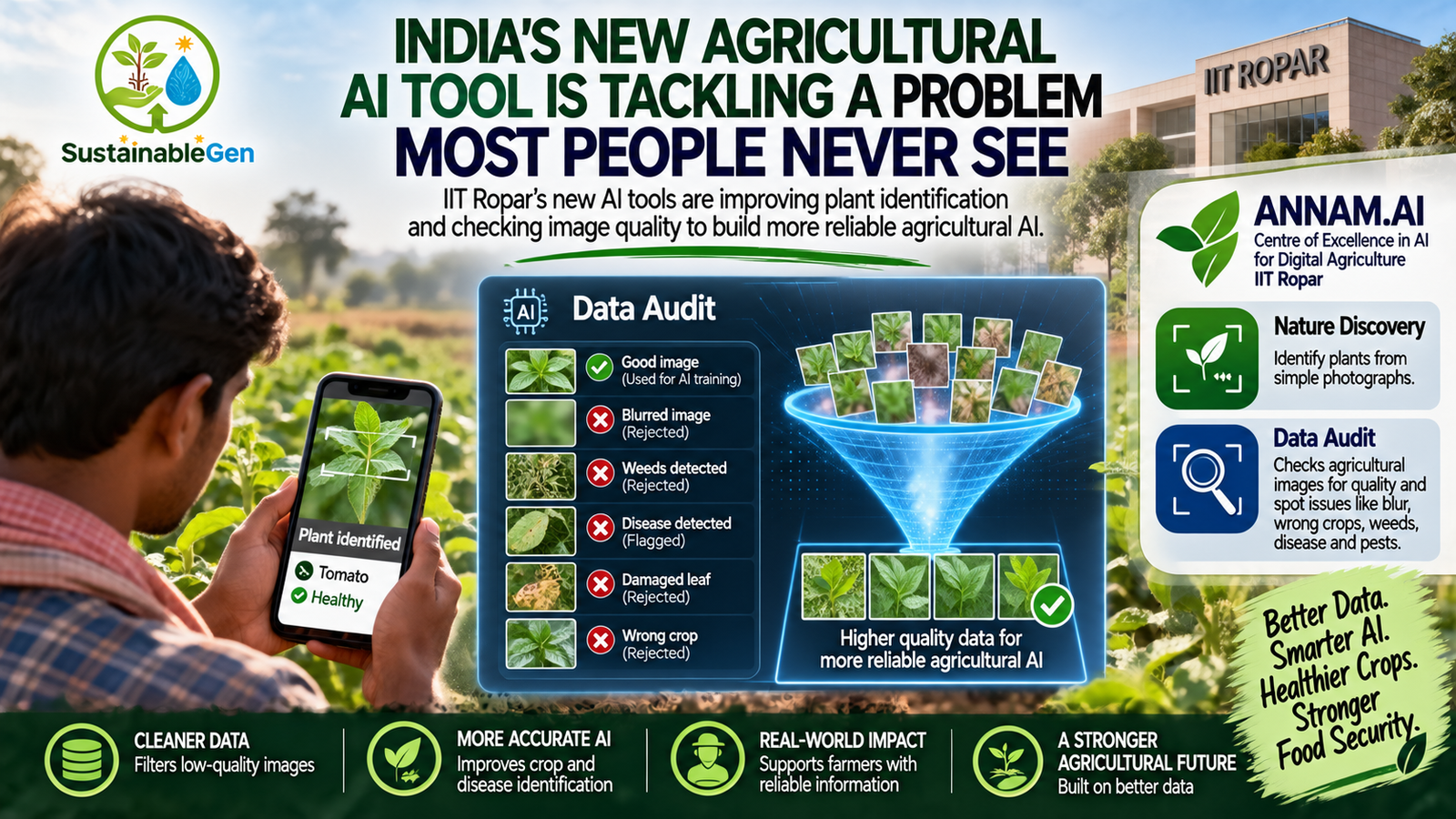
On October 2, ANNAM.AI, the Centre of Excellence in AI for Digital Agriculture at IIT Ropar, highlighted two new tools: Nature Discovery, which uses AI to identify plants from photographs, and Data Audit, which checks agricultural images before they are used to train or evaluate AI systems.
It is a less glamorous side of agricultural AI, but potentially one of the most important.
AI Cannot Be Better Than the Data It Learns From
Imagine training an AI system to identify crop diseases.
Researchers give it thousands of photographs.
But some photographs are blurred.
Others contain weeds instead of crops.
Some show damaged leaves.
Some have pests.
Others may have incorrect labels.
The AI does not automatically know which examples are trustworthy.
It learns from what it receives.
ANNAM.AI’s new Data Audit system is designed to screen real-world agricultural photographs across six quality dimensions, including crop identification, weeds, blur, damage, disease and pests.
That means the system is effectively asking a question before another AI gets involved:
“Is this image good enough to teach a machine?”
Why This Could Matter More Than Another Crop App
Agricultural AI is moving rapidly into disease detection, crop identification, pest monitoring and precision farming.
But these systems depend heavily on agricultural image datasets.
And agricultural images are messy.
A farmer does not photograph a leaf in a laboratory.
The photograph may come from a moving phone, under harsh sunlight, during rain, against a complicated background or with several leaves overlapping each other.
A useful AI system therefore needs to understand the conditions in which agricultural data actually gets collected.
Data Audit is aimed at that problem.
Instead of simply collecting more photographs, the objective is to improve the quality of the photographs entering the AI pipeline.
The Other New Tool Looks at Nature Through a Phone
ANNAM.AI is also highlighting Nature Discovery, an AI tool that allows users to photograph plants and learn about them.
The system is presented as part of the organisation’s wider effort to make AI useful beyond specialist agricultural laboratories.
That creates an interesting contrast.
One tool helps people understand what they are looking at.
The other helps machines learn from what they are looking at.
Together, they point toward a broader agricultural intelligence system where photographs become structured information rather than simply images sitting on someone’s phone.
IIT Ropar Is Building Something Much Bigger
These tools are part of ANNAM, short for Alliance for Next-Gen Nourishment through Agriculture Modernization.
The initiative operates through IIT Ropar’s Centre of Excellence in Artificial Intelligence for Digital Agriculture, supported by the Ministry of Education, Government of India. The centre describes its broader mission as building AI systems that combine crop intelligence, microclimate information and farmer-facing advisory tools.
Its architecture includes several layers.
One collects field-level microclimate information.
Another provides crop identification, diagnostics and predictive analytics.
A third is designed to deliver agricultural advice to farmers through multilingual interaction.
The ambition is therefore considerably larger than a mobile application.
It is an attempt to build an agricultural intelligence infrastructure.
Why Data Quality Becomes Critical at That Scale
The bigger the AI system becomes, the bigger the data problem becomes.
A model trained on a few thousand carefully selected images can be manually checked.
A national agricultural intelligence system cannot rely on humans examining every photograph.
It needs automated ways to identify bad or unreliable information.
This is where Data Audit becomes particularly interesting.
If agricultural AI eventually processes millions of field photographs, an automated quality-control layer could help prevent poor data from entering the system in the first place.
That could improve disease detection, crop classification and other downstream applications.
It is not as visible as a robot driving through a field.
But it could be just as important.
India Needs This Because Its Farms Are Not Uniform
One of the hardest problems in Indian agriculture is diversity.
A farming model that works in Punjab may not work in Maharashtra.
A disease photograph from Kerala may look very different from one captured in Rajasthan.
Crops, varieties, soil, weather, farming practices and even the way farmers capture images can change from one region to another.
ANNAM.AI says its broader objective is to develop hyperlocal agricultural intelligence that can account for these differences rather than relying on generic advice.
That is important because an AI system trained on narrow datasets can perform well in controlled conditions and then struggle when it encounters farms it has never seen before.
Better data coverage and better data quality can help address that problem.
There Is Already a Larger Ecosystem Behind the Project
ANNAM.AI is not developing in isolation.
In June, Syngenta announced a strategic partnership with the programme, contributing agronomic expertise toward crop-health, pest-forecasting and heat-stress models. The initiative also involves Google and Indian government institutions.
That combination is significant.
Universities bring research.
Government brings infrastructure and public-sector reach.
Agricultural companies bring agronomic knowledge.
Technology companies bring computing and AI expertise.
The challenge will be turning those capabilities into tools that actually work for farmers.
The Hardest Part May Still Be the Farmer
A technically impressive AI system does not automatically become useful agriculture.
Farmers need information that is understandable, timely and actionable.
Telling someone that a model has detected a particular disease is not enough.
The farmer needs to know what to do next.
Should they spray?
Should they wait?
Is the problem actually serious?
How much treatment is needed?
Can the crop recover?
And perhaps most importantly:
Can the farmer trust the recommendation?
ANNAM.AI’s broader system is being designed around multilingual, expert-validated agricultural advisories, which suggests that the developers recognise this gap between AI prediction and practical farm decisions.
The Most Important Innovation Might Be Invisible
There is a tendency to judge agricultural technology by what farmers can physically see.
A drone.
A robot.
A smart tractor.
A sensor.
But some of the most consequential agricultural technology may exist entirely behind the scenes.
A database that contains better crop images.
A model trained on cleaner information.
A system that understands regional differences.
A platform that can turn millions of observations into useful agricultural knowledge.
Those things are difficult to photograph.
But they can determine whether agricultural AI works or fails.
India Is Moving From “AI for Agriculture” to “Agriculture Built Around AI”
That is the more interesting development here.
The first phase of agricultural AI focused on individual applications.
Detect this disease.
Identify this crop.
Predict this yield.
The next phase could be much more connected.
Collect reliable data → understand the field → interpret the risk → provide advice → learn from what happens next.
If that cycle becomes reliable, AI could move from being a tool farmers occasionally use to becoming part of the infrastructure supporting everyday agricultural decisions.
ANNAM.AI’s latest tools are still early pieces of that much larger system.
But they highlight an important truth that the agricultural AI boom sometimes overlooks:
Before AI can make better farming decisions, it has to learn from better agricultural evidence.
And that may make the humble crop photograph one of the most valuable pieces of data on the farm.
Leave a Reply