

A plant cannot walk away from a disease.
It cannot move to healthier soil, escape a pathogen or choose a better neighbourhood.
But new research suggests plants may have a surprisingly sophisticated way of changing the community around their roots when they come under attack.
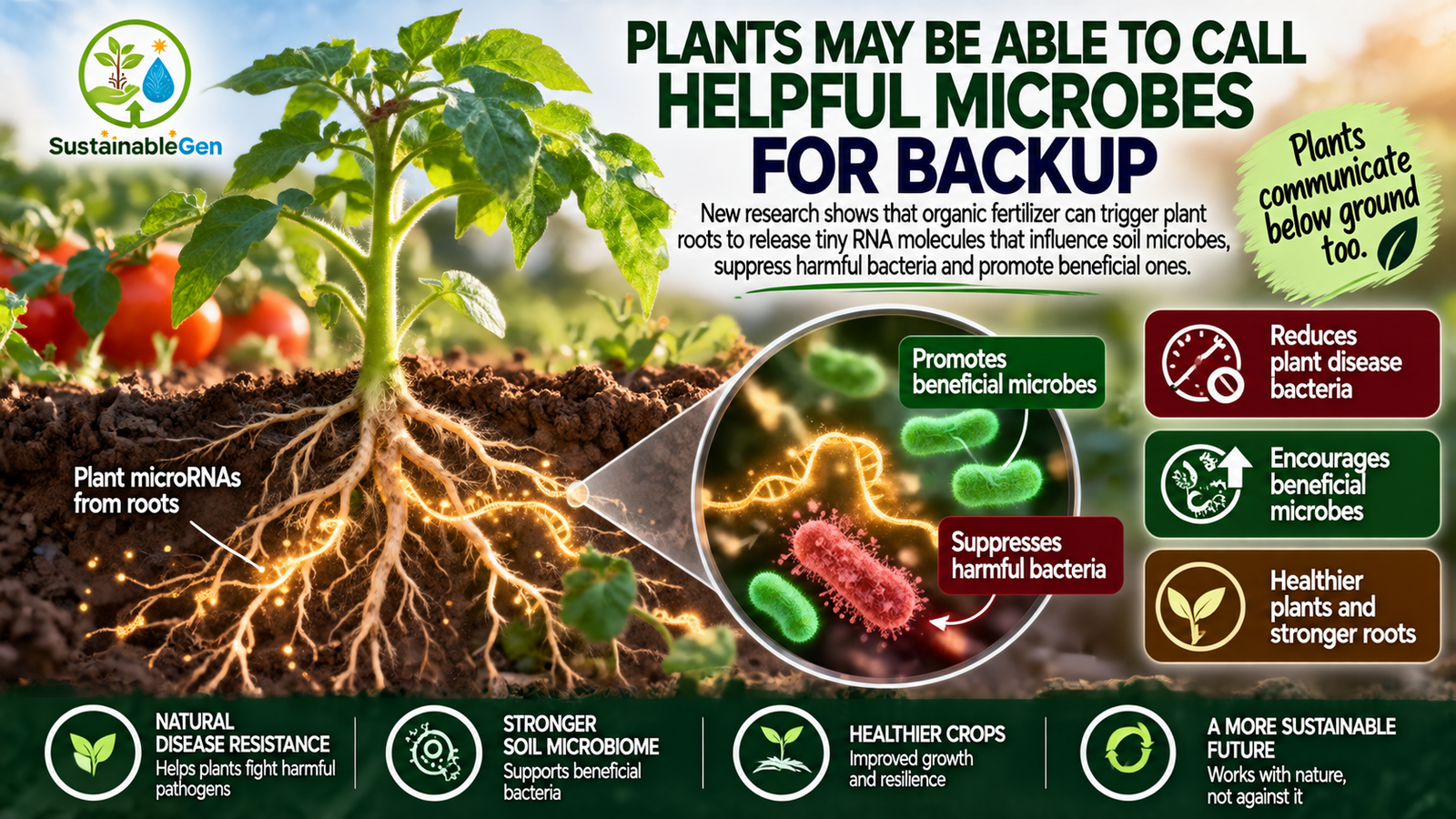
Scientists studying tomatoes have found evidence that organic fertilizer can trigger plant roots to release tiny molecules called microRNAs, which appear to influence the microorganisms living around the roots.
Some of these molecules can suppress a harmful bacterium while encouraging beneficial bacteria to grow.
The finding, discussed in a new October 1 article in npj Science of Plants, opens an unusual possibility for sustainable agriculture: instead of relying entirely on chemicals to control soil diseases, farmers may eventually be able to work with the plant’s own biological signalling system. Nature
The Hidden Community Around Every Root
The soil immediately surrounding plant roots is called the rhizosphere.
It is not just dirt.
It contains an enormous community of bacteria and other microorganisms that interact with plants in ways that can influence nutrient availability, growth and disease resistance.
Scientists sometimes describe the rhizosphere microbiome as a plant’s “second genome” because of its importance to how plants survive and adapt. Nature
Plants already release chemical compounds from their roots that can attract certain microorganisms.
Researchers have long studied this as a kind of plant “cry for help.”
The new research adds another possible communication channel to that story.
Instead of relying only on conventional chemical compounds, the plant may also use microRNAs to influence which microorganisms thrive around its roots.
Organic Fertilizer Appears to Trigger the Signal
The research focused on tomato plants affected by bacterial wilt caused by Ralstonia solanacearum.
Researchers compared plants receiving organic fertilizer with plants receiving chemical fertilizer over multiple generations.
After six generations, the organic fertilizer group had a bacterial wilt disease index of 52.43%, compared with 64.33% in the chemical fertilizer group.
More strikingly, the abundance of R. solanacearum fell by approximately 92% inside the plants and 94% in the surrounding rhizosphere soil compared with the chemical fertilizer treatment. Nature
The researchers then looked deeper.
They found specific tomato microRNAs in the rhizosphere that appeared in much greater quantities following organic fertilizer treatment.
One of them, sly-miR159, reached an abundance about 26.7 times higher than in the chemical fertilizer group. Nature
That raised a fascinating question.
Was the plant simply responding to better nutrition?
Or was it actively changing the microbial community around its roots?
The evidence pointed toward the second possibility.
One Tiny Molecule Appeared to Do Two Jobs
Researchers identified two particularly interesting microRNAs, sly-miR159 and sly-miR319c-3p.
Sly-miR159 showed a dual effect.
In laboratory co-culture experiments, it reduced the growth of Ralstonia solanacearum by around 30% to 40% compared with the control during the tested period.
At the same time, it increased the growth rates of two beneficial bacteria, Bacillus subtilis and Streptomyces fradiae, by about 25% and 35%, respectively. Nature
That is what makes the discovery particularly interesting.
The plant may not simply be trying to kill everything around its roots.
It appears to be doing something more selective.
Suppress the harmful organism while creating better conditions for helpful ones.
The Fertilizer Was Doing More Than Feeding the Plant
The researchers separated the organic fertilizer into different components to understand what was causing the effect.
They found that the non-microbial component could stimulate the roots to release the two key microRNAs.
But that component alone did not provide the strongest disease resistance.
The microbial component supplied beneficial microorganisms, but it also struggled to produce a strong effect on its own.
The strongest results came when the two worked together.
The researchers describe this as a combination of high microRNA secretion plus enrichment of beneficial bacteria. Nature
This changes how we might think about organic fertilizer.
It may not simply be a source of nutrients or microorganisms.
Some of its components could act as signals that change how a plant interacts with the microbial world around its roots.
Scientists Still Do Not Know Exactly How the Communication Works
This is where the research becomes even more interesting.
MicroRNAs normally regulate gene activity inside organisms.
But bacteria do not possess the same conventional RNA interference machinery found in plants and animals.
So researchers still do not fully understand how plant-derived microRNAs influence bacterial behaviour. Nature
Several mechanisms remain possible.
The microRNAs might interact with bacterial messenger RNA.
They might influence bacterial small RNAs.
Or they could potentially interact with receptors on bacterial cell membranes and trigger changes in microbial behaviour.
The researchers emphasise that these mechanisms remain hypotheses that require further testing. Nature
That distinction is important.
The study provides strong evidence that the interaction exists.
It does not yet provide a complete molecular explanation for how every step occurs.
This Could Eventually Change Disease Management
If scientists can understand exactly which organic fertilizer components trigger useful microRNAs, they could potentially develop more targeted biological treatments.
Imagine an agricultural product designed not simply to kill a pathogen, but to encourage the crop itself to recruit a protective microbial community.
That could lead to a very different approach to soil disease management.
Instead of asking:
“Which chemical will kill the pathogen?”
farmers might eventually ask:
“How can we make the soil community work against the pathogen?”
This could potentially reduce reliance on broad chemical treatments while supporting healthier soil microbial systems.
But that future remains experimental.
The Research Has a Major Limitation
The experiments were conducted in controlled conditions.
The researchers explicitly state that the system still needs testing under real field conditions, where soil types, weather changes and existing microbial communities create much greater complexity. Nature
That is a critical next step.
A mechanism that works in a controlled pot experiment may behave differently in a commercial field.
Researchers also need to understand how stable these microRNAs remain in different soils and whether they affect microorganisms that were not part of the experiments.
That last point matters.
Soil contains enormous microbial diversity.
A technology designed to help one beneficial bacterium should not accidentally disrupt organisms that help plants obtain nitrogen or phosphorus.
The Future Could Be About Engineering the Rhizosphere
The most exciting possibility is not simply using more organic fertilizer.
It is understanding the communication system well enough to design agricultural inputs around it.
Researchers suggest that future work could identify the specific active components in organic fertilizer, improve the stability of plant-derived microRNAs and potentially develop targeted biological agents. Nature
That could eventually lead to a new generation of agricultural products based on biological signalling rather than conventional chemical control.
It is still a long way from commercial farming.
But the principle is remarkable.
A plant may not just passively exist in the soil.
It may actively shape the microscopic community around its roots to improve its chances of survival.
Agriculture May Be Learning to Work With the Plant’s Own Language
The most interesting part of this research is how small the mechanism is compared with the problem it could eventually help address.
A microscopic RNA molecule.
A handful of bacteria.
A tomato root.
And yet those interactions could influence whether a crop suffers from a serious soil-borne disease.
Sustainable agriculture often focuses on what farmers add to the field.
Fertilizer.
Water.
Biological products.
Crop protection.
This research points toward another question:
What if the most effective intervention is one that helps the plant organise the biology already living around it?
The science is still developing, and field validation remains essential.
But if future research confirms the mechanism across crops and real farming systems, agriculture may gain a powerful new strategy:
not fighting the soil microbiome, but teaching the crop to recruit the right allies.
Leave a Reply