
The climate fight has spent years revolving around one molecule: carbon dioxide. That focus is justified. CO₂ drives long-term warming and must fall sharply.
But another group of pollutants is attracting renewed attention because cutting them can slow warming much faster.
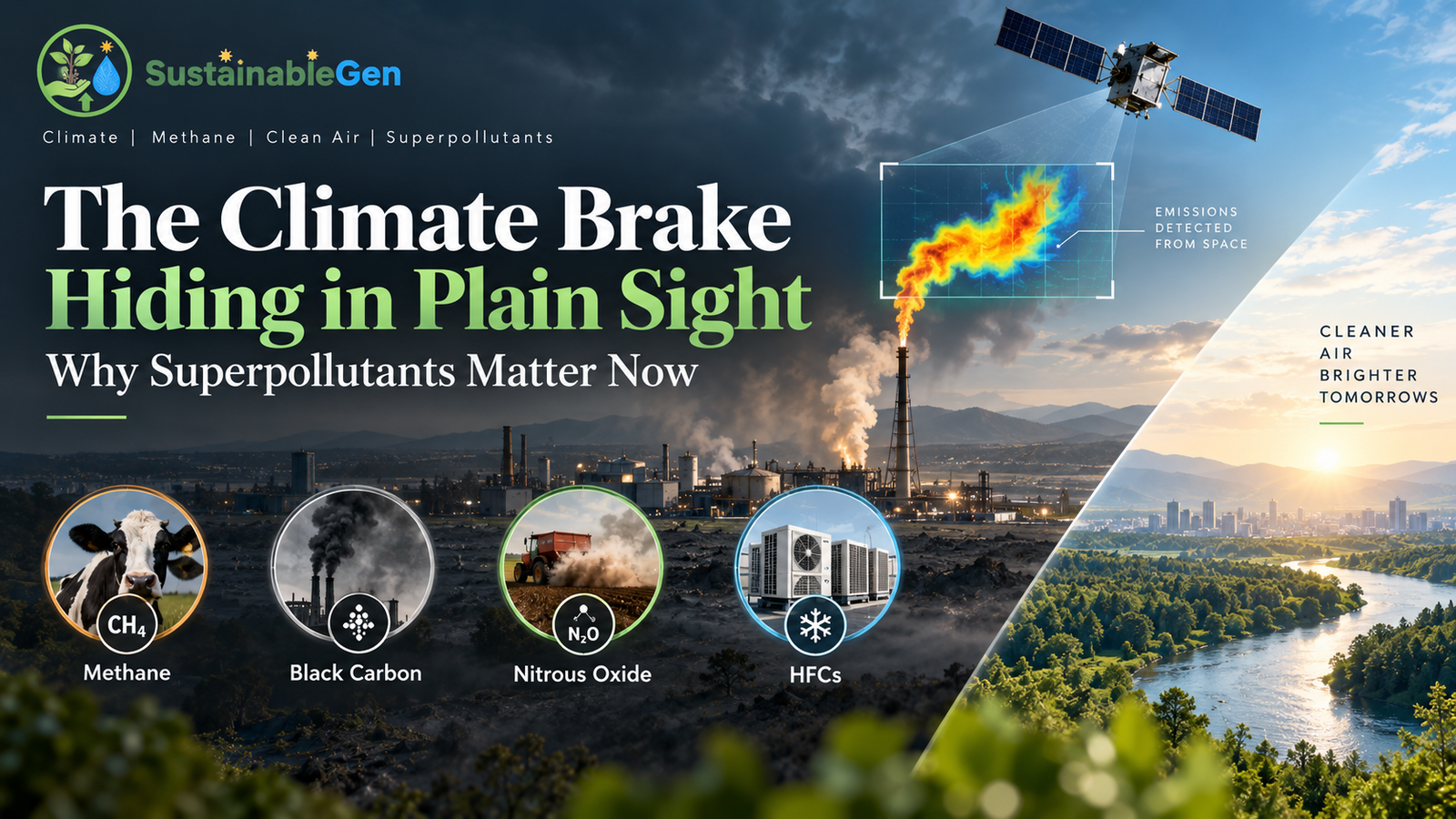
They are known as superpollutants. Methane, black carbon, nitrous oxide, hydrofluorocarbons and other powerful climate pollutants can trap far more heat than CO₂ over shorter periods. Together, these pollutants account for roughly half of the warming occurring today, according to the Carbon Containment Lab and the Climate and Clean Air Coalition. carboncontainmentlab.org
The important point is not that superpollutants replace CO₂ reduction. They do not. The opportunity lies in tackling both at the same time.
Why These Pollutants Are Different
CO₂ can remain in the atmosphere for centuries. Many superpollutants have much shorter atmospheric lifetimes.
That creates an unusual climate opportunity. If emissions fall quickly, their warming influence can also decline relatively quickly.
Methane provides one of the clearest examples. The Climate and Clean Air Coalition estimates that achieving the Global Methane Pledge target of cutting methane emissions by 30% from 2020 levels by 2030 could avoid more than 0.2°C of warming by 2050. The same action could prevent millions of tonnes of crop losses and deliver major public-health benefits. CCAC Coalition
This does not mean the world can simply cut methane and solve climate change. CO₂ still determines much of the long-term temperature trajectory. Instead, methane and other short-lived pollutants offer a faster lever while the much larger transition away from fossil carbon continues.
The Problem Is Often Hidden in Supply Chains
Superpollutants come from surprisingly different places.
Methane escapes from oil and gas infrastructure, coal mines, livestock systems, rice cultivation and decomposing organic waste. Black carbon comes from incomplete combustion, including diesel engines, biomass burning and some industrial processes. Nitrous oxide has strong links with fertilizer use and agricultural soils. Refrigerants can release highly warming fluorinated gases when equipment leaks or reaches the end of its life.
That makes the problem difficult for companies to see.
A food company, for example, may have relatively limited direct emissions while methane and nitrous oxide occur deep inside its agricultural supply chain. A retailer may sell products containing refrigerants without directly operating the equipment that leaks them.
This is one reason a new Superpollutant Roadmap for Corporate Action, launched during New York Climate Week, is gaining attention. The roadmap proposes three broad routes for companies: reducing emissions within their value chains, supporting high-integrity mitigation through carbon markets, and engaging with policies that can make reductions more durable. carboncontainmentlab.org
Technology Is Making the Invisible Easier to Find
One of the biggest changes is that some emissions can now be detected much more effectively.
Satellites can identify large methane sources from space. UNEP’s Methane Alert and Response System, for example, uses satellite observations to identify major methane emissions and help governments and companies respond to them. Its July 2026 data snapshot tracks some of the world’s largest detected methane sources across oil and gas, coal and waste. IMEO Eye on Methane
AI can add another layer by helping process enormous quantities of satellite and operational data, identify patterns and prioritize locations where intervention could deliver the greatest benefit.
That changes the nature of the problem. Instead of simply estimating emissions across an entire sector, governments and companies increasingly have the ability to ask a much more practical question:
Where is the pollution actually coming from, and what can we fix first?
Agriculture Has a Major Role
Superpollutant reduction is particularly relevant to agriculture.
Rice cultivation produces methane when flooded soils create oxygen-poor conditions. Livestock contributes methane through digestion and manure management. Nitrous oxide comes largely from agricultural soils and fertilizer use.
Some solutions are already familiar. Better water management in rice fields can reduce methane. Improved fertilizer management can reduce nitrous oxide. Better manure systems can capture methane while creating useful energy or fertilizer products.
The Climate and Clean Air Coalition’s latest methane assessment identifies more than 40 available methane-control technologies and practices across energy, agriculture and waste. It also estimates that agriculture represents about 18% of the maximum technically feasible methane reductions available by 2030, while waste represents another 10%. CCAC Coalition
This makes superpollutant reduction more than a climate issue. It connects directly with farm productivity, waste management, air quality and resource efficiency.
The $100 Million Signal
The growing corporate interest is another reason this story matters.
Companies including Amazon, Google and JPMorgan Chase have committed funding toward superpollutant reduction, with the broader initiative aiming to mobilize $100 million for projects targeting these emissions. Reuters
The significance is less about the headline amount and more about where capital could start flowing.
Methane monitoring, leak detection, waste treatment, improved agricultural practices, refrigerant management and cleaner combustion technologies are all areas where targeted investment can produce measurable results.
But commitments are not reductions. The real test will be whether these initiatives produce verified emissions cuts at meaningful scale.
The Climate Strategy Is Getting More Complicated
The superpollutant story does not replace the global push for renewable energy, electrification, energy efficiency or carbon reduction.
It adds another layer.
A company that reports only CO₂ may miss important climate risks and opportunities in its supply chain. A government that focuses exclusively on long-term carbon targets may overlook pollutants that can be reduced much faster. A farmer may see methane and nitrous oxide as technical environmental issues when they can also be connected to water management, fertilizer efficiency and farm economics.
That is why the emerging approach is increasingly about cutting every major climate pollutant at the source, rather than treating the climate problem as a single-gas challenge.
The opportunity is immediate because many of the tools already exist.
The harder question is whether governments, companies and investors will move quickly enough to deploy them.
The Bigger Picture
The climate transition will take decades. But not every climate solution has to wait decades to make a difference.
Superpollutants offer one of the clearest opportunities to slow near-term warming while the world works on the much longer task of transforming energy, transport, industry and food systems.
The next phase of climate action may therefore be less about finding one breakthrough technology and more about finding the emissions we can eliminate right now, measuring them accurately, and acting on them at scale.
That could make some of the most important climate solutions the ones we rarely see.
Leave a Reply