

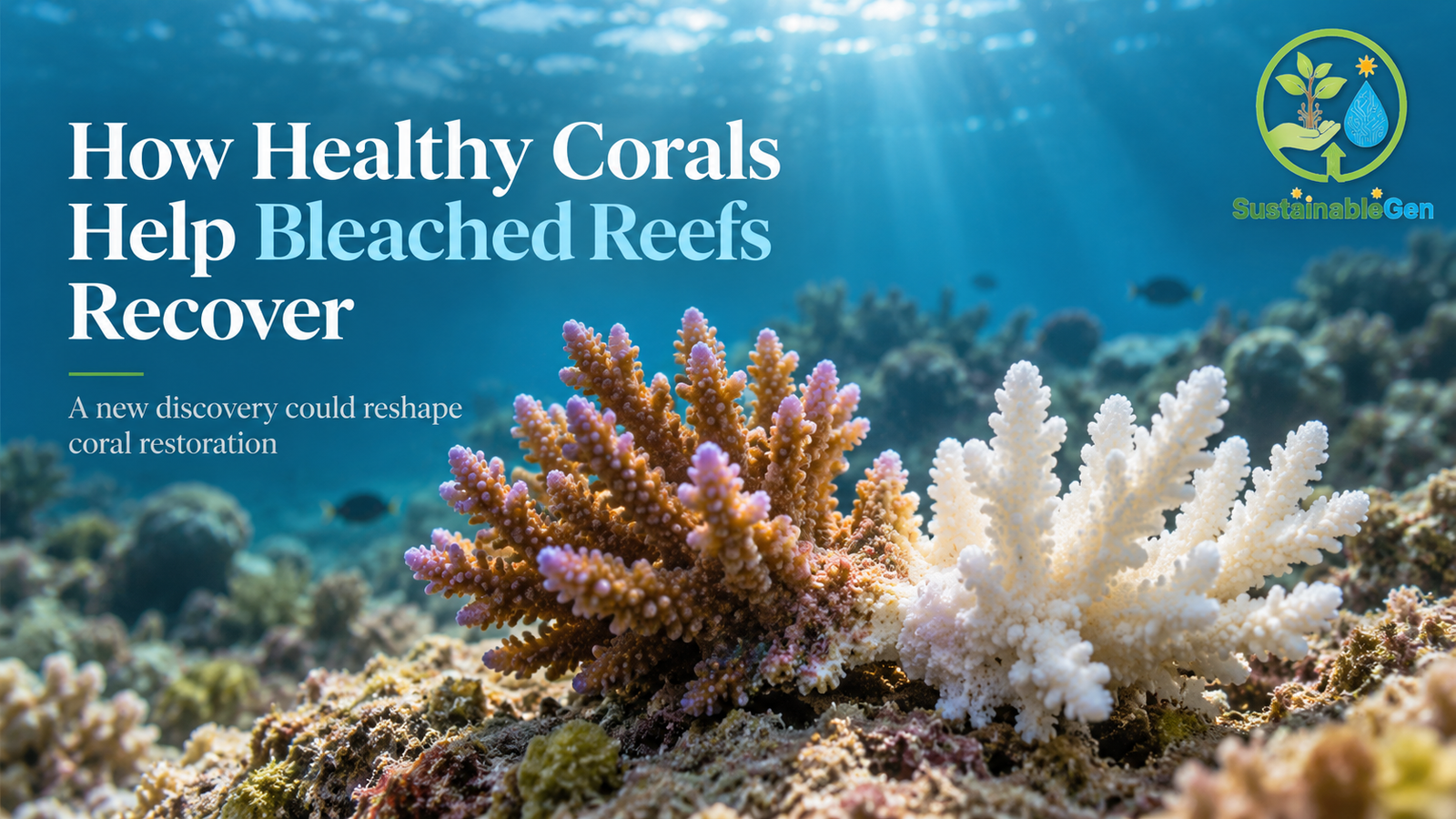
A coral reef turning white usually signals trouble. As ocean temperatures rise, corals lose the tiny algae that provide much of their food, leaving them weakened and vulnerable to death.
But scientists at Stanford University have discovered something remarkable.
A healthy coral can help a bleached coral recover simply by touching it.
In a study published in Science Advances on 14 October 2026, researchers found that healthy coral fragments could transfer life-sustaining algae to bleached fragments through a direct tissue connection. The affected corals then regained their colour and recovered within weeks.
The discovery offers a new direction for coral restoration research at a time when rising ocean temperatures threaten reefs around the world.
Why Coral Bleaching Is So Dangerous
Coral reefs support some of the richest marine ecosystems on Earth. Thousands of fish and other marine species depend on them for food, shelter and breeding grounds.
Yet the animals that build these reefs rely on a delicate relationship with microscopic algae.
These algae live inside coral tissues and use sunlight to produce energy through photosynthesis. In return, the corals provide protection and nutrients.
When seawater becomes unusually warm, this relationship can break down.
Stressed corals expel the algae, causing their vibrant colours to fade and leaving behind a pale or completely white appearance.
This process is called coral bleaching.
A bleached coral is not necessarily dead, but without its algae, it loses a major source of energy. If stressful conditions persist, the coral can starve, become vulnerable to disease and eventually die.
Scientists have been searching for ways to improve recovery as marine heatwaves become more frequent.
The Discovery Began With an Accident
The research began with an unexpected observation inside a laboratory at Stanford University’s Hopkins Marine Station in California.
Marine scientist Stephen Palumbi noticed that two coral fragments had accidentally fallen against each other.
One fragment appeared healthy and colourful. The other had lost its algae and turned pale.
But where the two pieces touched, something unusual was happening.
Colour was beginning to return to the bleached coral.
The observation caught the research team’s attention because it suggested that healthy coral might transfer something essential to its struggling neighbour.
Researcher Danny Collins and his colleagues decided to investigate.
What they discovered could change how scientists approach coral recovery.
Healthy Corals Shared Their Life-Sustaining Algae
The team worked with cauliflower coral, a species known scientifically as Pocillopora damicornis.
Researchers collected fragments from genetically identical coral colonies and created pairs containing one healthy fragment and one bleached fragment.
Some pairs touched directly, while the researchers kept others a few millimetres apart.
The difference was dramatic.
The fragments that touched formed a connection between their tissues. Through this connection, beneficial algae moved from the healthy coral into the bleached coral.
As the algae multiplied, the previously white fragment gradually regained its colour.
The team discovered that just three to five days of direct contact could begin the recovery process, while full recovery occurred within approximately seven to eight weeks.
In some experiments, the recovered fragments continued improving even after researchers separated them from their healthy partners.
The bleached fragments that remained apart from healthy coral did not experience the same recovery and eventually died during the observation period.
A Natural Connection Between Corals
To understand what was happening, the researchers examined the coral fragments using advanced microscopy.
They discovered that the two fragments could fuse their tissues together, creating a physical bridge.
That bridge allowed microscopic algae to move between them.
The process worked almost like a biological rescue system.
The healthy fragment supplied beneficial algae, while the bleached fragment gained an opportunity to rebuild its internal population of organisms that produce energy.
The finding is particularly interesting because researchers did not need to introduce an artificial chemical treatment or genetically engineer the corals.
Instead, they identified a natural biological process that could potentially inform new restoration techniques.
But There Is an Important Limitation
The experiment revealed a major restriction.
The rescue process worked only when the touching coral fragments shared the same genetic identity.
When researchers placed genetically different fragments together, they did not form the same beneficial connection.
In some cases, the corals responded aggressively through specialised stinging cells.
This creates an obvious challenge for restoring natural reefs.
Coral colonies vary genetically, and scientists cannot simply place any healthy coral beside any bleached coral and expect recovery.
The laboratory setup also allowed researchers to maintain carefully controlled conditions.
Natural reefs face currents, waves, changing temperatures, disease risks and complicated ecological interactions.
The team still needs to understand how the biological mechanism could work beyond the laboratory.
Could This Lead to a New Coral Restoration Method?
The discovery offers a possible starting point rather than a finished solution.
Scientists are already exploring whether they could collect beneficial algae from healthy corals, grow them separately and introduce them to bleached corals without requiring direct contact between genetically identical fragments.
That approach might eventually bypass one of the biggest limitations of the experiment.
Instead of bringing two corals together physically, restoration specialists could potentially deliver the beneficial organisms directly.
However, researchers will need to establish whether the algae can survive, colonise stressed corals and remain effective under real ocean conditions.
Developing a method that works across different coral species and reef environments will require substantial additional research.
Why This Matters for Marine Conservation
Coral restoration has traditionally involved techniques such as growing coral fragments in nurseries, transplanting healthy colonies and identifying species with greater heat tolerance.
These approaches remain important, but restoration becomes much harder when marine heatwaves damage large reef areas simultaneously.
The Stanford research introduces another possibility.
Rather than focusing only on replacing damaged corals, scientists might eventually find ways to help some surviving corals recover more quickly.
That could become a valuable addition to existing conservation methods.
Healthy reefs also support fisheries, tourism and coastal protection, meaning successful restoration can benefit both marine ecosystems and the communities that depend on them.
Still, restoration cannot replace the need to reduce greenhouse gas emissions.
Even a successful biological treatment would struggle if ocean temperatures continued rising beyond what corals can tolerate.
What Comes Next?
The research team now wants to understand how the algae transfer between coral tissues and whether scientists can use that knowledge to develop practical restoration techniques.
Future experiments will need to test different species, environmental conditions and methods of introducing beneficial algae.
Researchers must also examine whether recovered corals remain healthy over longer periods and how they respond to future heat stress.
The study remains an early laboratory discovery, but it challenges the assumption that severely bleached coral has little chance of rapid recovery.
That alone makes it significant.
Key Takeaway
Coral reefs face an uncertain future as marine heatwaves place growing pressure on ocean ecosystems.
But Stanford University’s latest research shows that nature may already possess mechanisms that scientists can learn from.
By allowing healthy coral to share beneficial algae with bleached fragments, the researchers demonstrated a surprisingly effective recovery process under laboratory conditions.
The technique is not ready for large-scale reef restoration, and protecting coral ecosystems will still require action on climate change.
Yet the discovery offers a valuable new possibility.
Sometimes, helping a damaged ecosystem recover begins with understanding how its living organisms already help one another.
Leave a Reply