
What happens to the leftover soybean pulp after a factory produces tofu or soy milk? Much of it becomes animal feed, compost or waste. But scientists in Italy have discovered that this overlooked material could have a much more valuable future.
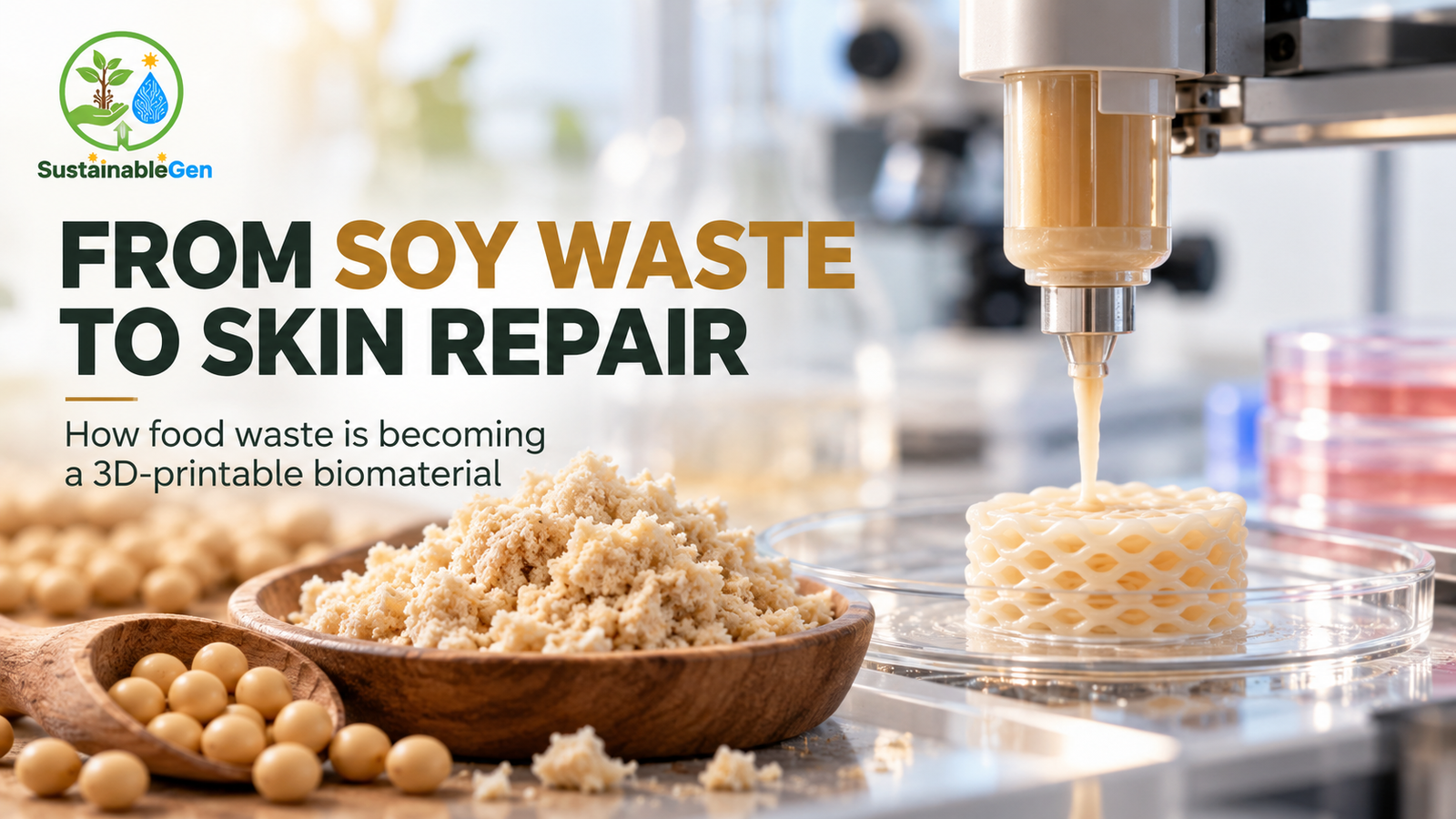
Researchers from the University of Milan and Politecnico di Milano have transformed soybean processing waste into a biodegradable, 3D-printable biomaterial with properties relevant to skin repair.
The research, featured in new international technology coverage on October 22, 2026, offers an unusual example of how food waste could contribute to biomedical innovation.
Instead of developing another disposable product, scientists are exploring how an agricultural by-product could become part of a material that supports human health.
The Hidden Potential of Soybean Waste
Soybeans are among the world’s most widely cultivated agricultural crops. They supply ingredients for cooking oil, tofu, plant-based beverages and numerous processed foods.
However, turning soybeans into these products also generates substantial by-products.
One of them is okara, the soft, fibrous pulp left after producers extract soy milk.
Although food processors sometimes reuse okara, it can spoil quickly because of its high moisture content. This makes storage, transportation and commercial processing difficult.
Yet okara still contains valuable nutrients, including proteins.
Researchers in Italy wanted to know whether those proteins could serve a completely different purpose.
Their idea was to extract useful biological compounds from soybean pulp and incorporate them into a material suitable for advanced manufacturing.
Turning Soybean Proteins Into a New Material
The scientists began by extracting proteins from okara and breaking them into smaller components called bioactive peptides.
These short chains of amino acids can interact with biological systems in ways that researchers are investigating for medical applications.
The team examined how the extracted compounds affected human skin cells under laboratory conditions.
The results were encouraging.
The soybean-derived compounds demonstrated antioxidant and anti-inflammatory activity. They also encouraged the movement of fibroblasts, cells that help maintain skin structure and participate in tissue repair.
But discovering useful biological activity was only the beginning.
The next challenge was turning those compounds into something that researchers could actually manufacture.
Where 3D Printing Enters the Picture
The research team combined the soybean-derived peptides with a biodegradable polymer called polycaprolactone, or PCL.
Scientists already study PCL for biomedical applications because it offers useful mechanical properties and can break down under suitable biological conditions.
By adding the soybean compounds, the researchers created a new composite material suitable for 3D printing.
This allowed them to manufacture experimental structures with customised shapes and internal patterns.
More importantly, the printed material retained the biological activities observed during earlier laboratory tests.
The researchers also found that the material could gradually release the incorporated peptides over time.
That combination could become valuable for developing medical materials that need both a specific physical structure and a useful biological function.
Why Customisation Matters
Traditional manufacturing often produces products in standard shapes and sizes.
3D printing provides greater flexibility.
Researchers can adjust a product’s geometry, thickness and structure to match a particular application.
In this project, the team is exploring how customised biomaterials could eventually support devices designed for women’s health.
The research forms part of the 3DBioPad project, which aims to develop personalised materials for potential use in managing discomfort associated with breastfeeding and recovery after breast cancer surgery.
The long-term idea is to create lightweight, breathable devices that deliver beneficial compounds locally.
However, these applications remain research goals. The scientists have not demonstrated a finished medical product that treats patients.
A Different Approach to Sustainable Materials
The environmental significance goes beyond the medical application.
Producing specialised materials often requires newly manufactured ingredients.
The Italian researchers are investigating whether food-processing waste can supply some of those ingredients instead.
This is an example of upcycling, where a low-value material becomes the starting point for a product with a potentially higher value.
The process could create new opportunities for food manufacturers while helping researchers reduce dependence on entirely virgin raw materials.
It also connects industries that rarely appear in the same conversation.
Agriculture produces the soybeans.
Food factories generate the leftover pulp.
Scientists extract useful compounds.
Materials engineers turn those compounds into printable structures.
Biomedical researchers investigate possible applications.
One agricultural by-product could therefore move through several industries before reaching its final use.
The Challenges Are Still Significant
The research is promising, but it remains at an experimental stage.
The scientists have demonstrated biological activity in laboratory tests involving human skin cells. They have not established that the material can safely and effectively heal wounds in people.
Before clinical use, researchers will need to examine its compatibility with living tissues, long-term stability, degradation behaviour and safety.
The environmental benefits also require further investigation.
Extracting and processing soybean proteins consumes energy and other resources. The composite also contains PCL, so the researchers have not produced a material made entirely from agricultural waste.
Commercial sustainability will depend on the complete manufacturing process, including energy use, costs and disposal.
These questions matter because a renewable ingredient does not automatically make an entire product environmentally sustainable.
What Comes Next?
The research team plans to develop a 3D-printed experimental model that reproduces certain characteristics of human breast skin.
This model will allow scientists to investigate the material’s behaviour under more realistic, but still controlled, conditions.
If future testing confirms its safety and performance, the technology could eventually support the development of customised biomedical products.
The opportunity may also extend beyond the original project.
Other agricultural residues contain valuable proteins and biological compounds that researchers could potentially recover for specialised materials.
That opens a much broader question about how food industries manage their by-products.
Key Takeaway
Soybean pulp may look like an ordinary food-processing leftover, but researchers in Italy have shown that it contains compounds with potentially valuable biomedical properties.
By combining those compounds with 3D printing, scientists have created an experimental material that could contribute to future skin-repair technologies.
The research still requires extensive validation before practical medical use.
Nevertheless, it demonstrates an important principle of sustainable innovation.
Sometimes, the next advanced material doesn’t begin in a factory producing something new. It begins with finding unexpected value in something we already throw away.
Leave a Reply