
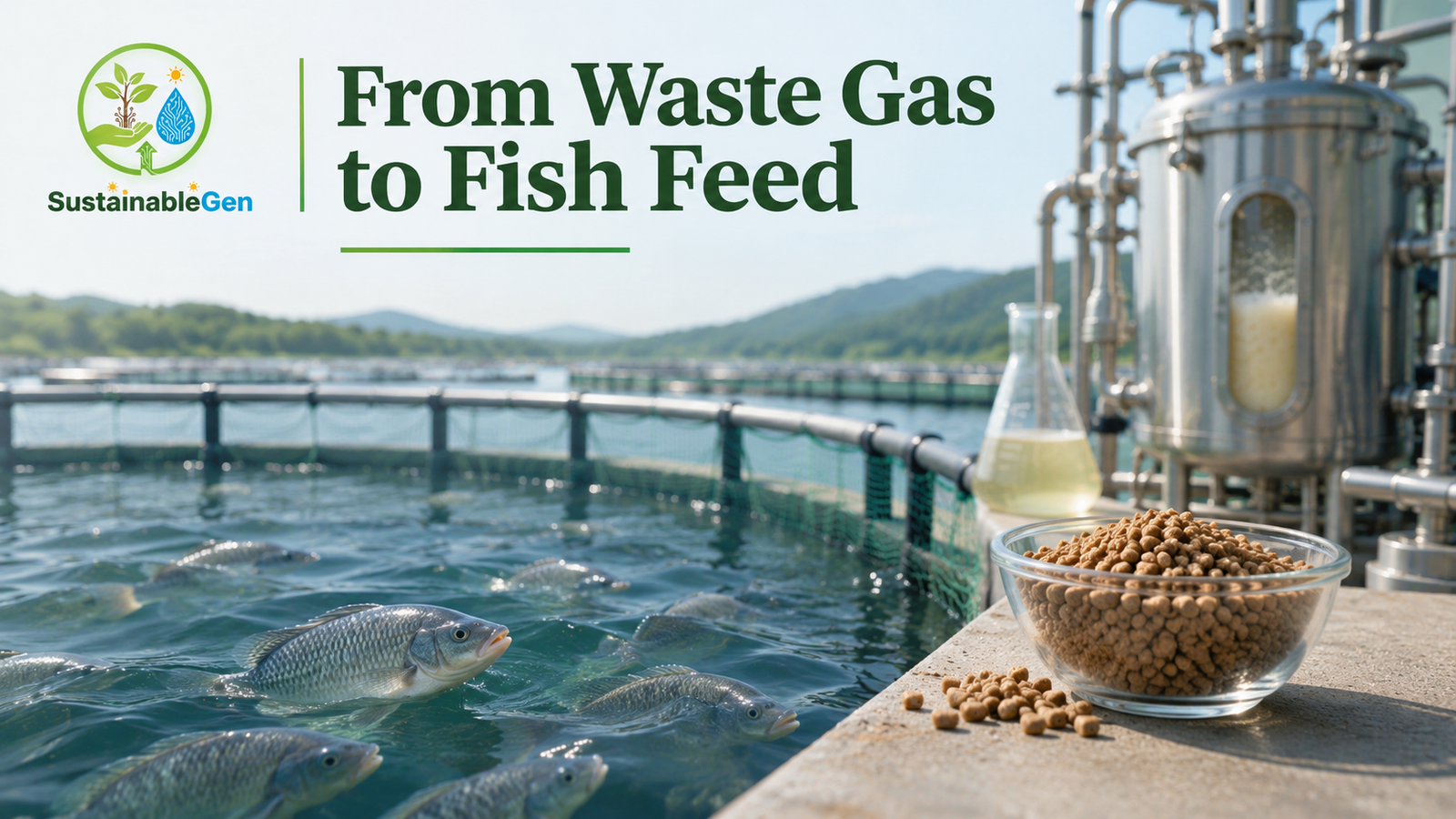
Fish farming has a problem that most consumers never see.
While aquaculture helps supply seafood to millions of people, many fish farms still depend on feed made partly from wild-caught fish. Small species such as anchovies are harvested, processed into fishmeal and used to feed farmed seafood.
This creates an uncomfortable question. If fish farming is supposed to reduce pressure on wild fish populations, why does it still need fish from the ocean to feed them?
Researchers at the University of Queensland in Australia are developing an alternative.
Their new technology uses gases generated from decomposing organic waste to grow protein-rich microorganisms that could eventually replace part of the fishmeal used in aquaculture.
Announced on October 28, 2026, the research offers an interesting possibility: transforming unwanted organic material into a valuable ingredient for feeding farmed fish.
The Hidden Problem With Fishmeal
Aquaculture has become one of the fastest-growing food production sectors in the world.
Fish farms raise species such as salmon, barramundi and shrimp to meet growing demand for seafood.
However, producing feed for these animals remains a major challenge.
Many commercial feeds contain fishmeal, a protein-rich ingredient produced by processing wild-caught fish.
Small schooling fish, including anchovies, form an important part of this supply chain.
These species also play essential roles in marine ecosystems. Larger fish, seabirds and marine mammals depend on them for food.
When fishing pressure becomes excessive, removing large quantities of these species can affect the wider marine food web.
Fishmeal production also requires processing and transportation, adding to the environmental footprint of aquaculture.
Researchers are therefore looking for protein sources that can support fish growth without depending so heavily on harvesting wild marine resources.
What If Waste Gas Could Become Fish Feed?
The University of Queensland team has developed a fermentation process that uses gases produced during the breakdown of organic waste.
When microorganisms decompose food scraps, agricultural residues and other organic materials in environments without oxygen, they produce biogas.
Biogas contains mainly methane and carbon dioxide.
Many facilities already capture this gas and use it to generate energy.
The Queensland researchers are investigating another possibility.
Instead of treating biogas only as a fuel, they use its carbon-containing gases to grow microorganisms that produce protein.
The resulting material could become a nutritious feed ingredient.
This changes the way we think about organic waste.
Something that originally had little value could potentially become part of the food production system.
How the Technology Works
The process begins with anaerobic digestion, which occurs when microorganisms break down organic material without oxygen.
This produces methane and carbon dioxide.
The researchers then use those gases in a specialised fermentation process to cultivate protein-rich microbial cells.
After harvesting and processing the cells, the team obtains an ingredient known as single-cell protein.
Despite its name, single-cell protein is not one individual protein molecule.
It refers to protein-rich biomass produced by microorganisms.
Scientists have studied microbial proteins for decades, but the Queensland team’s approach focuses on using carbon from organic waste streams as a resource for production.
The researchers have also secured a patent covering their biogas-conversion process.
Their goal is to create a feed ingredient with properties that could make it useful as an alternative to conventional fishmeal.
Why This Could Matter for Aquaculture
The environmental opportunity is significant.
Fishmeal contains valuable protein and nutrients, but its supply depends partly on wild fish populations.
If aquaculture producers can replace some fishmeal with suitable microbial protein, they could potentially reduce demand for harvested marine species.
That could help relieve pressure on certain fisheries while supporting continued growth in seafood production.
The University of Queensland points to earlier research showing that microbial single-cell proteins can replace up to 75% of fishmeal in some experimental barramundi diets.
That is an encouraging result for Australia’s aquaculture industry.
However, it does not mean the university’s newly developed biogas-derived protein has already achieved the same replacement rate.
The researchers still need to test their particular ingredient in aquaculture feeds.
That distinction matters because different microbial proteins can have different nutritional characteristics.
The Circular Economy Connection
One of the most interesting parts of the technology is its relationship with agriculture and waste management.
Food processing facilities, farms and other businesses generate organic residues every day.
Some of these materials can enter anaerobic digestion systems, where microorganisms convert them into biogas.
The Queensland research creates the possibility of another use for that biogas.
Instead of simply releasing or burning the gases, a production facility could potentially use part of the carbon to grow protein-rich microorganisms.
That protein could then support aquaculture.
The result would connect two industries that normally operate separately.
Organic waste management would supply raw materials for feed production, while aquaculture would gain another potential source of protein.
The process could also provide opportunities for rural businesses that already collect and process agricultural residues.
Could This Reduce Emissions Too?
The technology could offer climate benefits, but researchers still need to establish their full extent.
Conventional fishmeal production involves fishing vessels, processing facilities and transportation.
Producing microbial protein from locally available waste gases might reduce some of those activities.
Using carbon already present in organic waste streams could also make resource use more efficient.
However, fermenters need energy, and microbial growth requires appropriate nutrients and operating conditions.
The production process must also account for what happens to the methane and carbon dioxide throughout the system.
If methane escapes during collection or processing, it can create a substantial climate impact.
That means a proper environmental assessment must examine the entire process rather than assuming that using waste automatically produces a lower-carbon product.
The Biggest Challenge Is Making It Commercially Practical
The research remains at an early development stage.
Dr Lars Puiman and Dr James Heffernan, who are leading the work through the University of Queensland’s Australian Institute for Bioengineering and Nanotechnology, are preparing to test the production process at pilot scale.
The next stage will focus on producing sufficient quantities of the microbial protein and then evaluating its suitability for aquaculture feed.
Researchers will need to examine its nutritional quality, digestibility, safety and effects on fish growth.
Cost will also be important.
Fish farmers need feed ingredients that deliver consistent nutrition at competitive prices.
Even a promising alternative could struggle to gain adoption if production remains too expensive.
The university’s goal is to develop a practical solution that can compete with existing protein sources while reducing pressure on marine resources.
What Comes Next?
The Queensland team plans to advance its technology into pilot-scale production before testing the resulting protein in aquaculture diets.
If those trials succeed, researchers could explore how existing biogas facilities might support larger-scale microbial protein manufacturing.
The process may also have potential applications beyond fish farming.
The university believes similar approaches could eventually produce ingredients for other animal feeds and possibly agricultural products.
Those applications remain possibilities rather than demonstrated commercial uses.
For now, the most important challenge is proving that the technology can produce safe, nutritious and affordable fish feed at meaningful scale.
Key Takeaway
The future of sustainable seafood will depend on more than finding better ways to raise fish.
It will also depend on finding better ways to feed them.
The University of Queensland’s latest technology explores how methane and carbon dioxide from organic waste can become a raw material for producing protein-rich microorganisms.
The process is not yet commercially available, but it offers a promising direction for reducing aquaculture’s reliance on wild-caught fish.
The bigger lesson is about recognising connections between industries that might otherwise remain separate.
What one industry considers waste could eventually become the resource another industry needs to grow more sustainably.
Leave a Reply