
Tag: soil health

  • How AI Is Bringing Nature into Corporate Decision Making

    Modern corporate boardroom with executives around a conference table looking at a transparent holographic screen that shows real-time environmental data, including satellite maps of land use, soil health layers, biodiversity hotspots, and bird-flight paths, highlighting the role of AI sustainability in blending nature and technology within a professional, eco-conscious setting.
    generated by google gemini

    Introduction

    Sustainability is no longer limited to tracking carbon emissions. Today, businesses are expected to understand how their operations influence land, water resources, and biodiversity. This shift is pushing companies to rethink how they measure environmental impact.

    Artificial intelligence is playing a key role in this transformation. It is helping organizations convert complex environmental data into clear and actionable insights. As a result, sustainability is moving beyond annual reports and becoming part of everyday strategic discussions in boardrooms.


    Why Nature Is Becoming a Business Priority

    Across the globe, governments and regulatory bodies are strengthening rules around biodiversity and environmental reporting. Companies are now required to go beyond carbon accounting and consider their broader ecological footprint.

    For example, the International Sustainability Standards Board is working to include nature-related disclosures in global reporting standards. At the same time, policies like biodiversity net gain in England require businesses to actively improve ecosystems through their projects.

    Despite these developments, many organizations still struggle to measure their impact on nature. This gap leaves decision makers without a complete understanding of environmental risks.


    Making Sense of Complex Environmental Data

    Today, companies have access to an enormous amount of environmental data. This includes satellite imagery, soil health metrics, bioacoustic recordings, and even DNA samples collected from ecosystems.

    Experts like Drew Purves have highlighted how modern technology allows us to process far more data than ever before.

    Artificial intelligence helps by analyzing this data and identifying patterns. Instead of dealing with raw information, businesses can now understand trends related to land use, habitat conditions, and species presence. This makes it easier for leaders to make informed decisions.


    Moving from Reporting to Prediction

    Traditional sustainability reports often focus on past performance. However, AI is changing this approach by enabling companies to look ahead.

    With AI-powered tools, organizations can simulate future scenarios. They can evaluate how changes in climate, farming practices, or conservation efforts might affect soil quality, water availability, and biodiversity.

    This predictive capability allows businesses to plan for long-term environmental resilience rather than just meeting short-term compliance requirements.


    Tools That Reveal a Company’s Nature Footprint

    New digital platforms are making it easier for companies to understand their environmental impact. These tools combine multiple data sources into simple dashboards that provide a clear overview of risks and opportunities.

    One example is NatureMetrics, which offers AI-driven assessments using environmental DNA, camera monitoring, and acoustic data. These insights help organizations identify biodiversity risks across their operations and supply chains.

    By highlighting trends and detecting potential threats, such tools support better investment decisions in conservation and restoration.


    Understanding Soil and Land Health

    For industries like agriculture, soil health is a critical factor. Advanced data platforms are now helping businesses analyze how land use practices affect soil quality over time.

    Initiatives such as the EU Soil Health Data Cube allow users to combine soil, climate, and vegetation data. This helps companies understand whether their practices are improving or degrading land resources.

    Such insights are essential for businesses that need to support their sustainability claims with credible data.


    Protecting Wildlife with Smart Technology

    AI is also improving how infrastructure projects interact with wildlife. For instance, Boulder Imaging developed the IdentiFlight system, which is used near wind farms.

    This system uses sensors and AI to detect birds, track their movement, and temporarily stop turbines when there is a risk of collision. It has significantly reduced bird fatalities while maintaining energy efficiency.

    This example shows how technology can balance environmental protection with operational performance.


    Bringing Biodiversity Metrics into Strategy

    Scientific tools are now being adapted to support corporate decision making. The Natural History Museum has developed the Biodiversity Intactness Index, which compares current species levels to historical baselines.

    When companies integrate such metrics into their internal systems, they gain a clearer understanding of biodiversity loss. This makes it easier to incorporate environmental considerations into investment and operational strategies.


    Addressing the Environmental Cost of AI

    While AI offers many benefits, it also has its own environmental impact. Large models and data centers consume significant energy and resources.

    Organizations like Google DeepMind are working to improve efficiency and reduce this footprint. They are also developing tools to help businesses measure the environmental cost of their AI systems.

    This ensures that technology supports sustainability goals rather than creating new challenges.


    What This Means for the Future of Business

    Artificial intelligence is quickly becoming an essential part of environmental strategy. It is helping companies move from fragmented reporting to continuous monitoring of natural resources.

    By combining data from satellites, sensors, and field observations, businesses can make more informed decisions about land, water, and biodiversity.

    For sustainability professionals and agri-tech leaders, this shift represents a major opportunity. AI is bringing nature into the center of business strategy, where it is treated as a valuable asset rather than an external concern.
  • Hope for the Planet: Encouraging Environmental Progress in 2026

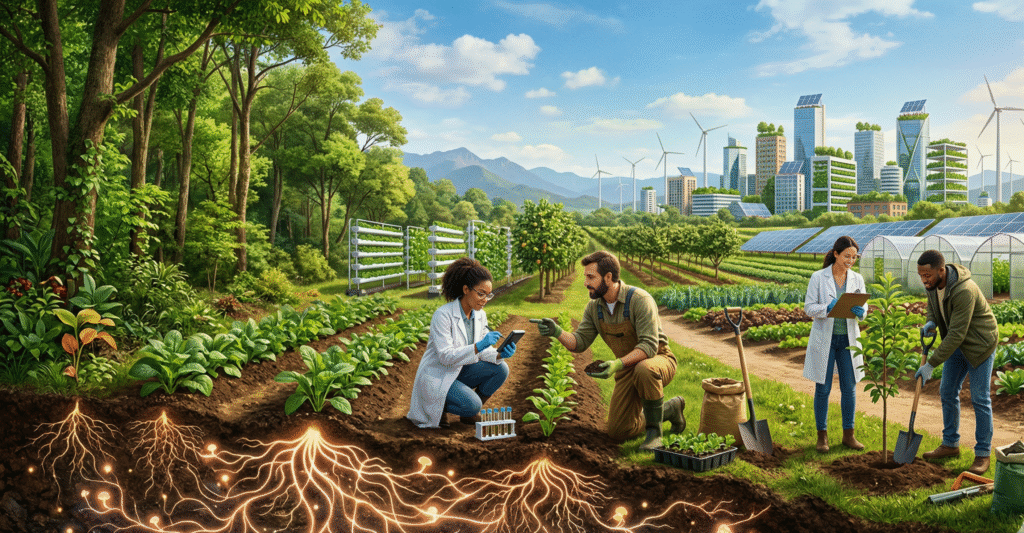
    A hopeful environmental scene showing a lush green forest merging into a sustainable farm landscape, with glowing underground fungal networks in the soil symbolizing carbon capture and **environment 2026** progress. In the background, a clean city skyline with solar panels and wind turbines sits under a bright blue sky, while farmers and scientists work together in the foreground, planting trees and examining soil, conveying collaboration, innovation, and a healthy planet.
    generated by google gemini

    Climate concerns continue to shape global conversations, but 2026 is offering a refreshing shift in perspective. Alongside the challenges, there are meaningful signs of progress that show real change is possible. From scientific breakthroughs to community-driven initiatives, these developments highlight how collective action can create a more sustainable future.

    This article explores some of the most promising environmental advancements of the year and explains how they can inspire individuals, communities, and policymakers to take practical steps toward sustainability.


    Natural Climate Solutions: The Rising Role of Soil and Fungi

    One of the most fascinating areas of research in 2026 focuses on the hidden power of soil ecosystems. Scientists are increasingly studying how certain types of fungi help absorb and store carbon beneath the ground. This process reduces the amount of carbon dioxide in the atmosphere and strengthens the soil at the same time.

    For agriculture, this discovery has practical benefits. Farming practices such as cover cropping, reduced tillage, and the use of organic compost can work in harmony with these fungal systems. The result is healthier soil that retains nutrients and carbon more effectively.

    In countries like India, where agriculture plays a vital role in livelihoods, these methods present a cost-effective and sustainable opportunity. Farmers can improve productivity while also contributing to climate solutions without relying heavily on expensive technologies.


    Stronger Action Against Harmful “Forever Chemicals”

    Another important step forward in 2026 is the growing global effort to regulate harmful industrial chemicals known as PFAS, commonly referred to as “forever chemicals.” These substances are widely used in everyday products such as non-stick cookware, food packaging, and firefighting materials, but they persist in the environment for years.

    Governments and regulatory bodies are now introducing stricter controls on the production and use of these chemicals. Measures include tighter safety standards, improved water monitoring systems, and dedicated programs to clean up contaminated areas.

    While implementation will take time, this shift reflects increasing awareness and accountability. It also shows that public demand for safer environments is influencing policy decisions in a meaningful way.


    Community-Led Sustainability Initiatives Making a Difference

    Not all progress comes from large-scale policies or advanced technologies. Some of the most impactful changes are happening at the local level through community participation.

    Across different regions, small initiatives are creating visible results. These include tree plantation drives, urban green space development, and campaigns to reduce plastic waste. Although these efforts may seem modest, they demonstrate how consistent local action can lead to broader environmental benefits.

    In many parts of India, communities are adopting practical solutions such as waste segregation, rainwater harvesting, and planting native species. These initiatives are not only improving environmental conditions but also raising awareness and encouraging long-term behavioral change.

    For bloggers and sustainability advocates, these grassroots efforts provide valuable insights and real-world examples that can be shared to inspire others.


    Why Climate Optimism Matters More Than Ever

    The way environmental issues are communicated is also evolving. In 2026, there is a growing emphasis on highlighting solutions alongside challenges. This balanced approach helps people stay informed without feeling overwhelmed.

    Focusing on positive developments does not ignore the seriousness of climate change. Instead, it encourages action by showing that progress is achievable. When people see real examples of success, they are more likely to participate and support sustainable practices.

    For content creators, this approach offers an opportunity to present meaningful stories that combine awareness with actionable ideas. Whether it is adopting eco-friendly habits, supporting green businesses, or advocating for policy change, every effort contributes to a larger impact.


    Conclusion: Turning Progress into Momentum

    The environmental progress seen in 2026 proves that change is not only necessary but also possible. Scientific innovation, stronger regulations, and community efforts are all working together to shape a more sustainable future.

    The key now is to build on this momentum. By learning from these developments and applying them in everyday life, individuals and organizations can play an active role in protecting the planet.