Tag: sustainability trends

  • How a Green Digital Economy Can Reduce Energy Use and Improve Public Health by 2030

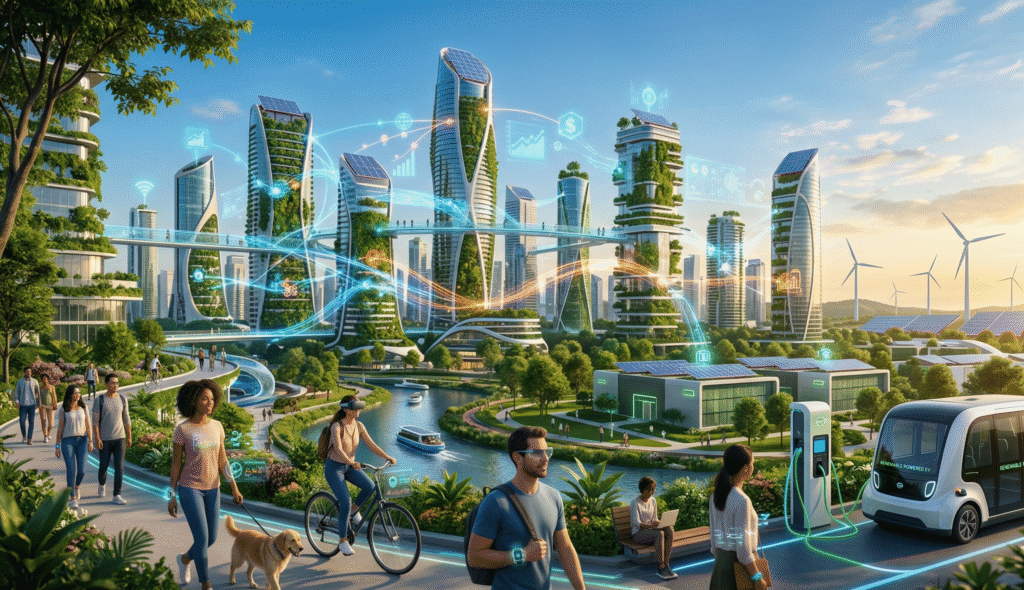
    A photorealistic view of a futuristic sustainable city in 2030, highlighting the green digital economy with skyscrapers featuring vertical gardens and solar panels, glowing data streams linking smart buildings, people using wearable health tech in clean air, wind turbines, EV stations, and green data centers amid parks, all under golden hour lighting.
    generated by google gemini

    The transition toward a green digital economy is quickly becoming a practical solution for countries aiming to balance economic growth with environmental responsibility. By combining digital innovation with sustainable practices, it is possible to reduce energy consumption while improving public health and overall environmental quality.

    Recent research focusing on China’s economic future shows that this transformation can deliver measurable benefits without slowing down development. Instead, it may even accelerate growth in a cleaner and more efficient way.

    Understanding the Study Behind the Shift

    A research team from Henan University of Urban Construction explored how digital technologies can work alongside green energy systems to shape future economic outcomes. They used a Dynamic Energy Computable General Equilibrium model to simulate different scenarios up to 2030.

    This advanced modeling approach allowed researchers to examine how economic growth, digital infrastructure, and energy transitions interact with each other. The findings clearly show that digital tools can play a major role in building a sustainable and resilient economy.

    Significant Energy Savings Through Digital Integration

    One of the most important outcomes of this study is the potential reduction in energy consumption. With a green digital transition, total energy use could drop to nearly 250 million tons of standard coal equivalent by 2030.

    This represents a reduction of about 20 percent compared to conventional projections. The decrease is largely driven by smarter systems, improved efficiency, and increased reliance on renewable energy sources. Technologies such as smart grids, automated systems, and data-driven energy management help minimize waste and optimize usage.

    Cleaner Air and Better Public Health

    Improved air quality is another major benefit of this transformation. The study suggests that PM2.5 levels could fall to approximately 22.36 micrograms per cubic meter. This is about 11.5 percent lower than expected under standard conditions.

    Lower pollution levels directly contribute to better respiratory health and longer life expectancy. Cleaner air reduces the burden on healthcare systems and improves the quality of life for communities. In simple terms, a greener digital economy does not just protect the environment, it also protects people.

    Economic Growth Without Environmental Trade-Offs

    A common concern is that sustainability may slow down economic progress. However, the findings suggest the opposite. The green digital model shows stronger GDP growth compared to traditional approaches.

    This proves that environmental responsibility and economic expansion can go hand in hand. By investing in digital infrastructure and clean energy, governments can create new opportunities, improve productivity, and build a competitive advantage in the global market.

    A Practical Policy Roadmap for the Future

    To unlock these benefits, policymakers need to focus on building infrastructure that connects digital systems with low-carbon energy sources. High-speed internet, cloud computing, and renewable energy must work together as part of a unified strategy.

    Global trends support this direction. The rise of digital healthcare, remote services, and virtual operations is already helping reduce emissions in many sectors. Cities and countries around the world can adapt these insights to design their own low-emission and high-growth futures.

    Conclusion

    The shift to a green digital economy is not just an environmental necessity, it is a strategic opportunity. By embracing digital innovation and clean energy together, nations can reduce energy use, improve public health, and achieve sustainable economic growth.

    As the world moves closer to 2030, adopting this integrated approach could define which economies thrive in a future shaped by sustainability and technology.

  • Revolutionizing Sustainability Through Bold Innovation

    Young woman smiling confidently while holding a small windmill model, representing hands-on renewable energy innovation and youth-led sustainable technology.
    Royalty free image via pexels.

    Sustainability is no longer just about reducing harm. It is about reimagining how systems work from the ground up. Today, innovation is playing a central role in building a future where environmental health, social well-being, and economic growth can coexist.

    Young innovators, in particular, are driving this transformation. With fresh perspectives and fewer limitations, they are designing solutions that restore ecosystems, strengthen communities, and create long-term value.

    What Is Sustainable Innovation

    Sustainable innovation focuses on redesigning how we use resources, produce goods, and consume services. It aims to align human activity with the limits of the planet while ensuring fairness and economic stability.

    Instead of making small improvements, this approach challenges existing systems. It asks a fundamental question: should the current model exist at all?

    For example, rather than improving efficiency in traditional manufacturing, sustainable innovation promotes circular systems where materials are reused, waste is minimized, and ecosystems are supported rather than depleted.

    Key Types of Sustainable Innovation

    Sustainable innovation can take different forms, each contributing to long-term impact in its own way.

    1. Product Innovation

    This focuses on creating eco-friendly products or services. Examples include apps that reduce food waste or sustainable packaging alternatives. These innovations influence consumer behavior and encourage responsible choices.

    2. Process Innovation

    Process improvements aim to make production more efficient and less harmful. This could involve using renewable inputs, reducing emissions, or minimizing waste during manufacturing.

    3. Technological Innovation

    Advanced technologies help scale sustainability solutions. Renewable energy systems, smart grids, and energy storage technologies are examples that enable widespread impact.

    4. Organizational Innovation

    This involves changing how businesses operate internally. Companies adopt circular models, sustainable supply chains, and ethical practices that reshape their overall structure.

    5. Market Innovation

    Market-based solutions redefine value systems. Repair services, sharing economies, and carbon pricing models shift how businesses and consumers interact economically.

    When these approaches are combined, their impact becomes even stronger. For instance, electric vehicles become more effective when supported by clean energy infrastructure and updated market systems.

    Characteristics of Successful Sustainable Innovation

    Not all innovation leads to meaningful sustainability. Successful solutions share a few important traits:

    • They focus on long-term impact rather than short-term gains
    • They address root causes instead of surface-level problems
    • They respect planetary boundaries and resource limits
    • They create value for multiple stakeholders, including communities and ecosystems

    Scalability is also critical. A solution must grow without causing unintended harm elsewhere. Early evaluation helps ensure that ideas are practical, inclusive, and effective.

    The Role of Youth and Diverse Teams

    Young innovators bring creativity and a willingness to challenge outdated systems. They are more open to experimentation and cross-disciplinary thinking, which is essential for solving complex sustainability challenges.

    Diverse teams further strengthen innovation. When people from different backgrounds collaborate, they bring unique insights into cultural, economic, and environmental factors. This helps identify hidden challenges and develop solutions that work across regions.

    Collaboration across borders also improves adoption. Local knowledge ensures that solutions are practical and accepted by communities.

    Challenges in Sustainable Innovation

    Despite its potential, sustainable innovation faces several barriers:

    Limited Funding

    Many sustainable projects require long-term investment, which can be difficult to secure. Combining grants, public funding, and private investment can help bridge this gap.

    Lack of Collaboration

    Different sectors often have conflicting priorities. Building strong partnerships between governments, businesses, and communities is essential.

    Resistance to Change

    Established systems can be difficult to shift. Engaging stakeholders early helps reduce resistance and build trust.

    Adoption Barriers

    Solutions sometimes fail because they do not fit local needs. Co-creating with communities ensures better usability and acceptance.

    Addressing these challenges early allows innovators to adapt quickly and increase their chances of success.

    Why Action Is Needed Now

    The need for sustainable innovation has never been greater. Climate challenges, resource scarcity, and social inequalities demand bold and immediate action.

    Initiatives like the Mars Challenge are empowering young people to think systemically and develop regenerative solutions. These platforms provide the tools, mentorship, and global networks needed to turn ideas into real-world impact.

    Final Thoughts

    Sustainable innovation is not just a trend. It is a necessary shift in how we design systems for the future. By focusing on regeneration, collaboration, and scalability, innovators can create solutions that benefit both people and the planet.

    The next wave of change will be led by those willing to rethink the status quo. Now is the time to act, experiment, and build a more sustainable world.