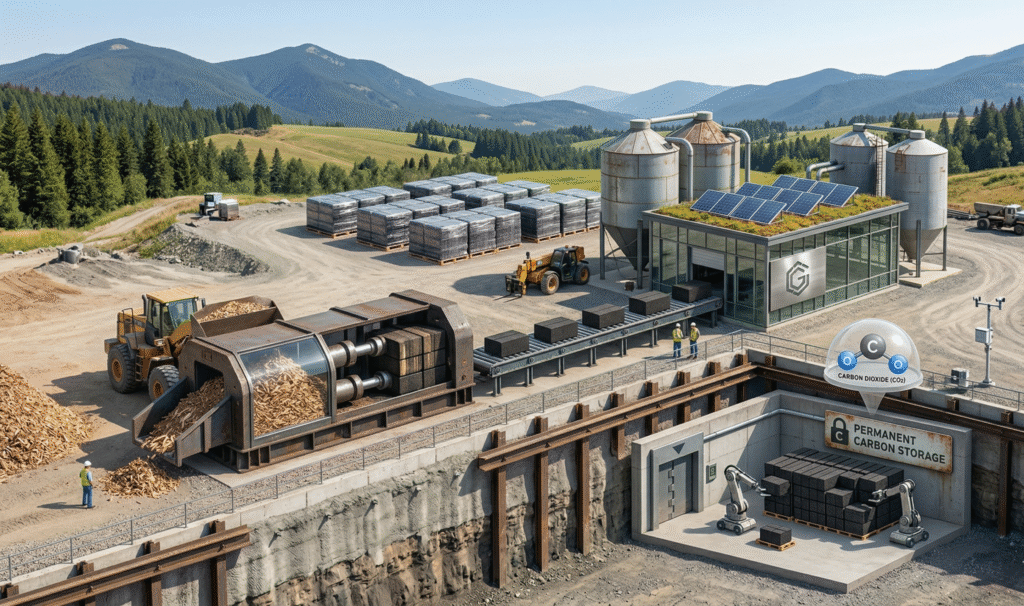
Businesses and governments are searching for practical ways to remove carbon dioxide from the air. Graphyte, a U.S.-based company, offers a simple yet effective solution. Rather than relying on costly machines or chemical processes, it uses plant-based waste to store carbon underground for centuries.
Affordable and Scalable Carbon Removal
Graphyte uses biomass carbon removal and storage (BiCRS). Analysts in the mid-2020s recognized BiCRS as one of the most cost-effective ways to remove CO₂ permanently. By converting low-value wood and agricultural residues into dense blocks, the company locks carbon underground.
Unlike other carbon-capture methods that depend on electrochemicals or minerals, Graphyte’s process is straightforward and scalable. Additionally, it creates a market for biomass that would otherwise decompose or be burned, reducing waste and environmental risks.
How Carbon Casting Works
Graphyte’s core process is carbon casting, which involves three main steps:
- Collect Biomass: The company gathers harvest residues, small trees, and leftover branches from timber operations.
- Compress into Blocks: The material is dried and pressed into solid, dense blocks.
- Seal and Store Underground: Airtight blocks are buried underground, keeping carbon out of the atmosphere for centuries.
Because the carbon originally comes from plant photosynthesis, this method effectively prevents CO₂ from returning to the air. Moreover, the process uses existing biomass, avoiding energy-intensive alternatives.
Early Projects and Clients
Founded in February 2023 with backing from Breakthrough Energy Ventures, Graphyte quickly moved from lab experiments to real-world applications. Its first major initiative, the Loblolly Project in Pine Bluff, Arkansas, began construction in 2023 and started operating in early 2024.
The facility initially removes 15,000 metric tons of CO₂ per year, with plans to reach 50,000 tons by 2025. In addition, it uses local timber and agricultural by-products, turning them into carbon-rich blocks. This approach reduces carbon emissions and also lowers wildfire risks by utilizing low-value biomass.
Corporate and Consumer Access
Graphyte’s approach has attracted attention from industries seeking long-term carbon offsets. In November 2023, American Airlines signed a deal to purchase 10,000 tons of permanent carbon removal, marking Graphyte’s first commercial contract.
Later, in August 2024, the company launched an online platform for individuals and small businesses. Through this platform, anyone can purchase verified carbon-removal credits. Consequently, Graphyte expanded access beyond large corporations, encouraging broader climate participation.
Funding and Growth
Graphyte raised $30 million in a Series A funding round in July 2024. Prelude Ventures and Carbon Direct Capital led the round, joined by Breakthrough Energy Ventures and Overture.
The company uses the funds to scale current facilities, build new sites, and refine the carbon casting process for larger deployments. Ultimately, Graphyte aims to transform agricultural and timber waste into a reliable carbon storage source, helping industries meet net-zero goals.
Why Graphyte Matters
Graphyte operates at the intersection of agriculture, forestry, and carbon markets. By converting everyday biomass into a long-term carbon sink, it offers a low-cost, scalable alternative to high-tech carbon capture methods.
Companies seeking durable carbon removal can rely on Graphyte’s solution. Moreover, as voluntary carbon markets grow, Graphyte can help turn forests, farm fields, and waste streams into certified, permanent carbon-removal credits.
Leave a Reply