

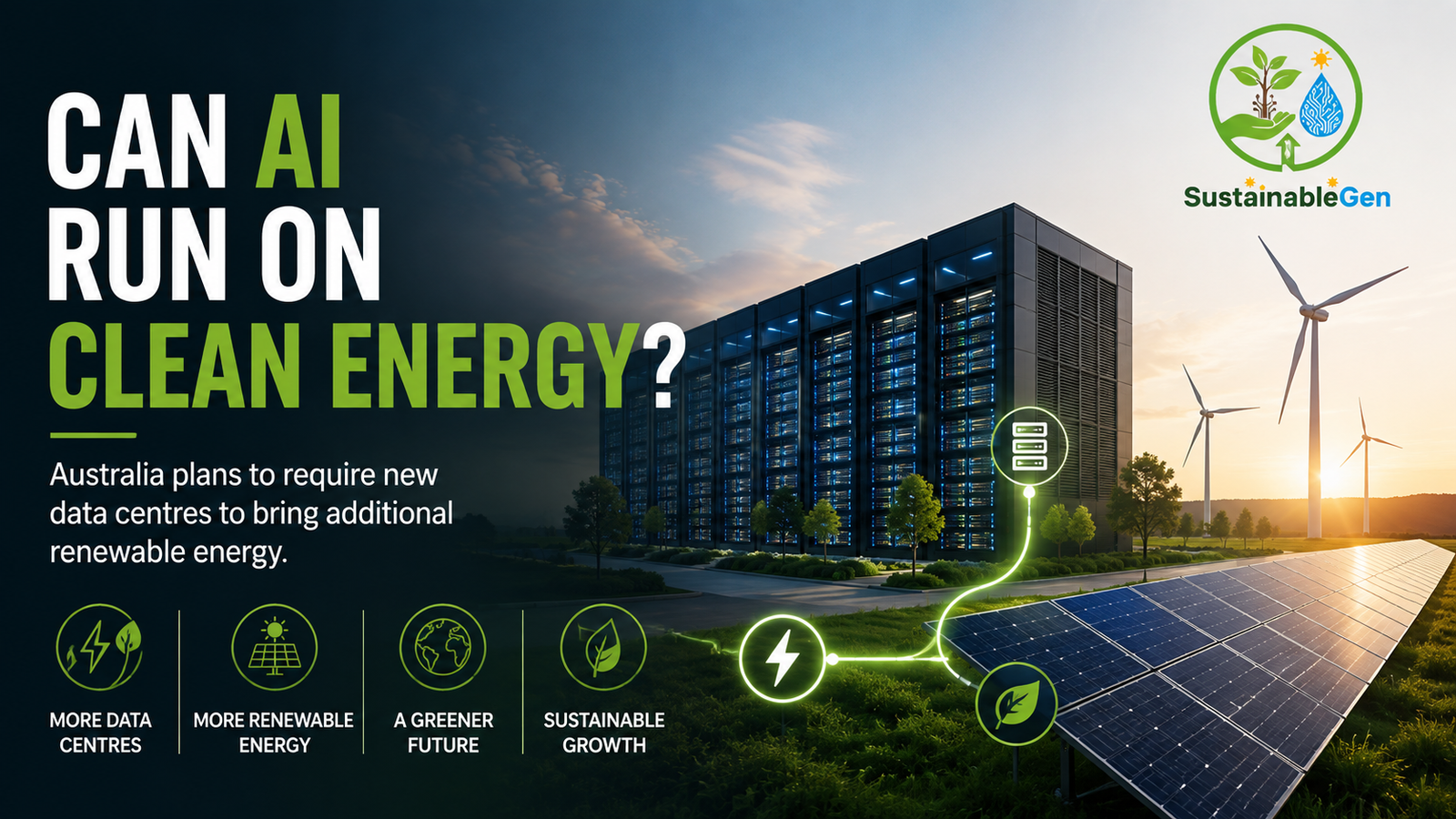
The rapid expansion of artificial intelligence is creating a new sustainability challenge: how do we power the enormous computing infrastructure behind AI without adding equally enormous pressure on the climate and electricity grid?
Australia is now taking a notable approach. Its federal government is developing rules that would require new data centres to bring additional renewable energy capacity rather than simply increasing demand on the existing electricity system.
The Problem: AI Needs a Lot of Energy
Data centres already consume significant amounts of electricity, and the growth of AI is increasing demand for high-performance computing infrastructure.
This creates a sustainability dilemma. Building more data centres can support digital services, AI development and economic growth—but if their electricity comes primarily from fossil fuels, their expansion can also increase greenhouse-gas emissions.
The challenge becomes particularly important as countries compete to attract large AI and technology investments.
Australia’s government has therefore been looking at ways to ensure that new data-centre demand is accompanied by new clean-energy supply.
The New Approach: Bring Additional Renewable Energy
On August 5, Australia’s Energy Minister Chris Bowen said proposed national standards would prevent new data centres from relying entirely on gas-fired power.
The emerging framework would require new data centres to bring their own additional renewable energy, rather than simply drawing more electricity from existing grid capacity. The government has also said new centres should have flexibility and redundancy in their power systems.
That distinction matters.
Instead of:
More data centres → more electricity demand → existing grid supplies the difference
the proposed approach aims for:
More data centres → additional renewable generation → additional clean electricity for new demand
This could make the growth of digital infrastructure more closely connected to the growth of renewable energy.
Why Data Centres Are Becoming a Sustainability Issue
A data centre may look like a technology facility, but its environmental footprint extends far beyond computers.
It requires:
- Large quantities of electricity
- Cooling systems
- Buildings and construction materials
- Backup power infrastructure
- Network equipment
- Land and supporting infrastructure
As AI systems become more computationally intensive, the electricity requirements of the facilities running them become an increasingly important sustainability consideration.
Australia’s Energy Minister has argued that clean energy should not be treated as a barrier to data-centre investment, but as an essential part of building that infrastructure responsibly.
A Major Test for AI and Renewable Energy
The Australian debate also illustrates a broader question facing countries around the world:
Can the AI boom accelerate the clean-energy transition rather than slow it down?
If large technology facilities help finance new solar, wind, battery and other renewable projects, their growing electricity demand could potentially support additional clean-energy investment.
Australia already has programmes designed to expand renewable generation and storage. Its Capacity Investment Scheme, for example, is targeting substantial new renewable and clean dispatchable capacity through competitive tenders.
This creates an opportunity to connect two rapidly developing sectors: AI infrastructure and renewable energy.
But There Are Still Challenges
The proposed approach does not automatically make data centres sustainable.
Renewable generation must actually be developed at sufficient scale, and new power infrastructure can require significant investment, land and transmission capacity.
There is also a question of how renewable energy certificates and other mechanisms are designed. Simply purchasing certificates does not necessarily mean that a project has directly created new renewable generation.
And renewable energy itself needs supporting infrastructure. Solar and wind generation vary with weather and time of day, meaning batteries, flexible demand, transmission and other forms of firming can become important.
Australia’s proposed framework therefore also emphasises flexibility and redundancy rather than focusing only on the electricity source.
What Comes Next?
Australia is still developing the regulatory framework.
The federal government has asked the Australian Energy Market Commission to develop options for rules governing new data centres, while states and territories continue working through the framework.
That means this should be viewed as an emerging policy direction rather than a fully implemented nationwide requirement.
The outcome could nevertheless become an important example for other countries facing the same problem: rapidly increasing electricity demand from AI and digital infrastructure.
Key Takeaway
AI is changing not only how we use technology, but also how much energy technology requires.
Australia’s proposed approach offers a simple principle: if new digital infrastructure creates new energy demand, it should also help create the clean energy needed to support it.
The bigger sustainability challenge will be ensuring that the AI revolution grows alongside renewable energy, efficient infrastructure and responsible resource use—not at their expense.
Leave a Reply