
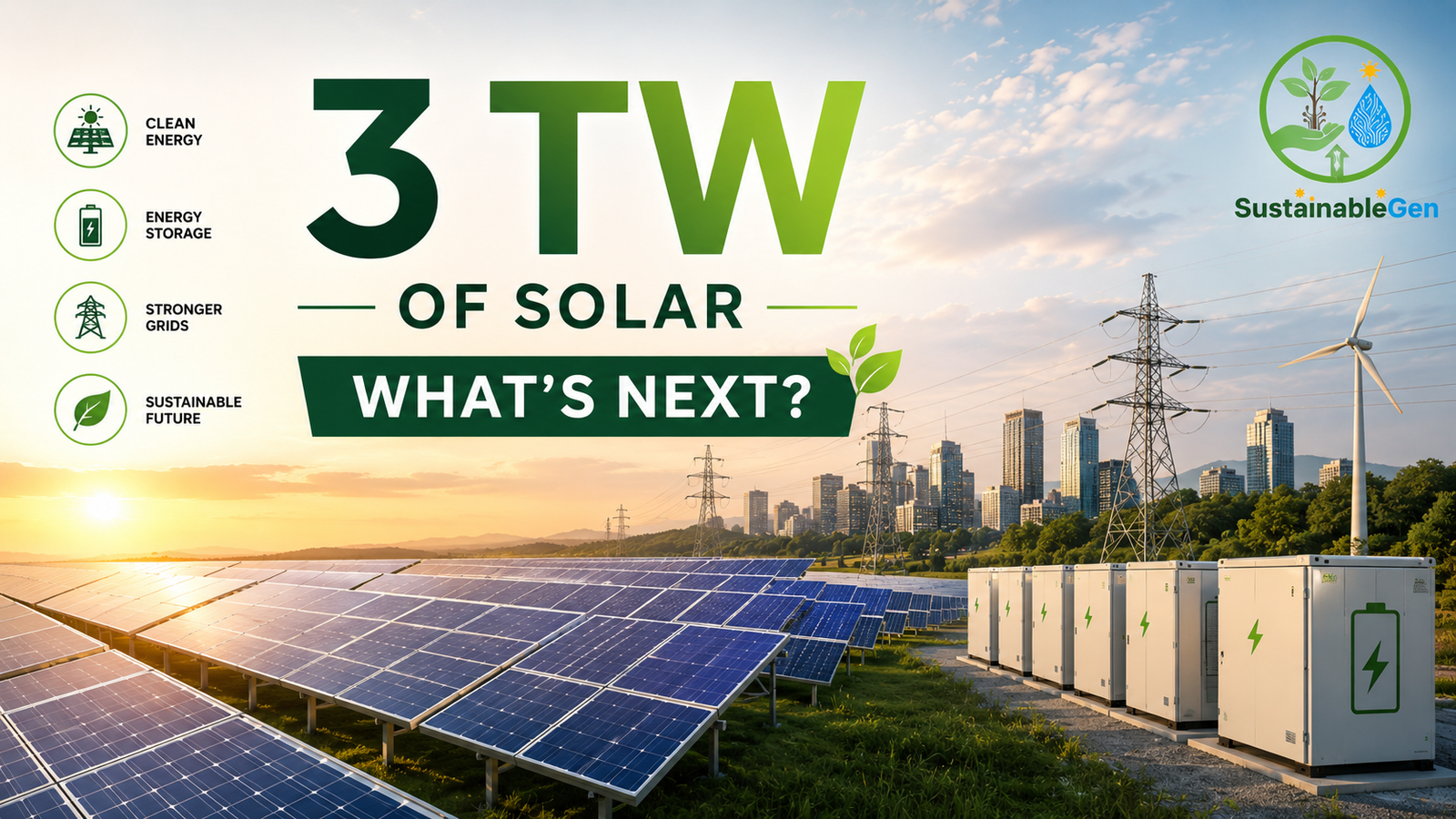
Solar energy has reached a remarkable milestone. The world has now crossed 3 terawatts (TW) of installed solar photovoltaic capacity, marking a rapid expansion of one of the most important technologies in the clean-energy transition. SolarPower Europe reported that the global solar fleet passed the 3 TW mark in early 2026 after the world added a record 664 GW of solar PV in 2025.
But reaching 3 TW is not the end of the story. It changes the question from “Can we build enough solar?” to “Can our energy systems effectively use all this solar power?”
Why 3 Terawatts Matters
A terawatt is one trillion watts. So 3 TW represents an enormous amount of solar-generating capacity installed around the world.
According to the IEA Photovoltaic Power Systems Programme, global PV capacity approached 3 TW by the end of 2025, with approximately 698 GW added during that single year. Solar remained the fastest-growing power-generation technology globally.
The growth has also accelerated dramatically.
The world took decades to build its first terawatt of solar capacity. The next two terawatts arrived much faster, showing how quickly manufacturing, investment and deployment have expanded.
What Is Driving Solar’s Growth?
Several factors are contributing to this expansion.
Falling technology costs
Solar panels have become significantly more affordable over the past decade, helping households, businesses and utilities install larger amounts of capacity.
Large-scale manufacturing
Manufacturing capacity has expanded rapidly, particularly in China, allowing solar modules to be produced at unprecedented scale.
Energy security
Solar does not require a continuous fuel supply. Once installed, a solar system can generate electricity from sunlight without importing coal, oil or gas.
That has made renewable energy increasingly attractive not only as a climate solution, but also as an energy-security strategy. SolarPower Europe specifically highlights solar’s role in reducing dependence on imported fossil fuels.
Wider global adoption
Solar deployment is no longer limited to a small group of wealthy countries.
The IEA PVPS reports that nearly 40 countries installed at least 1 GW of new PV in 2025, showing how the technology is spreading across different markets.
The Next Challenge: Solar Doesn’t Produce Electricity All the Time
This is where the sustainability conversation becomes more complicated.
Solar panels generate electricity when sunlight is available. Production can fall in the evening, during storms or during periods of low sunlight.
As solar becomes a larger part of electricity systems, countries need better ways to manage the difference between when electricity is produced and when people need it.
That means the next phase of the solar transition will increasingly depend on:
- Battery storage
- Stronger electricity grids
- Better transmission infrastructure
- Flexible electricity demand
- Smart energy-management systems
- Greater integration with other renewable sources
The IEA PVPS has identified system integration, flexibility and storage as defining challenges for the next stage of solar deployment.
More Solar Does Not Automatically Mean a Fully Clean Grid
This distinction is important.
Installed capacity is not the same as electricity generated.
A solar farm with a certain capacity does not produce that amount of electricity continuously. Actual generation depends on sunlight, location, weather and system design.
Solar also has environmental impacts of its own, including the materials required to manufacture panels, land-use considerations and the eventual challenge of recycling older equipment.
So the goal should not simply be to install as many panels as possible.
The bigger objective is to build an efficient, resilient and circular energy system around them.
The Opportunity for Innovation
The 3 TW milestone creates opportunities beyond solar-panel manufacturing.
Energy-storage companies are developing better batteries. Grid operators are exploring digital tools to manage renewable electricity. Researchers are improving solar-cell efficiency, while businesses are developing systems that can shift electricity consumption toward periods when renewable power is abundant.
This means the next generation of clean-energy innovation may focus less on generating electricity and more on managing it intelligently.
Solar could increasingly work together with batteries, electric vehicles, smart buildings and flexible industrial demand.
What Comes Next?
Solar deployment is expected to remain substantial, although SolarPower Europe forecasts that global installations could temporarily decline in 2026 before returning to growth in 2027.
That potential slowdown does not change the larger picture: solar has moved from being a relatively small alternative energy source to becoming a central component of global electricity systems.
The next challenge will be making sure grids, storage, transmission and energy markets evolve quickly enough to keep up.
Key Takeaway
The 3-terawatt solar milestone demonstrates how quickly clean-energy technology can scale.
But the next stage of the transition will require more than building solar panels. We need to learn how to store, transmit and use renewable electricity efficiently.
The future of solar may therefore be less about simply producing more energy—and more about building smarter systems capable of making the most of it
Leave a Reply