

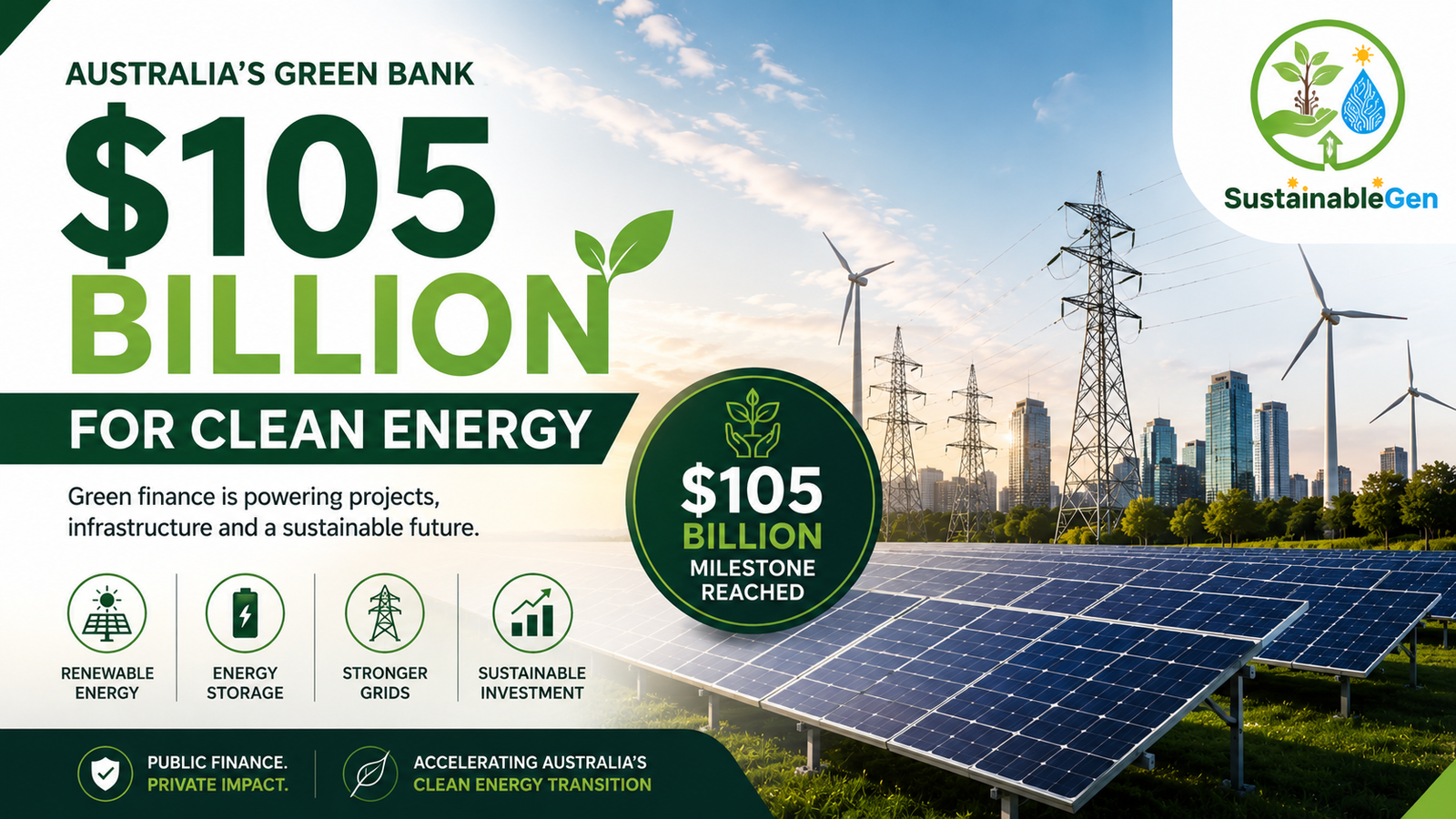
Australia’s clean-energy transition has reached a significant financial milestone. The country’s Clean Energy Finance Corporation (CEFC) says projects supported through its financing have now reached $105 billion in total value, highlighting how public finance can help move renewable-energy projects from plans to construction.
The milestone comes as Australia increases investment in renewable generation, electricity transmission, storage and other technologies needed to reduce dependence on fossil fuels.
Why Clean Energy Needs More Than Technology
Solar panels and wind turbines are becoming increasingly competitive, but building a clean-energy system requires much more than installing generation capacity.
Renewable electricity needs to reach homes and businesses through transmission networks. Batteries and other storage technologies can help balance variable generation. New projects also need large amounts of upfront capital.
This is where green finance becomes important.
Governments and public financial institutions can use their capital to reduce investment risks, attract private investors and help technologies reach commercial scale.
Australia’s CEFC is an example of this approach.
What the CEFC Has Achieved
During the 2025–26 financial year, the CEFC committed a record A$9.1 billion in discounted finance, helping support projects with a combined value of about A$19.6 billion, according to RenewEconomy’s report on the CEFC’s latest figures.
The CEFC says it has now committed A$27.1 billion since its establishment in 2012.
Importantly, the institution does not finance projects alone. In 2025–26, every dollar committed by the CEFC attracted about A$3.40 from co-investors.
That leverage is one of the most interesting parts of the model.
Public money can potentially have a much larger impact when it helps unlock private investment that might otherwise remain on the sidelines.
Renewable Energy Is Only Part of the Story
A large portion of the latest investment is going toward renewable generation and storage.
The CEFC committed A$7.8 billion toward wind, solar and storage during 2025–26.
But another major area is receiving increasing attention: the electricity grid itself.
Through its Rewiring the Nation Fund, the CEFC committed another A$7.2 billion to transmission infrastructure during the year.
This matters because some of Australia’s best renewable resources are located far from major population centres.
Building renewable generation without sufficient transmission can leave clean electricity stranded or make it harder to replace retiring fossil-fuel generation.
Marinus Link Shows Why Infrastructure Matters
One of the biggest investments involves Marinus Link, an electricity interconnector linking Tasmania with Victoria.
The CEFC committed A$3.8 billion toward the first stage of the project, which includes a 705 MW undersea electricity and data connection across Bass Strait.
The project is designed to strengthen connections between Tasmania’s renewable-energy resources and the mainland electricity system.
This illustrates an important point about the energy transition:
A renewable-energy project is only as useful as the system that allows its electricity to reach consumers.
Generation, transmission and storage therefore need to develop together.
Why Public Finance Can Matter
Clean-energy projects can face several barriers before construction begins.
They may require:
- Large upfront investment
- Long development periods
- New transmission infrastructure
- Technology risk
- Changing electricity-market conditions
- Investor uncertainty
Public financing can help reduce some of these barriers.
The CEFC’s model is particularly interesting because it operates as a commercial investor rather than simply distributing grants. Its stated role is to invest in technologies and infrastructure that support Australia’s transition to net zero while seeking financial returns.
That creates the possibility of recycling capital into future projects rather than treating every investment as a one-time expense.
The Challenges Are Still Real
A $105 billion project-value milestone does not mean Australia’s energy transition is complete.
Large renewable projects can face planning delays, environmental concerns, community opposition, transmission constraints and supply-chain challenges.
Projects also need to deliver real emissions reductions over their operating lives. Financial mobilisation is therefore only one measure of progress.
The quality, location, reliability and environmental impact of the projects matter just as much as the amount of money invested.
What Comes Next?
Australia’s next challenge will be turning large-scale investment into a reliable and integrated clean-energy system.
That means continuing to expand renewable generation while strengthening transmission, developing storage and electrifying sectors such as transport and industry.
The CEFC’s latest figures suggest that clean-energy investment is increasingly moving beyond individual technologies toward the infrastructure connecting the entire system.
And that may be one of the most important lessons from Australia’s experience: the energy transition is not simply about replacing coal and gas with solar and wind. It is about rebuilding the system around cleaner sources of energy.
Key Takeaway
Australia’s $105 billion milestone shows how strategic public finance can help accelerate clean-energy development by attracting additional private investment.
The next stage will be about turning that investment into a connected, reliable and affordable energy system.
Clean technology needs clean infrastructure—and both need the capital to scale.
Leave a Reply