

One of Australia’s most energy-intensive industrial facilities is preparing for a major transformation.
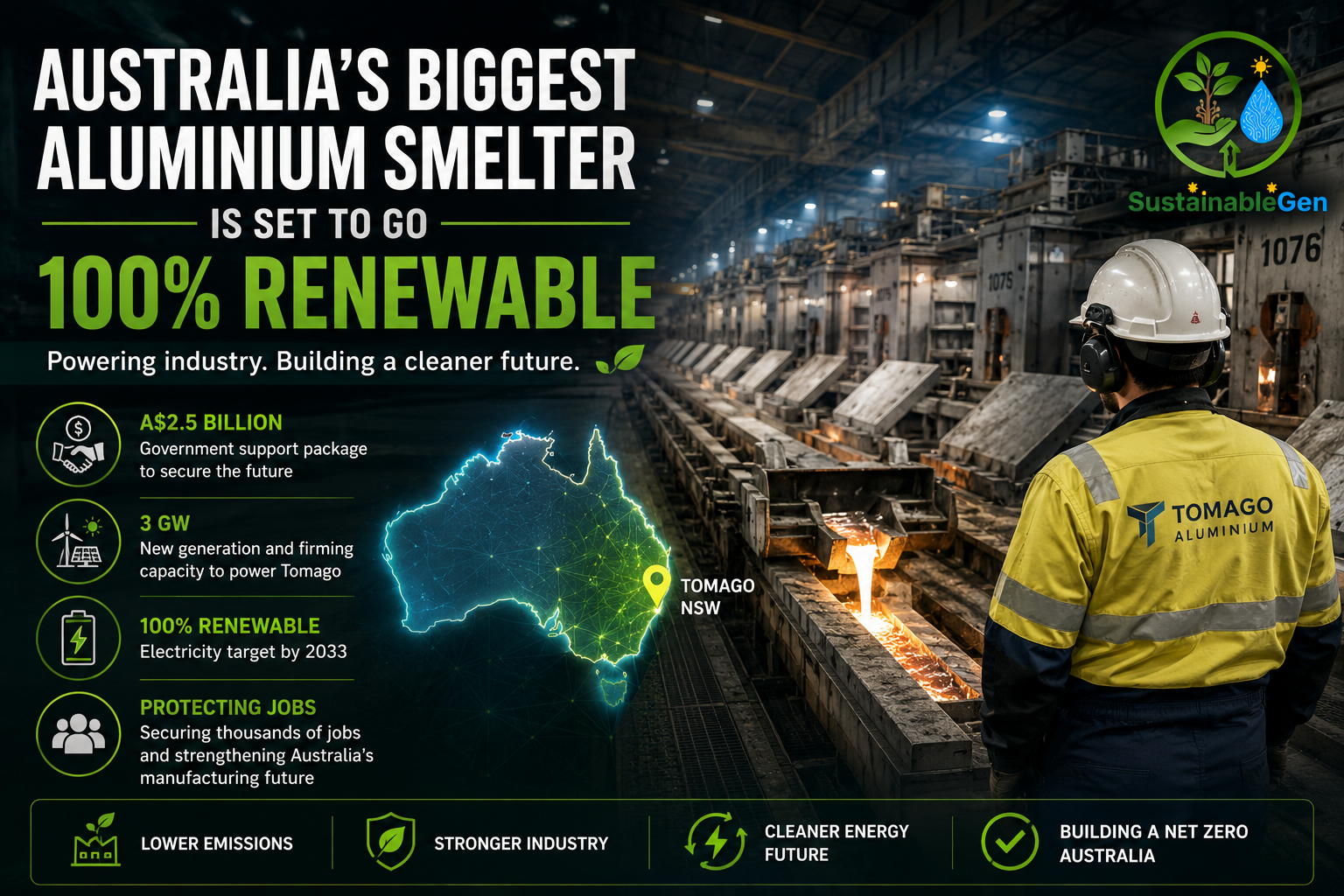
The Australian and New South Wales governments have announced a A$2.5 billion support package for Tomago Aluminium, Australia’s largest aluminium smelter, to keep the facility operating beyond 2028 while helping it transition toward 100% renewable electricity by 2033.
The development is significant because aluminium smelting requires enormous amounts of continuous electricity. Decarbonising a facility of this scale shows what the transition to cleaner industry can look like when renewable energy, storage and industrial infrastructure have to work together.
Why Aluminium Is Difficult to Decarbonise
Aluminium is an important material for modern life. It is used in cars, aircraft, buildings, packaging, renewable-energy equipment and many other products.
But producing primary aluminium is extremely electricity-intensive.
Tomago uses around 950 MW of continuous power, making it one of Australia’s largest individual electricity loads. Rio Tinto says the smelter produces up to 590,000 tonnes of aluminium each year.
The challenge is therefore not simply replacing one fuel with another.
A smelter needs a large, reliable and competitively priced supply of electricity around the clock. Intermittent renewable generation such as solar and wind has to be supported by storage, firming capacity, transmission and appropriate electricity contracts.
What Is Changing at Tomago?
Tomago’s existing electricity contract expires at the end of 2028. The company had previously warned that finding an economically viable energy supply after that point was a major challenge, with electricity accounting for more than 40% of its operating costs.
The new government package is intended to provide a pathway beyond that deadline.
The A$2.5 billion package is expected to support 3 GW of new generation and firming capacity and enable the smelter to reach 100% renewable electricity by 2033. Tomago will also invest A$1.1 billion over the next 12 years, including A$100 million specifically for further decarbonisation.
A new 10-year power purchase agreement will replace the facility’s current coal-based electricity contract.
Why Firming Matters
There is an important lesson here for anyone trying to understand industrial decarbonisation.
Solar and wind can generate enormous amounts of low-carbon electricity, but their output changes with weather and time of day.
An aluminium smelter cannot simply stop operating whenever the sun goes down or wind speeds fall.
That is why the transition requires more than renewable generation.
Firming capacity—which can include batteries and other flexible or dispatchable resources—helps provide electricity when renewable generation is insufficient.
New South Wales is already expanding this infrastructure. Its electricity roadmap includes long-duration storage projects, while a 2026 tender round selected a 500 MW / 2,000 MWh battery at Tomago designed to strengthen grid reliability.
This creates an important connection between industrial decarbonisation and wider grid development.
Why This Matters Beyond One Smelter
Tomago is not a small industrial facility.
It produces up to 590,000 tonnes of aluminium annually and contributes significantly to Australia’s manufacturing economy. Rio Tinto says the operation contributes about A$2.2 billion annually to the Australian economy, with around 90% of its aluminium exported to the Asia-Pacific region.
Keeping such a facility operating while shifting its electricity supply toward renewables demonstrates a possible pathway for other energy-intensive industries.
Steel, chemicals, cement, mining and other industrial sectors face similar questions:
How can heavy industry reduce emissions without losing reliable energy, competitiveness and jobs?
There is unlikely to be one answer for every sector. But Tomago shows that renewable electricity can become part of the solution even for industries that operate continuously and consume huge quantities of power.
The Economic Question
The project also raises a difficult issue that is important to acknowledge.
The transition to clean industry requires significant investment, and this agreement involves substantial public financial support.
Supporters argue that government intervention can protect strategic manufacturing, accelerate renewable-energy investment and prevent industrial capacity from moving overseas.
Critics have questioned whether taxpayers should carry so much of the financial risk.
That debate is part of a much larger question surrounding the global energy transition:
Who should pay for industrial decarbonisation—the companies, governments, consumers, or some combination of all three?
The answer will influence how quickly other hard-to-abate industries can make similar transitions.
What Comes Next?
The immediate priority is building and securing the electricity system required to support Tomago beyond 2028.
That includes renewable generation, firming capacity, transmission infrastructure and long-term electricity arrangements.
The project is therefore better understood as an industrial transition pathway, not as a completed decarbonisation project.
Tomago’s own stated target is to reach more than 50% renewable electricity by 2030 and aspire to 100% by 2035. The newly announced pathway brings the government’s target forward to 2033.
The actual environmental benefit will ultimately depend on how quickly the supporting clean-energy infrastructure is delivered and how the electricity supply is structured.
Key Takeaway
Decarbonising heavy industry is much harder than simply installing solar panels.
Tomago’s transition shows why renewable generation, energy storage, reliable grids, industrial investment and long-term policy all have to move together.
If the plan succeeds, one of Australia’s largest industrial electricity users will demonstrate that even highly energy-intensive manufacturing can move toward a renewable-powered future.
The bigger challenge will be taking lessons from projects like Tomago and applying them across the industries that are hardest to decarbonise.
Leave a Reply