
Wastewater treatment is usually thought of as an essential service: remove pollutants, clean the water and safely release it back into the environment.
But researchers are exploring a more ambitious idea—turning wastewater treatment plants into resource-production facilities that can also help reduce carbon emissions.
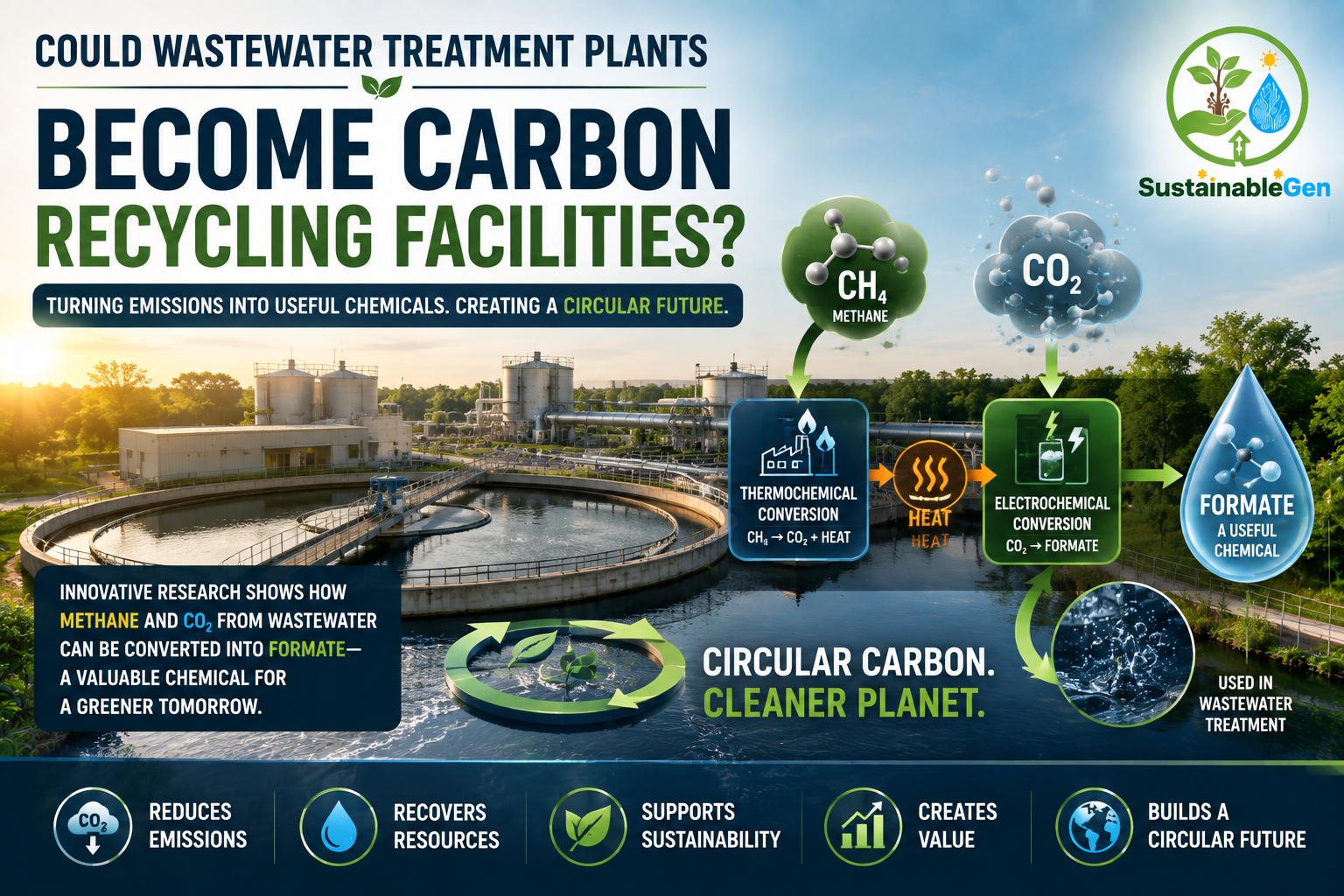
A study published in Nature Communications on 17 August 2026 presents a system that uses methane and carbon dioxide associated with wastewater treatment to produce formate, a useful carbon-based chemical. The researchers describe the approach as a potential pathway for bringing carbon circularity directly into wastewater infrastructure.
The Problem With Traditional Wastewater Treatment
Wastewater treatment protects public health and the environment, but the process itself has an environmental footprint.
Treatment plants consume energy and can generate greenhouse gases, including methane and carbon dioxide.
At the same time, some treatment processes require external carbon sources to support biological treatment.
This creates an unusual situation:
Wastewater plants can both produce carbon emissions and need carbon-based inputs.
Researchers are asking whether these two challenges can be connected.
Turning Emissions Into a Resource
The new research investigates a system that combines two processes.
First, methane is processed through a thermochemical reaction that produces carbon dioxide and heat.
That carbon dioxide is then fed into an electrochemical process, where it is converted into formate.
Formate is a useful chemical that can potentially serve as a carbon source for processes inside wastewater treatment systems.
The interesting part is that the two processes are connected.
The heat generated during the methane-conversion step can help improve the downstream carbon-dioxide conversion process.
Instead of treating heat and carbon as waste, the system attempts to make them part of a circular process.
Why Formate Matters
Formate may sound unfamiliar, but carbon-based chemicals like it can have practical uses in industrial and biological processes.
In this research, the researchers identify formate as a particularly promising product because it can potentially be reused within wastewater treatment rather than requiring an external carbon source.
That creates a possible loop:
Wastewater → methane and CO₂ → chemical conversion → formate → wastewater treatment
The objective is not simply to remove pollution.
It is to recover value from what the treatment system currently treats as a waste stream.
The Numbers Behind the Research
The researchers evaluated 32 different waste-to-chemical pathways using life-cycle assessment.
Their analysis found that sequential thermochemical-electrochemical systems offered the strongest climate benefits among the pathways studied.
The researchers estimate that the best-performing configuration could reduce emissions by up to around 35% compared with direct-emission baselines.
They also tested the approach experimentally.
Using commercially available catalysts, the system achieved a 97.2% ± 1.2% Faradaic efficiency toward formate under the reported experimental conditions.
In simple terms, most of the electrical charge going into the electrochemical stage was directed toward producing the desired chemical.
Why This Could Be Important
The bigger idea goes beyond one chemical.
Wastewater contains a surprising amount of potentially useful material and energy.
Organic matter can generate biogas. Nutrients can potentially be recovered. Water can be reused. And, as this research demonstrates, carbon-containing emissions may potentially become inputs for new processes.
This is the foundation of a circular wastewater economy.
Instead of:
Treat → Remove → Dispose
the model becomes:
Treat → Recover → Convert → Reuse
That shift could help wastewater infrastructure become part of the circular economy rather than simply being an environmental cost.
But This Is Still Research
This distinction is important.
The study demonstrates the technology experimentally, but it does not mean wastewater treatment plants are already operating this way commercially.
The researchers describe their approach as a potentially scalable strategy, but further work is needed to establish how the system performs outside laboratory conditions, how much energy and infrastructure it would require, and whether the economics work at full scale.
Real wastewater treatment plants are also highly variable.
Their methane production, carbon flows, energy requirements and operating conditions can differ considerably.
A technology that performs well under controlled experimental conditions therefore needs additional testing before widespread deployment.
What Comes Next?
The next step is likely to be moving from laboratory validation toward larger-scale demonstrations.
Researchers will need to determine whether the thermochemical and electrochemical processes can operate reliably with real wastewater infrastructure and whether the recovered formate can be integrated economically into treatment operations.
If successful, the concept could change how we think about wastewater facilities.
They could become more than places where cities dispose of unwanted materials.
They could become distributed facilities for recovering water, energy, nutrients and carbon-based resources.
Key Takeaway
Wastewater is usually seen as something that needs to be cleaned up.
But new research is showing that it can also be viewed as a resource stream.
The latest study demonstrates a promising research pathway for converting methane and carbon dioxide associated with wastewater treatment into a reusable chemical.
It is still experimental—but the underlying idea is powerful:
The most sustainable waste system may be one that learns how to turn its waste streams into useful resources.
Leave a Reply