

Renewable energy is becoming a larger part of electricity systems around the world. But there is a fundamental challenge: clean electricity is not always available when people need it.
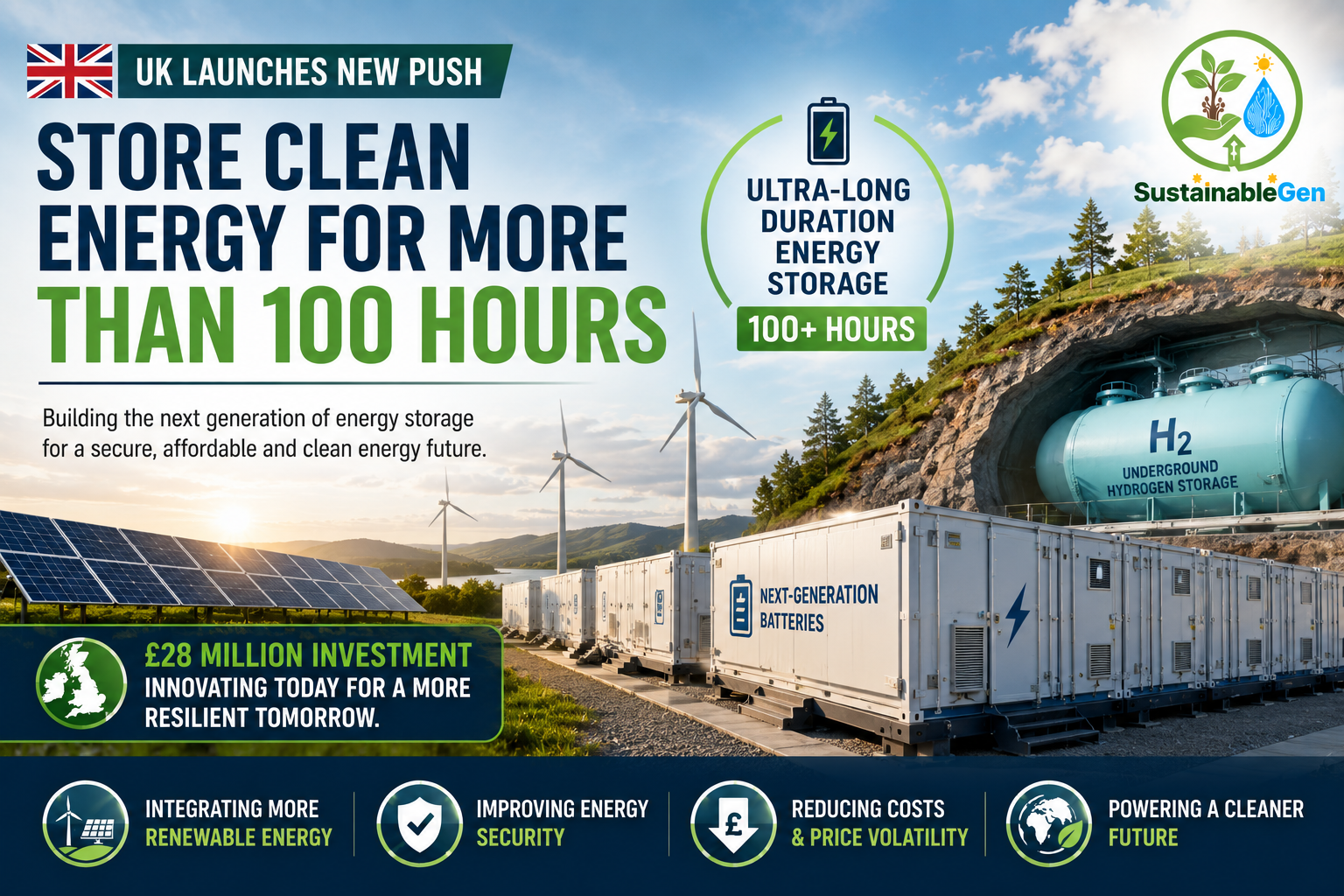
The UK has now launched a new initiative aimed at solving that problem by supporting technologies capable of storing clean energy for more than 100 hours—potentially allowing renewable electricity to be held for several days before being used.
The Ultra-Long Duration Energy Storage Challenge, announced on 20 August 2026, will provide £28 million in government-backed funding for research and development.
Why Long-Duration Storage Matters
Solar and wind power can produce large amounts of low-carbon electricity, but their output changes with weather conditions.
There may be periods when renewable generation is abundant, followed by periods when there is little wind or sunlight.
Today, gas-fired generation and other flexible resources can help fill these gaps.
Long-duration energy storage offers another possibility:
Store clean electricity when it is available → release it when the grid needs it.
The UK says this could reduce reliance on more expensive and volatile sources of power while improving energy security.
What Makes 100 Hours Different?
Many existing battery systems are designed to store electricity for relatively short periods.
The new challenge is targeting technologies capable of supplying electricity for 100 hours or more—roughly four days.
That changes the role of energy storage.
Instead of simply shifting electricity from afternoon to evening, ultra-long-duration systems could potentially help the grid manage multi-day periods of low renewable generation.
This could become increasingly valuable as electricity systems rely more heavily on variable renewable sources.
Two Technologies Are in Focus
The UK programme is concentrating on two areas.
1. Next-Generation Batteries
The first area involves developing electrochemical storage technologies capable of delivering electricity for more than 100 hours.
These technologies are not yet commercialised at scale.
The government sees this as an opportunity to support British researchers and businesses while the industry is still developing.
UK Research and Innovation has separately launched a £3 million competition for project-development studies focused on ultra-long-duration electrochemical storage.
2. Underground Hydrogen Storage
The second area focuses on storing hydrogen underground and releasing it when electricity is needed.
Hydrogen can potentially act as a way of storing energy over much longer periods than conventional batteries.
The UK Government estimates that underground hydrogen storage could potentially reduce total energy-system costs by £14 billion to £50 billion between 2035 and 2050.
That figure is a projected potential, not a guaranteed saving.
More Than a Climate Technology
The initiative is also about energy security.
The UK still relies partly on natural gas when renewable generation is insufficient. Reducing that dependence could make the electricity system less exposed to international fuel-price fluctuations and supply disruptions.
Long-duration storage could therefore provide three benefits at once:
Cleaner electricity + greater energy security + potentially lower system costs.
The Technology Is Not Ready Yet
This is an important distinction.
The UK is funding development of technologies, not announcing that 100-hour storage is already commercially available at the required scale.
Some of the electrochemical technologies targeted by the programme have yet to be commercialised at scale.
Developers will still need to demonstrate that these systems can operate reliably, achieve competitive costs, use materials responsibly and survive long operating cycles.
Large-scale hydrogen storage also requires appropriate geological sites, infrastructure, safety systems and connections to the wider energy network.
What Could Happen Next?
The Ultra-LDES Challenge is part of the UK’s wider Clean Energy Superpower Mission.
The government says the broader R&D programme is expected to invest at least £500 million by 2030 in research and development addressing major challenges facing the economy and society.
Meanwhile, Ofgem is consulting on support for 16 long-duration electricity-storage projects, including potential new pumped-storage hydropower projects.
Together, these developments suggest that the UK’s energy transition is moving beyond simply adding renewable generation.
The next challenge is building the infrastructure that allows clean electricity to remain useful even when the weather does not cooperate.
Key Takeaway
The clean-energy transition needs more than renewable generation.
It also needs ways to store electricity for hours, days and potentially longer periods.
The UK’s new £28 million challenge is an attempt to accelerate technologies that could eventually provide that missing piece.
If ultra-long-duration storage becomes affordable and scalable, it could help transform renewable electricity from an intermittent resource into a more dependable foundation for the energy system.
Leave a Reply