
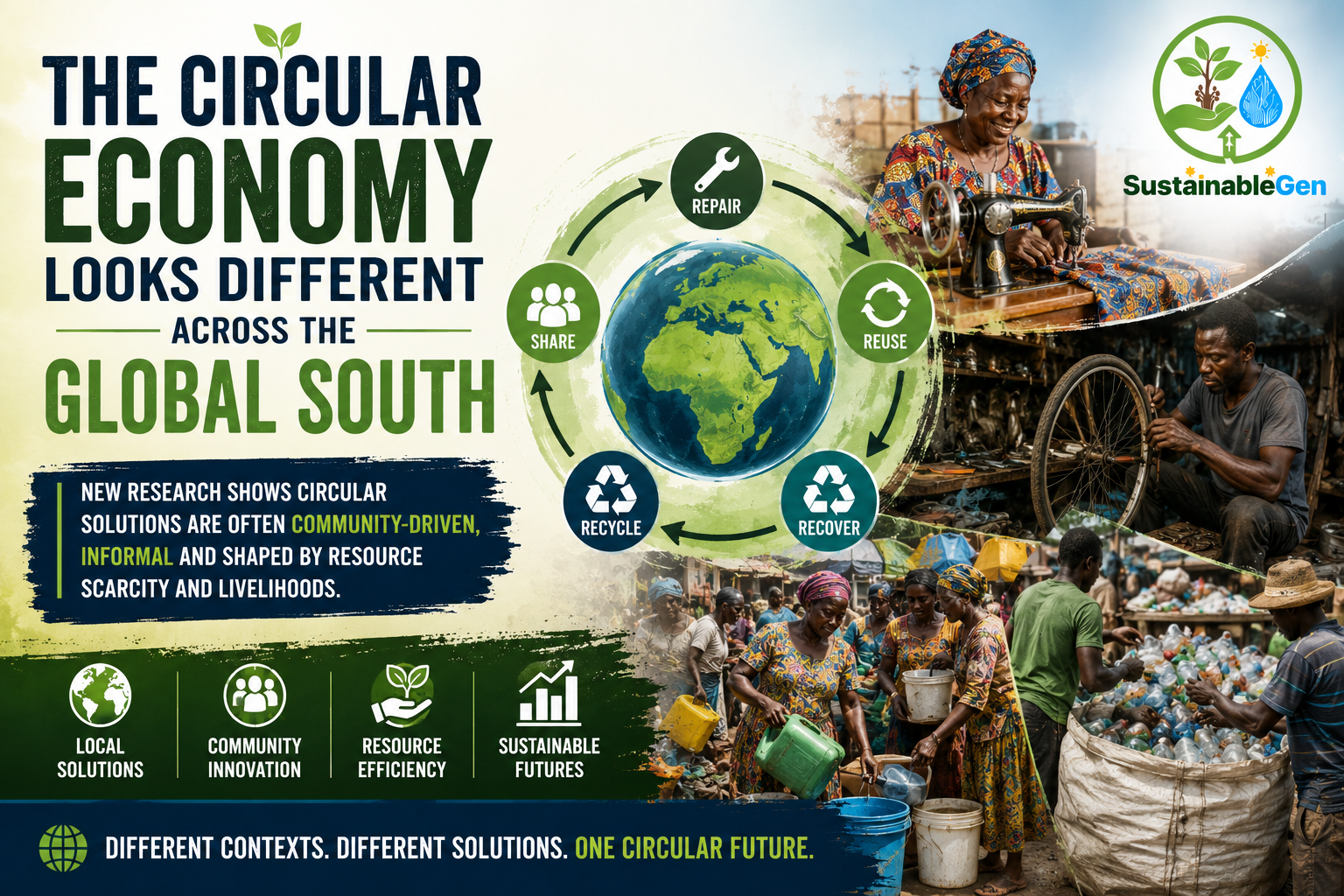
The circular economy is often presented through images of advanced recycling plants, smart factories and high-tech waste systems.
But new research suggests that this picture is incomplete.
A study published in Nature Sustainability on 20 August 2026 reviewed 183 peer-reviewed studies across 28 low- and lower-middle-income countries and found that circular-economy practices in the Global South often develop in very different ways.
Instead of being driven mainly by large industries and government policy, many circular practices are community-based, informal and shaped by everyday economic needs.
Circular Economy Is Not One-Size-Fits-All
The basic idea of a circular economy is to move away from the traditional:
Take → Make → Use → Throw Away
model.
Instead, products and materials are kept in use for longer through reuse, repair, sharing, recycling and recovery.
But the new research shows that the reasons for doing this can differ dramatically depending on where people live.
In wealthier economies, circularity is often discussed as a response to excessive resource consumption, industrial waste and environmental damage.
In many lower-income countries, however, resource scarcity and livelihoods can be the immediate drivers.
People may repair, reuse or recover materials because replacing them is expensive—or simply not possible.
Communities Are Already Practising Circularity
The researchers found that circular solutions in the Global South are frequently more bottom-up than the dominant models discussed in wealthier countries.
Small businesses, households, community groups and informal workers can play an important role.
Examples include extending the life of products, recovering valuable materials, repairing goods and finding new uses for materials that would otherwise be discarded.
These activities may not always carry a formal “circular economy” label.
Yet they can achieve the same fundamental objective:
getting more value from resources before they become waste.
Why Informal Systems Matter
One of the study’s important findings is that informal economic systems are not simply obstacles to a modern circular economy.
In many places, informal workers already perform activities such as collection, repair, reuse and material recovery.
These systems can help communities make better use of limited resources while creating livelihoods.
That means circular-economy policies that focus exclusively on large-scale technology could overlook systems that are already working at the local level.
Technology Is Not Always the Main Answer
Sustainability discussions often focus on innovation through new technology.
But the research suggests that circularity can also depend on social innovation.
A community finding a way to share equipment, a repair business extending the life of products, or a local network recovering materials can be just as important as an advanced recycling facility.
This does not mean technology is unimportant.
Rather, it suggests that the best solution may depend on the local problem, available resources, infrastructure and community capabilities.
What the Global North Can Learn
Interestingly, the research argues that lessons can also travel in the opposite direction.
Circular-economy thinking developed largely around industrialised economies could learn from the resource-efficient practices already found in lower-income settings.
The researchers suggest that greater attention to community-level and locally grounded circularity could strengthen circular-economy approaches globally.
That challenges a common assumption:
A circular economy does not necessarily have to begin with expensive technology.
Sometimes it begins with people finding better ways to use what they already have.
The Challenge: Scaling Without Losing Context
There is still a major challenge.
A successful local practice cannot automatically be copied into another country or community.
Circular solutions depend on local markets, culture, infrastructure, regulations and resource availability.
Policies therefore need to create room for different forms of circularity, rather than imposing a single model everywhere.
The researchers argue for more flexible, evidence-based approaches that recognise these differences.
What Comes Next?
The next stage for circular-economy policy may be less about finding one perfect global model and more about understanding which approaches work in different contexts.
That could mean combining industrial innovation with community practices, formal businesses with informal systems, and advanced technology with simple resource-saving solutions.
A truly global circular economy may therefore look very different from country to country.
And that diversity could be a strength rather than a weakness.
Key Takeaway
The circular economy is not simply a technology challenge.
It is also a social, economic and local-development challenge.
New research from the Global South shows that people are already practising circularity in ways shaped by resource scarcity, livelihoods and community needs.
The lesson is valuable for everyone:
Sustainability solutions work best when they fit the people and places they are designed to serve.
Leave a Reply