

The ocean has just crossed a threshold scientists have been watching closely.
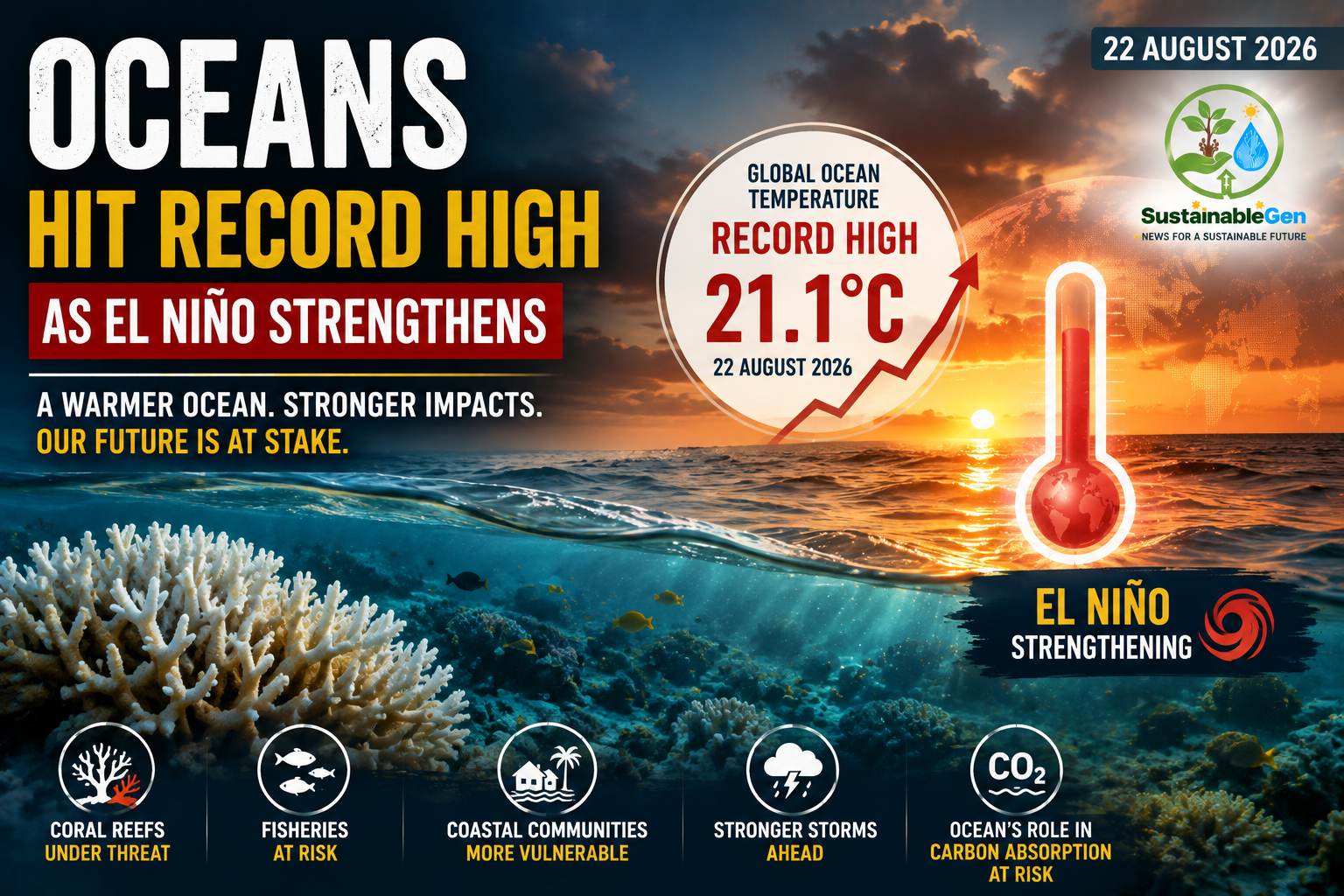
On 22 August 2026, the average surface temperature of the world’s extra-polar oceans reached 21.1°C, according to the European Union’s Copernicus Climate Change Service. That is the highest daily global average recorded in the dataset, narrowly surpassing the previous record of 21.09°C set in March 2024.
What makes the development particularly striking is the timing. Ocean temperatures normally reach their annual peak around March and April. Yet this new record has arrived in August, while a powerful El Niño is still strengthening.
For a planet whose oceans absorb most of the excess heat associated with global warming, this is much more than another temperature record.
The Ocean Has Been Taking the Heat
The ocean is Earth’s great climate buffer.
It absorbs enormous amounts of heat from the atmosphere and takes in a significant share of human-generated carbon dioxide. That has slowed some of the warming that would otherwise be felt in the atmosphere.
But warmer water changes how that system works.
As ocean temperatures rise, the ability of seawater to absorb carbon dioxide can weaken. At the same time, hotter seas can place marine ecosystems under severe stress.
This means the ocean is not simply a victim of climate change. Its changing condition can also influence how the climate behaves in the future.
El Niño Is Adding More Heat
There is an important piece of the story happening in the tropical Pacific.
El Niño is currently strengthening, and NOAA’s latest assessment gives it a greater than 90% chance of becoming a very strong event during the Northern Hemisphere autumn and winter of 2026–27. Sea-surface temperature anomalies in parts of the eastern tropical Pacific have already exceeded 2°C above average.
El Niño naturally shifts large amounts of heat within the climate system.
But this does not mean El Niño is responsible for the entire record.
The current event is developing on top of decades of human-driven ocean warming. Scientists therefore see the record as the result of natural climate variability interacting with a much warmer baseline.
That distinction matters.
When the climate system is already warmer, a natural event such as El Niño can push conditions into territory that would have been far less likely in the past.
Coral Reefs Are Among the First to Feel It
Some of the most vulnerable ecosystems are beneath the surface.
Coral reefs are extremely sensitive to prolonged marine heat. When corals experience excessive temperatures, they can expel the microscopic algae that provide much of their energy and colour—a process known as coral bleaching.
If heat stress lasts long enough, bleaching can lead to widespread coral mortality.
Scientists are particularly concerned because many reefs have already experienced repeated marine heatwaves in recent years. Another period of extreme ocean temperatures could leave ecosystems with less time to recover.
And the consequences would not stop with corals.
Reefs support fisheries, coastal economies and natural protection against waves and storms.
Fisheries Could Feel the Change Too
A warmer ocean can shift where marine species live.
Fish populations may move toward cooler waters, altering ecosystems and creating difficulties for fishing communities that depend on predictable seasonal patterns.
El Niño itself is associated with major changes in fisheries, including historically sharp declines in anchovy populations along parts of the Pacific coast of South America.
For coastal communities, this means ocean warming is not simply an environmental statistic.
It can affect food, employment and local economies.
A Warmer Ocean Also Means More Energy in the Climate System
There is another reason scientists are paying attention.
Warm ocean water provides additional heat and moisture to the atmosphere. Under the right conditions, this can contribute to stronger storms and heavier rainfall.
At the same time, rising sea temperatures and the expansion of warmer seawater contribute to sea-level rise.
The effects are therefore interconnected: an increasingly warm ocean can influence ecosystems, weather patterns, coastal communities and the carbon cycle at the same time.
The Record Is Important—But One Day Is Not the Whole Story
It is tempting to look at a single record and treat it as proof of what will happen next.
Scientists are more cautious.
Daily temperatures naturally fluctuate, and El Niño is itself a temporary climate pattern.
What makes this particular record concerning is the longer trend behind it.
Copernicus data show that global ocean temperatures have remained exceptionally high, while the current El Niño is adding another source of warming.
The question is therefore not simply whether today’s record will be broken tomorrow.
It is whether these increasingly warm conditions are becoming part of a new and more persistent climate baseline.
What Comes Next?
The coming months will be closely watched.
NOAA forecasts indicate that the current El Niño is likely to strengthen further, while experimental modelling from NOAA’s Geophysical Fluid Dynamics Laboratory suggests the event could approach historically exceptional strength later this year.
That does not mean every region will experience record heat or the same impacts.
But it does mean governments, fisheries, conservation organisations and coastal communities have strong reasons to prepare for continued marine heat stress.
The ocean has often been described as the planet’s climate safety net.
The latest record is a reminder that even that safety net has limits.
Key Takeaway
The world’s oceans have reached their highest daily average surface temperature on record, and the timing is particularly significant because a powerful El Niño is still developing.
This is not simply another number on a climate chart.
It is a signal of how human-caused warming and natural climate variability are now interacting in an already-heated ocean system.
The consequences will be measured not only in degrees Celsius, but in coral reefs, fisheries, coastal communities, carbon absorption and the stability of marine ecosystems.
The ocean has been absorbing the consequences of a warming planet for decades. This record shows just how much pressure that system is now under.
Leave a Reply