
For many farmers, deciding how much fertilizer to apply still involves experience, observation and a fair amount of guesswork.
A new agricultural technology emerging from the Philippines is trying to change that by putting rapid soil diagnostics directly into the field.
Developed by GreenVisions PH, the system combines soil sensors, artificial intelligence and digital farm monitoring to give farmers information about their soil in minutes rather than waiting weeks for conventional laboratory results. The technology was highlighted in a report published by Mindanao Times on 30 August 2026.
The idea is simple, but its implications for sustainable farming could be significant: use fertilizer because the soil needs it, not because the calendar says it is time.
The Problem: Farmers Often Don’t Have Timely Soil Data
Fertilizer is essential for modern agriculture, but applying too much can waste money and contribute to nutrient runoff and soil problems.
The difficulty is that conventional soil testing can be slow and inconvenient for small farmers. By the time laboratory results arrive, the farmer may already have made the fertilization decision for that growing cycle.
That creates a strange situation: farmers can have access to scientific testing, but not necessarily at the speed required for everyday farm decisions.
GreenVisions PH was developed around this gap.
A “Hospital for Farms”
The startup describes its approach as a “hospital for farms.”
The concept has three stages: diagnose the condition of the soil, recommend an appropriate treatment and continue monitoring what happens afterward.
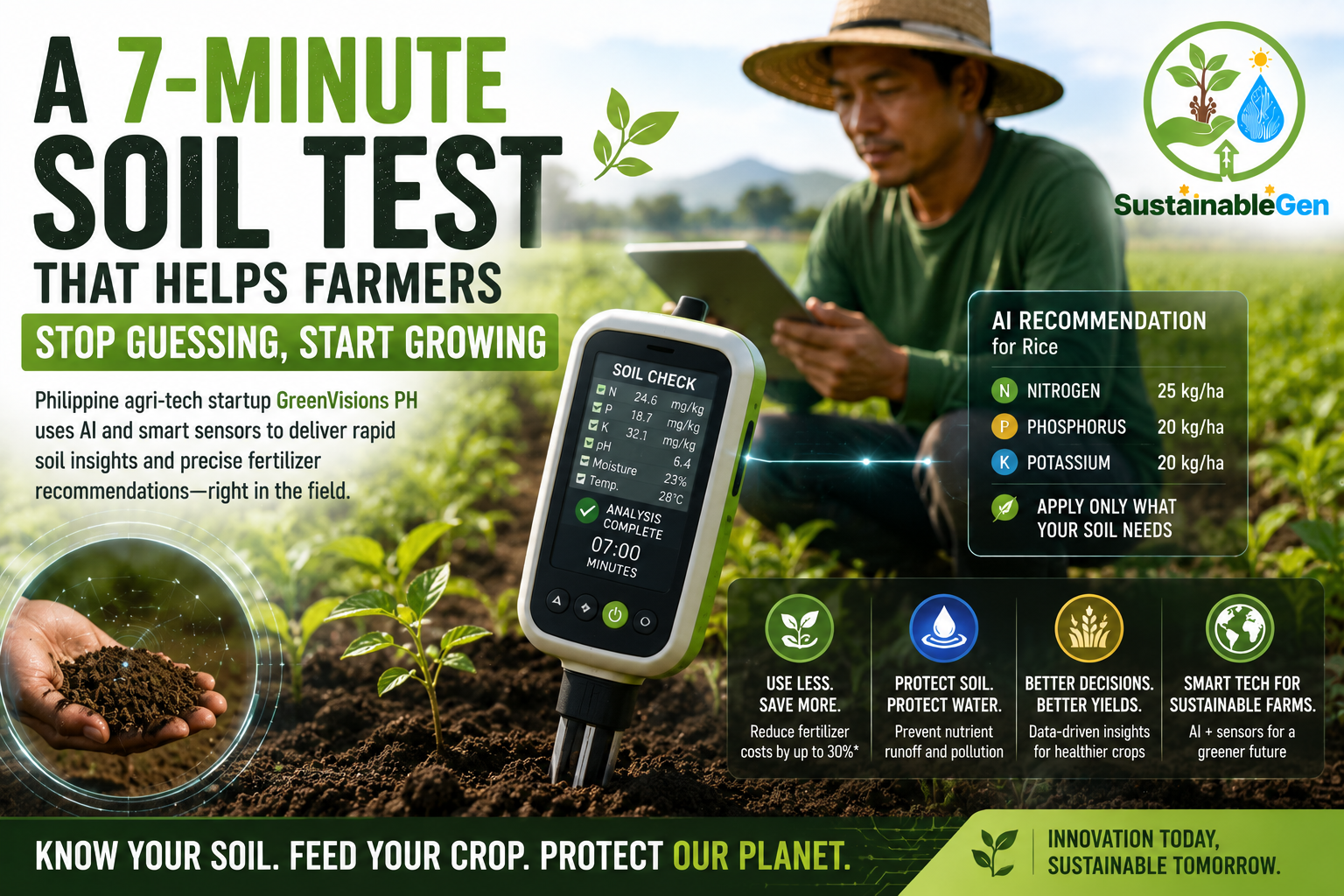
Its AI-Driven Farm Management Module (AID-FMM) uses sensors to measure indicators including nitrogen, phosphorus, potassium, pH, moisture and temperature. According to the company’s reporting, the complete field-reading process takes around seven minutes, with recommendations generated from the measurements and crop information.
Instead of giving farmers a complicated laboratory report, the system is designed to translate the measurements into practical guidance—such as what nutrients a crop needs and how much should be applied.
That last step may be the most important.
Collecting data is useful only if the farmer can actually use it to make a better decision.
Where AI Fits In
The technology isn’t using AI simply as a buzzword.
Its purpose is to connect soil measurements with crop requirements and turn them into a decision that can be understood at farm level.
GreenVisions says its recommendations draw on Philippine soil-testing references, crop-specific agronomy and other scientific resources, while the system is being refined through field testing.
The company also has a separate Agricultural Intelligence & Monitoring System, designed to help farms record inputs and activities and monitor conditions over time.
That creates the possibility of moving from a single soil test toward a more continuous picture of farm health.
The Sustainability Opportunity
The environmental case for precision fertilization is straightforward.
If a farmer applies nutrients that the crop does not need, the additional input represents wasted money and resources. Excess nutrients can also move into surrounding water systems and contribute to environmental problems.
Better soil information could therefore help farmers reduce unnecessary inputs while maintaining crop productivity.
This is particularly relevant in countries where farmers operate with tight margins.
GreenVisions reported that some farms involved in its pilots reduced fertilizer use by at least 30%, although these figures are company-reported pilot results rather than independently verified industry-wide results.
That distinction matters.
The technology is promising, but its broader environmental and economic impact still needs to be demonstrated across more farms, crops and growing conditions.
From Satellites to the Soil Beneath Our Feet
There is also something interesting about the story’s approach.
Agricultural technology is often associated with drones, satellites and large-scale data platforms.
GreenVisions’ experience suggests that sometimes the most useful innovation is much closer to the ground.
The founder, Lorilyn Daquioag, originally explored technologies involving remote sensing and satellite mapping. But discussions with farmers led the team toward a more immediate problem: farmers needed practical soil information they could use now.
It is a useful reminder that sustainable technology does not always begin with the most sophisticated technology available.
It begins with understanding the problem properly.
The Innovation Has Government Support
GreenVisions PH is not operating entirely on its own.
The Philippines’ Department of Science and Technology – Technology Application and Promotion Institute (DOST-TAPI) says it has supported the company’s technology from its pre-commercialisation stage through the TECHNiCOM 2.0 Program.
DOST-TAPI also supported the company’s international exposure through its SPICE programme, including participation at GITEX AI Asia 2026 in Singapore.
The Philippine Embassy in Singapore also listed GreenVisions among Filipino technology innovators showcased at the event, describing its system as an AI-driven farm-management and monitoring solution focused on rapid soil diagnostics and sustainable agriculture.
But Is It Ready to Transform Farming?
Not yet.
A field device that works on selected farms is very different from a technology proven across millions of hectares.
Soil varies enormously from region to region, and crop requirements change with varieties, weather, management practices and growth stages.
The accuracy of recommendations, affordability of the equipment, farmer adoption and long-term results will all determine whether rapid AI-assisted soil diagnostics can move beyond promising pilots.
There is also an important human factor.
Farmers have to trust the recommendations enough to change practices that may have been followed for years.
What Comes Next
The more interesting question is not whether AI can analyse soil.
It clearly can.
The bigger question is whether technologies like this can make evidence-based farming practical and affordable for ordinary farmers.
If they can, the impact could extend beyond individual farms. Less unnecessary fertilizer could mean lower production costs, more efficient use of resources and reduced pressure on surrounding ecosystems.
That is where agricultural technology becomes genuinely sustainable—not when it is simply digital, but when the technology helps farmers make better decisions with fewer wasted resources.
Key Takeaway
The future of smart farming may not always look like autonomous tractors or fields covered in drones.
Sometimes, it may look like a farmer putting a small device into the soil and getting an answer before making the next decision.
GreenVisions PH is an example of how AI, sensors and agronomic knowledge are being brought together to tackle one of agriculture’s most basic problems: knowing what the soil actually needs.
And in sustainable agriculture, knowing what not to use can be just as valuable as knowing what to use.
Leave a Reply