

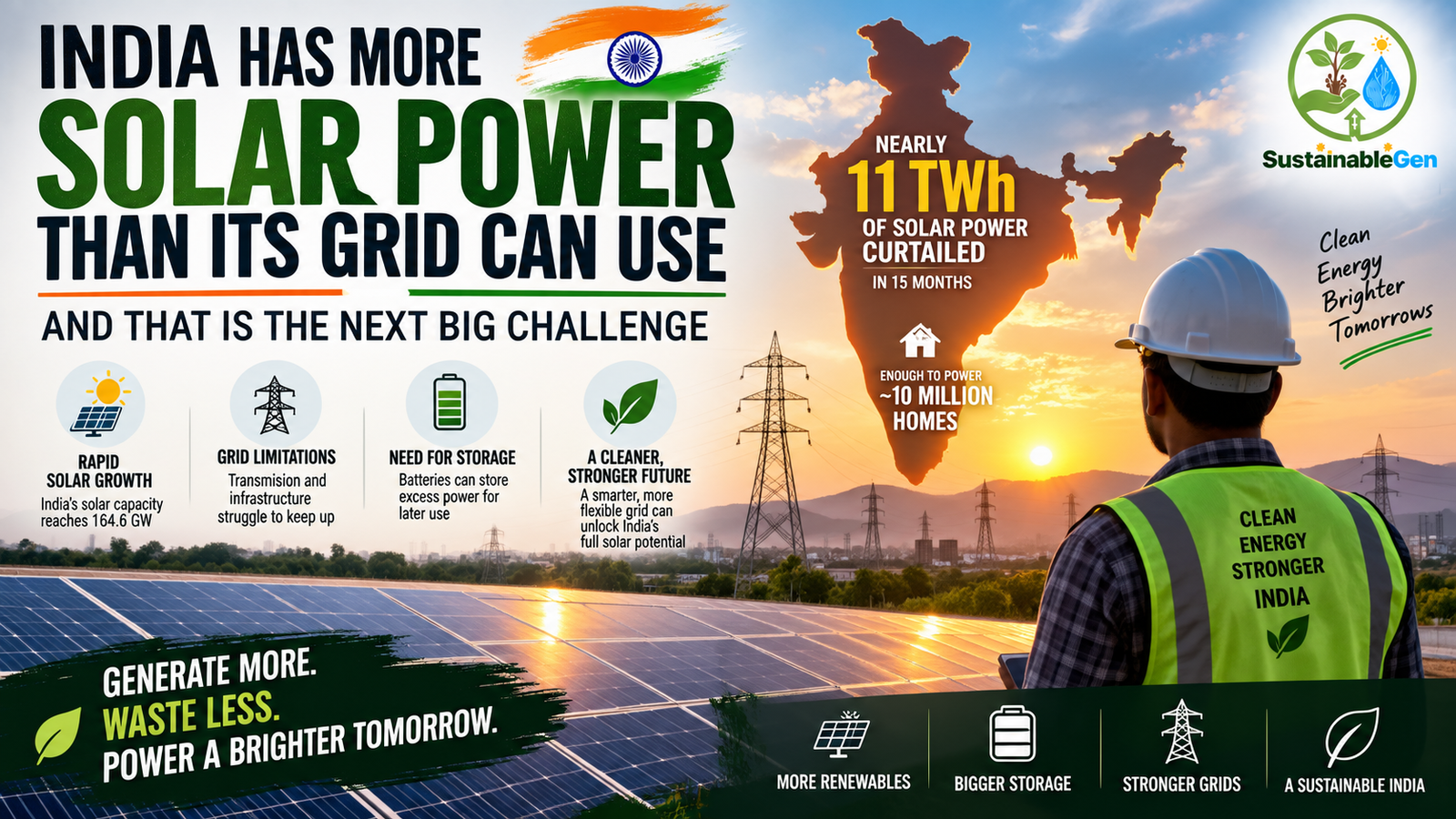
India is adding solar power at remarkable speed. But a surprising problem is emerging alongside that success: sometimes the country has more solar electricity available than its power grid can absorb.
New reporting this week shows that India curtailed nearly 11 terawatt-hours of solar generation over the past 15 months because transmission constraints, limited storage and grid inflexibility prevented the electricity from reaching consumers. That amount of unused solar power could have supplied roughly 10 million homes.
The situation creates an unusual contradiction.
India needs more clean electricity. At the same time, some of the clean electricity it already produces never reaches the people who need it.
The Solar Success Has Created a New Problem
India’s solar capacity has expanded rapidly.
According to India’s Ministry of New and Renewable Energy, the country had about 164.6 GW of installed solar capacity by the end of July 2026, including ground-mounted projects, rooftop systems and off-grid installations.
But solar generation does not arrive evenly throughout the day.
Solar farms can produce enormous amounts of electricity around midday, while demand often remains high later in the evening when the sun has already gone down.
That creates a timing problem.
India can have abundant electricity at one moment and need more electricity a few hours later.
Why Does Solar Power Get Wasted?
The technical term is curtailment.
When the grid cannot safely accept all the electricity that renewable generators could produce, grid operators can instruct those generators to reduce or stop their output.
That does not mean the solar panels stopped working.
It means the wider electricity system could not use everything they were capable of producing.
India’s current challenge comes from several factors working together.
Transmission lines need to move electricity from areas with abundant solar generation—particularly parts of western India—to areas where consumers need it.
Storage needs to capture surplus electricity during sunny hours and release it later.
And conventional power plants need enough flexibility to reduce their output when renewable generation rises.
The current system does not always provide all three.
The Battery Could Become as Important as the Solar Panel
This is where energy storage becomes crucial.
A solar panel produces electricity when sunlight is available.
A battery can change when that electricity becomes useful.
India’s Ministry of New and Renewable Energy explains that energy-storage systems can absorb renewable electricity and release it during peak periods, helping reduce renewable variability and improve grid stability.
India’s storage requirement will also grow rapidly.
The Ministry cites Central Electricity Authority projections showing that India could need around 82.37 GWh of energy storage in 2026–27, increasing to approximately 411.4 GWh by 2031–32.
That means batteries and other storage technologies are moving from being an optional addition to renewable projects toward becoming an essential part of the electricity system.
Transmission Is the Other Missing Piece
Batteries alone cannot solve the problem.
India also needs more transmission capacity.
Solar generation is concentrated in regions with excellent sunlight, while demand exists across the country.
A stronger transmission network can move electricity from where it is generated to where people need it.
Without that infrastructure, adding more solar farms can eventually produce diminishing returns: the country keeps increasing generation capacity while struggling to deliver all of it.
This is why India’s renewable-energy transition increasingly depends on the grid itself, not simply on building more generation.
Extreme Heat Makes the Contradiction Even More Important
The timing could hardly be more significant.
India has experienced strong electricity demand during periods of intense heat, with air conditioners and water pumps increasing consumption. Poor monsoon conditions have also increased pressure on electricity systems used for agricultural water pumping.
So the problem isn’t that India has no demand for electricity.
The problem is that the electricity is not always available at the right place and the right time.
That distinction will become increasingly important as climate change pushes temperatures higher and electricity demand for cooling grows.
The Future May Be a More Flexible Grid
The next phase of India’s clean-energy transition will require more than solar farms.
It will require a system that can respond quickly when electricity supply changes.
That could involve large battery-storage projects, pumped-storage hydropower, stronger transmission networks, demand-response systems and more flexible conventional generation.
India already has policies supporting energy-storage deployment, including financial support for battery storage and measures designed to make renewable energy more dispatchable.
The objective is to turn intermittent renewable electricity into something closer to a reliable, flexible power resource.
This Is Not a Failure of Solar Energy
It is tempting to look at curtailed solar electricity as evidence that India has built too much solar.
The bigger lesson is different.
Solar power has expanded quickly enough that the rest of the electricity system now has to catch up.
The challenge has shifted from:
“How do we generate more clean electricity?”
to:
“How do we use every possible unit of clean electricity when we generate it?”
That is a much more sophisticated problem—and solving it could determine how quickly India can move away from fossil fuels without compromising grid reliability.
What Comes Next?
India’s clean-energy target makes this challenge even more important.
The country aims to reach 500 GW of non-fossil-fuel capacity by 2030, while continuing to expand solar and wind generation.
Achieving that target will require a parallel expansion of transmission and storage.
Otherwise, India could continue adding renewable capacity while leaving an increasing amount of potential clean electricity unused.
The next big innovation in India’s energy transition may therefore not sit inside a solar panel.
It may sit between the power plant and the consumer—in batteries, transmission networks, software and grid-management systems that make renewable electricity available exactly when people need it.
Key Takeaway
India has shown that it can build solar power at enormous scale.
Now it faces a different challenge: making sure the electricity actually gets used.
Nearly 11 TWh of curtailed solar generation in 15 months shows that the clean-energy transition needs more than generation capacity.
It needs storage, transmission and a smarter, more flexible grid.
The next chapter of renewable energy may not be about producing more electricity.
It may be about wasting less of the electricity we already know how to produce.
Leave a Reply