
Wood is one of the oldest materials humans use, but the sustainability question around it is becoming much more modern.
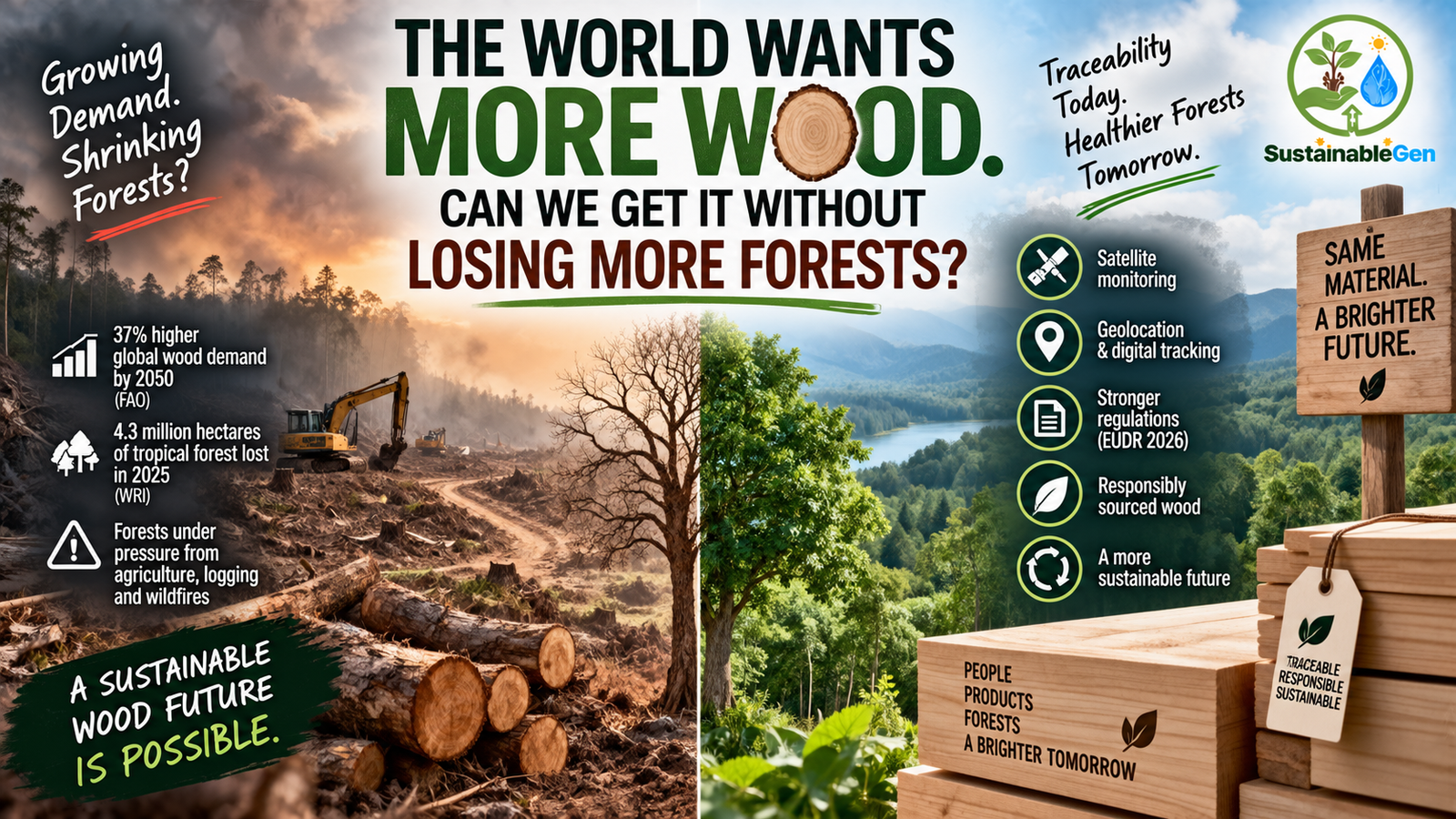
The world is expected to consume significantly more wood in the coming decades. The Food and Agriculture Organization estimates that demand for primary processed wood products could rise 37% by 2050 under a business as usual scenario. At the same time, forests remain under pressure from agriculture, logging and increasingly severe wildfires.
That creates a difficult question for the future: How do we meet growing demand for wood without putting more pressure on natural forests?
A major part of the answer may come from something that sounds less exciting than planting trees: knowing exactly where every piece of wood came from.
The Traceability Problem
Wood moves through complicated supply chains.
A tree can be harvested in one country, processed somewhere else, turned into paper, furniture or packaging, and eventually sold thousands of kilometres away.
By the time the final product reaches a customer, its connection to the original forest can be difficult to see.
That makes it harder for companies and regulators to distinguish responsibly produced wood from material connected to illegal logging or forest destruction.
Technology is beginning to change that.
Satellite imagery, geolocation data, digital records and supply chain tracking can connect a finished product back to the land where its raw material originated.
This is becoming particularly important in Europe.
Europe Is About to Change the Rules
The European Union’s Deforestation Regulation, or EUDR, will begin applying to large and medium sized operators from December 30, 2026.
The regulation covers commodities including wood, soy, cocoa, coffee, palm oil, rubber and cattle. Companies placing covered products on the EU market will need to demonstrate that they are not linked to deforestation or forest degradation and that they comply with relevant laws in the country of production.
For wood companies, this means traceability is moving from a sustainability preference toward a commercial requirement.
A company will increasingly need more than a general statement saying its timber is responsibly sourced.
It needs evidence.
Satellites Could Become Part of the Supply Chain
Modern forest monitoring can already provide remarkably detailed information.
The World Resources Institute’s Global Forest Review uses satellite data, computer algorithms and geospatial analysis to track changes in forests. Its latest analysis found that the world lost 4.3 million hectares of tropical primary forest in 2025, although tropical primary forest loss fell 36% from the previous year’s record.
The technology can help answer questions that traditional paperwork cannot easily answer.
Was a forest standing before a plantation appeared?
Did land conversion happen recently?
Where exactly is a supplier operating?
Has forest cover changed around a production area?
These kinds of questions can increasingly be investigated using satellite observations combined with location data and company records.
The result is a supply chain that can become much more transparent.
But Plantations Are Not the Same as Natural Forests
There is an important distinction here.
Planting trees does not automatically replace a natural forest.
Natural forests support complex ecosystems, wildlife, soil systems and water cycles that commercial plantations may not reproduce. This is why expanding plantations into existing natural forests can create serious environmental problems.
The more sustainable approach is to increase wood production without clearing intact ecosystems.
One example highlighted in recent reporting is the use of degraded land for eucalyptus plantations in Brazil, combined with geolocation and traceability systems.
Such approaches remain debated, particularly around biodiversity and land use, but they demonstrate the broader idea: future wood production may need to focus more strongly on already degraded or appropriate land rather than expanding into natural forests.
Certification Still Has a Role
Digital traceability does not make certification irrelevant.
Certification systems such as FSC and PEFC already provide frameworks for responsible forest management and chain of custody.
Companies are also increasingly combining certification with digital tracking.
Suzano, one of Brazil’s major pulp and paper producers, says its certified chain of custody tracks eucalyptus from plantations through to finished products. The company also publishes information on its forest management and zero deforestation commitments.
This combination could become increasingly important.
Certification provides standards and independent verification.
Digital traceability provides more detailed information about where materials come from and how they move through the supply chain.
Together, they can give buyers stronger evidence.
The Bigger Challenge Is Global
Europe can tighten its own supply chains, but forests do not stop at national borders.
Demand for wood, paper, packaging and other forest products exists around the world.
If one major market introduces stronger traceability requirements while other markets do not, suppliers may end up managing different standards for different customers.
That could make compliance more complicated.
It could also create an opportunity.
If companies decide that maintaining separate supply chains is too costly, stronger traceability could gradually become a broader business standard rather than something used only for European exports.
Similar effects are already appearing in other commodities. Recent reporting from Ivory Coast, for example, shows cocoa traders and cooperatives adapting to new digital traceability requirements ahead of the EU’s anti-deforestation rules.
What Sustainable Wood Could Look Like
The future of sustainable forestry probably will not depend on one solution.
It will require a combination of responsible forest management, better land-use planning, stronger governance, restoration, certification and reliable supply chain data.
Technology can help connect those pieces.
A satellite can observe a forest.
A geolocation system can identify where a product originated.
A digital record can follow material through a supply chain.
Certification can establish whether management practices meet an agreed standard.
And regulation can create consequences when companies fail to meet those requirements.
None of these tools can replace forests themselves.
But together, they can make it much harder for irresponsible production to disappear behind a complicated supply chain.
The Key Takeaway
The world’s wood demand is unlikely to disappear. Wood remains valuable for construction, furniture, paper, packaging and many products that can replace more carbon intensive materials.
The real sustainability challenge is making sure that growing demand does not come at the expense of forests that society cannot afford to lose.
That means the future of forestry may depend on a simple principle:
If we want to call wood sustainable, we should be able to show where it came from
Leave a Reply