

Developing a crop that can survive drought, heat or other environmental stresses can take years.
Researchers first need to identify useful traits, develop or select promising plant lines, grow them, test how they respond to different conditions and then repeat the process before a variety can reach the field.
India has now opened a new research facility designed to make one important part of that process much faster.
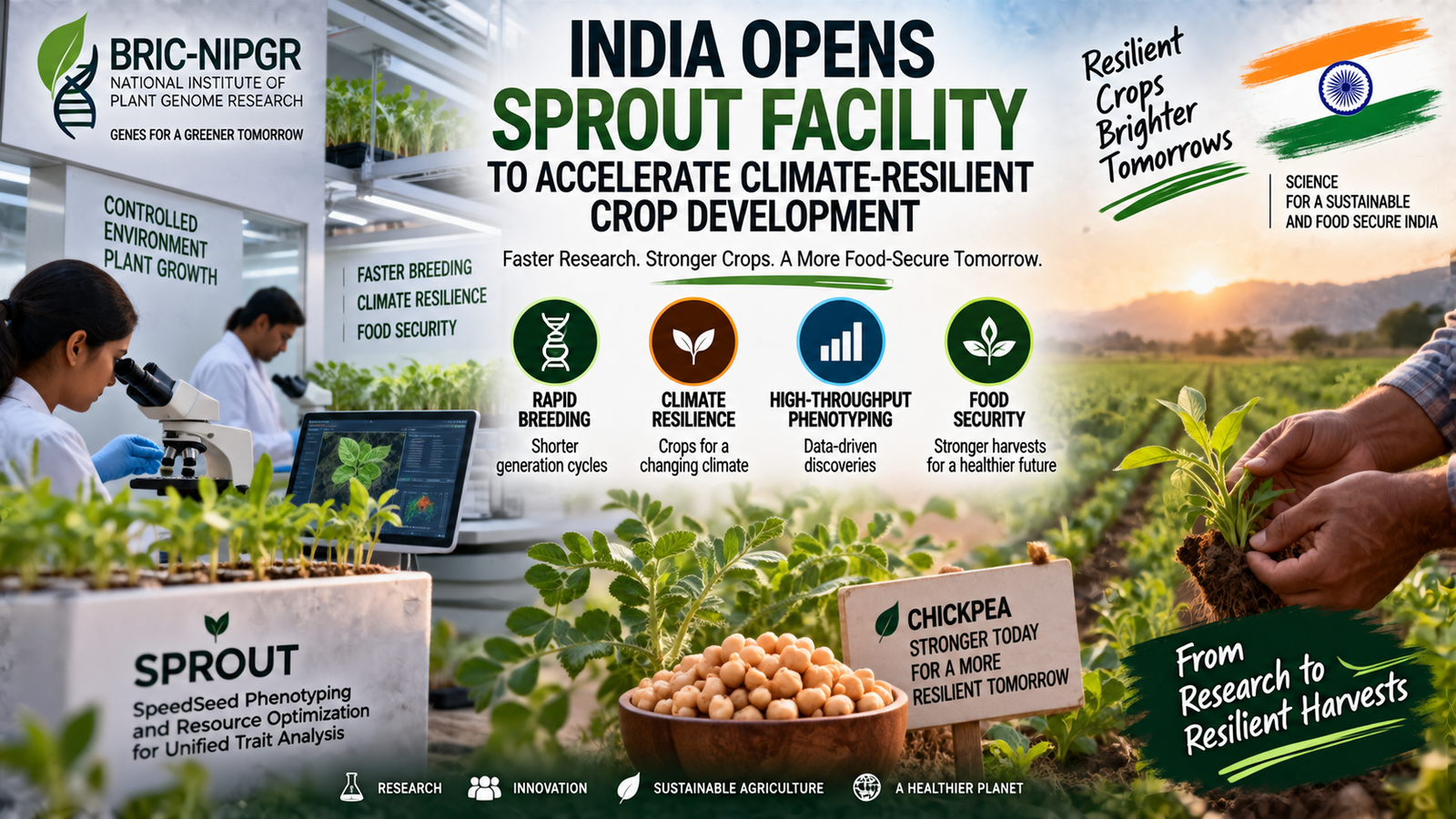
On September 15, 2026, scientists at the BRIC National Institute of Plant Genome Research (BRIC-NIPGR) in New Delhi inaugurated the SPROUT facility, a controlled-environment platform that allows researchers to test crops under different conditions throughout the year rather than waiting for natural growing seasons.
The development is particularly interesting because it combines plant genomics, controlled environments and rapid breeding techniques to tackle one of agriculture’s biggest challenges: preparing crops for a less predictable climate.
Why Crop Breeding Is Getting More Urgent
Farmers cannot simply adjust planting dates every time the climate changes.
Crops need to tolerate the conditions in which they will actually grow.
Higher temperatures, irregular rainfall, drought, salinity and other stresses can affect crop growth and yields. Developing varieties that perform better under these conditions therefore has become an important part of agricultural adaptation.
But conventional crop breeding takes time.
Researchers often need to grow several generations of a crop before they can identify and select the traits they want.
Weather adds another limitation.
If researchers need to test how a crop responds to drought or heat, they cannot always recreate those conditions reliably in an open field.
That is where controlled-environment research can make a difference.
What Is SPROUT?
SPROUT stands for SpeedSeed Phenotyping and Resource Optimization for Unified Trait Analysis.
The facility provides controlled environmental conditions where researchers can evaluate plants throughout the year.
According to India’s Department of Science and Technology, SPROUT is designed for high-throughput phenotyping, precision stress screening and evaluation of germplasm, breeding populations, mutants, transgenic lines and genome-edited plants.
In simpler terms, researchers can grow many different plant lines and observe how they respond to specific environmental conditions in a controlled setting.
They can then identify promising traits more efficiently before taking the strongest candidates into field trials.
The Technology Behind the Facility
One of the most important concepts here is phenotyping.
Genomics tells researchers about the genetic characteristics of a plant.
Phenotyping tells them what those genes actually produce in the plant, such as growth patterns, stress responses, biomass or other observable characteristics.
The two sides need to work together.
A researcher might identify a genetic change that appears promising for drought tolerance. But the real question is whether plants carrying that trait actually perform better when exposed to water stress.
SPROUT provides an environment where researchers can test those differences systematically.
This makes it a bridge between genetic research and practical crop improvement.
Chickpea Could Be One of the Early Beneficiaries
The facility has particular relevance for chickpea, an important pulse crop.
India is one of the world’s major producers and consumers of pulses, making improvements in pulse productivity particularly important for food security.
The inauguration also highlighted NIPGR’s SpeedSeed technology, which can reduce the chickpea generation cycle to around 40 days under optimised conditions.
That does not mean a new climate-resilient chickpea variety can be created in 40 days.
The figure refers to the generation cycle under the SpeedSeed approach.
Breeding still requires multiple generations, trait evaluation and eventually field testing.
But shortening each generation can significantly accelerate the overall research pipeline.
Why Speed Matters in Climate-Smart Agriculture
Imagine researchers are testing a particular genetic trait for drought tolerance.
With a traditional breeding cycle, they may have to wait months before plants mature enough to produce the next generation.
If researchers can shorten that cycle, they can move through breeding generations faster.
SPROUT adds another advantage because researchers can conduct controlled experiments independent of the normal agricultural season.
Together, these capabilities could help scientists evaluate promising crop lines more quickly.
The government describes the facility as an indigenous capability aimed at developing crops suited to different environmental conditions across India’s highly diverse agricultural regions.
It Is Not a New Crop Yet
This distinction is important.
SPROUT is research infrastructure, not a newly released climate-resilient crop variety.
The facility does not automatically produce drought-proof or heat-proof crops.
Instead, it gives researchers a better environment and faster tools for identifying and evaluating promising traits.
Any crop emerging from this research would still need rigorous testing outside controlled conditions.
A plant that performs well inside a research facility may respond differently to real farms, where soil conditions, pests, rainfall, temperature fluctuations and management practices interact in complicated ways.
Field validation therefore remains essential.
Why Controlled Environments Matter
Natural weather is unpredictable.
That can be useful when researchers want to understand how plants behave under real-world conditions, but it can make controlled experiments difficult.
A controlled facility allows scientists to create repeatable conditions.
They can expose different plant lines to specific stresses and compare their responses under similar conditions.
This can help researchers answer questions such as:
Which plants tolerate heat better?
Which lines continue growing when water becomes limited?
Which genetic traits appear useful under stressful conditions?
Which candidates deserve further field testing?
The facility therefore does not replace agricultural fields.
It helps researchers decide which candidates are worth taking into them.
The Bigger Opportunity Is Faster Crop Innovation
Climate-resilient agriculture often focuses on what farmers should do differently.
But there is another side to the equation.
The crops themselves need to evolve.
Better irrigation, soil management and weather forecasting can help farmers adapt, but crops with stronger tolerance to environmental stress can provide another layer of resilience.
That makes faster breeding infrastructure strategically important.
India’s government has placed climate-resilient agriculture among the focus areas of its broader BioE3 biotechnology policy, which aims to connect biotechnology research with economic and societal applications.
What Comes Next?
The real measure of SPROUT’s success will not be the facility itself.
It will be what researchers eventually produce with it.
That means stronger evidence on crop performance, successful field trials, useful varieties and eventually adoption by farmers.
The journey from a gene or experimental plant line to a crop grown across farms can still take years.
But reducing unnecessary waiting time in the research process could give breeders more opportunities to test, select and improve plants before climate pressures become even harder to manage.
For agriculture, that matters.
Climate adaptation is not only about responding to the next drought or heatwave.
It is also about developing crops today that are better prepared for the conditions farmers will face tomorrow.
Leave a Reply