

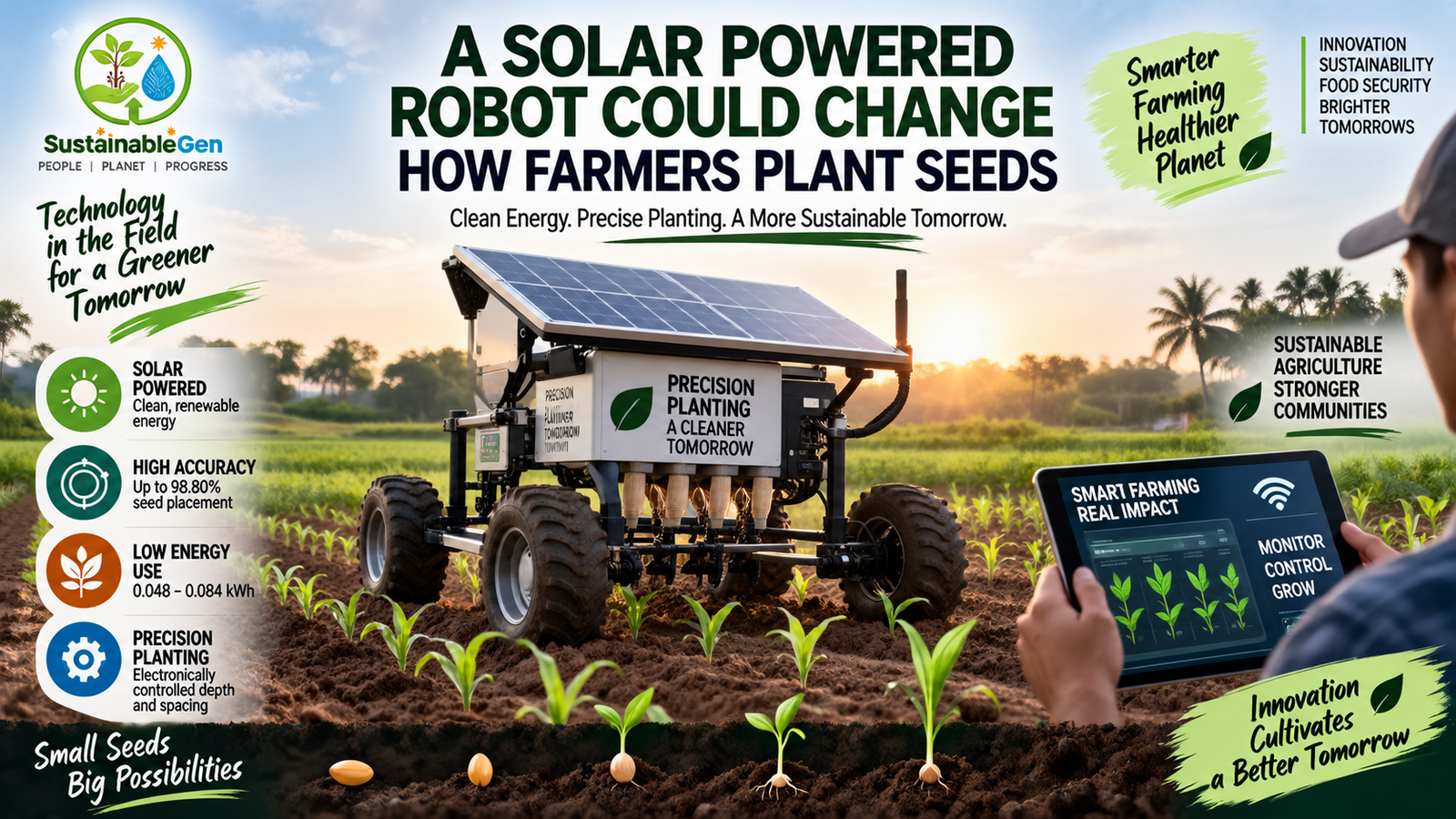
A small agricultural robot has just demonstrated something that could become increasingly important as farms look for ways to reduce fuel use without sacrificing precision.
Researchers in Egypt have developed and tested a solar powered, remotely controlled robot designed to plant seeds accurately while using very little energy.
The study, published in Scientific Reports on September 15, 2026, combines photovoltaic power, electric seed metering and electronically controlled planting depth in a single machine. In testing, the robot achieved seed placement accuracy of 98.08% to 98.80%.
It is still a research prototype, not a commercial replacement for tractors. But the technology points toward a different approach to agricultural mechanisation, one where the machine itself can generate much of the energy it needs.
Why Seed Placement Matters
Planting is one of those farm operations where small errors can create problems much later.
Seeds need to reach the right depth and spacing. If they are planted too closely, too deeply or too shallowly, crop establishment can suffer and farmers may waste valuable seed.
Large agricultural machinery already performs this job with impressive precision, but conventional equipment can require significant amounts of fuel and can be expensive for smaller farms.
The Egyptian research team wanted to explore whether a smaller electrically powered machine could perform precision planting while reducing energy requirements.
How the Robot Works
The machine combines three important systems.
A photovoltaic system supplies electricity.
An electric seed metering mechanism controls how seeds are released.
An electronic depth adjustment system controls how deeply the seed enters the soil.
The researchers tested the robot at four operating speeds ranging from 0.42 to 1.60 kilometres per hour and tested seed spacing between 10 and 25 centimetres.
The strongest performance appeared at speeds between 0.82 and 1.20 kilometres per hour, with the researchers reporting high placement accuracy and low rates of missed or multiple seeds.
That combination is important because the goal is not simply to build a robot that moves using solar power.
It needs to perform an agricultural task accurately enough to be useful.
The Energy Numbers Are What Make It Interesting
The robot consumed between 0.048 and 0.084 kWh during the tested operating conditions.
The researchers calculated a solar power supply ratio between 95% and 167%, indicating that the photovoltaic system could provide the energy required by the machine under the tested conditions.
The higher figure does not mean the robot produces 167% more usable electricity than it consumes in every situation. It reflects the relationship between available solar power and the robot’s energy requirement under the tested conditions.
That distinction matters when considering whether the technology could work outside controlled experiments.
Real farms bring cloudy weather, uneven terrain, dust, changing soil resistance and longer operating periods.
A Different Kind of Agricultural Electrification
Solar power already plays a growing role in agriculture.
Farmers use solar energy for irrigation, water pumping, crop drying and other stationary applications.
This robot takes the idea in a different direction.
Instead of using solar electricity to power equipment located at a fixed point, the researchers integrated the energy source directly into a mobile agricultural machine.
That could become particularly interesting for farms operating in regions where access to reliable electricity or diesel fuel is difficult.
A machine that can generate much of its own operating energy could potentially reduce dependence on fuel deliveries and electrical infrastructure.
Precision Could Matter More Than Size
The research also highlights an important trend in agricultural robotics.
Farm machinery does not necessarily have to become larger to become more productive.
Smaller machines can potentially operate with lower energy requirements and may be easier to deploy on smaller fields or in situations where large tractors are impractical.
A remotely controlled robot can also perform highly specific tasks without requiring a person to operate a conventional tractor continuously.
The current study focuses on seed planting, but the same basic concept could eventually be adapted for other agricultural operations.
That could include targeted fertilisation, weed management, crop monitoring or other precision tasks.
Those applications would require separate engineering and testing, however. The current research demonstrates a planting robot, not a multifunctional autonomous farm machine.
The Technology Still Has a Long Way to Go
The results are promising, but it would be too early to call this a ready-to-deploy farming solution.
The researchers tested the robot under specific experimental conditions. Commercial agricultural equipment needs to operate reliably across much larger areas and under constantly changing field conditions.
Durability, battery storage, charging, maintenance, operating range and performance on different soil types will all influence whether the technology can become commercially viable.
Farmers will also need to see a convincing economic advantage.
A machine can be technically impressive and still struggle to gain adoption if its purchase and maintenance costs are too high.
Why This Research Deserves Attention
What makes this development interesting is the combination of precision agriculture, robotics and renewable energy in one relatively simple machine.
Agricultural sustainability is often discussed in terms of soil health, water conservation or crop varieties.
Energy use in farm machinery deserves equal attention.
Planting is performed across millions of hectares every year, and mechanisation remains heavily dependent on conventional energy systems.
If future agricultural robots can perform specific tasks accurately while using far less energy, farming machinery itself could become part of the sustainability transition.
The Egyptian research is only one step toward that possibility.
But it shows that the next generation of farm equipment does not necessarily have to be bigger, heavier and more fuel intensive.
It could be smaller, smarter and powered by the energy available around it.
Leave a Reply