
A tractor running on fuel made from agricultural waste sounds like something from a future farm.
But the technology already exists.
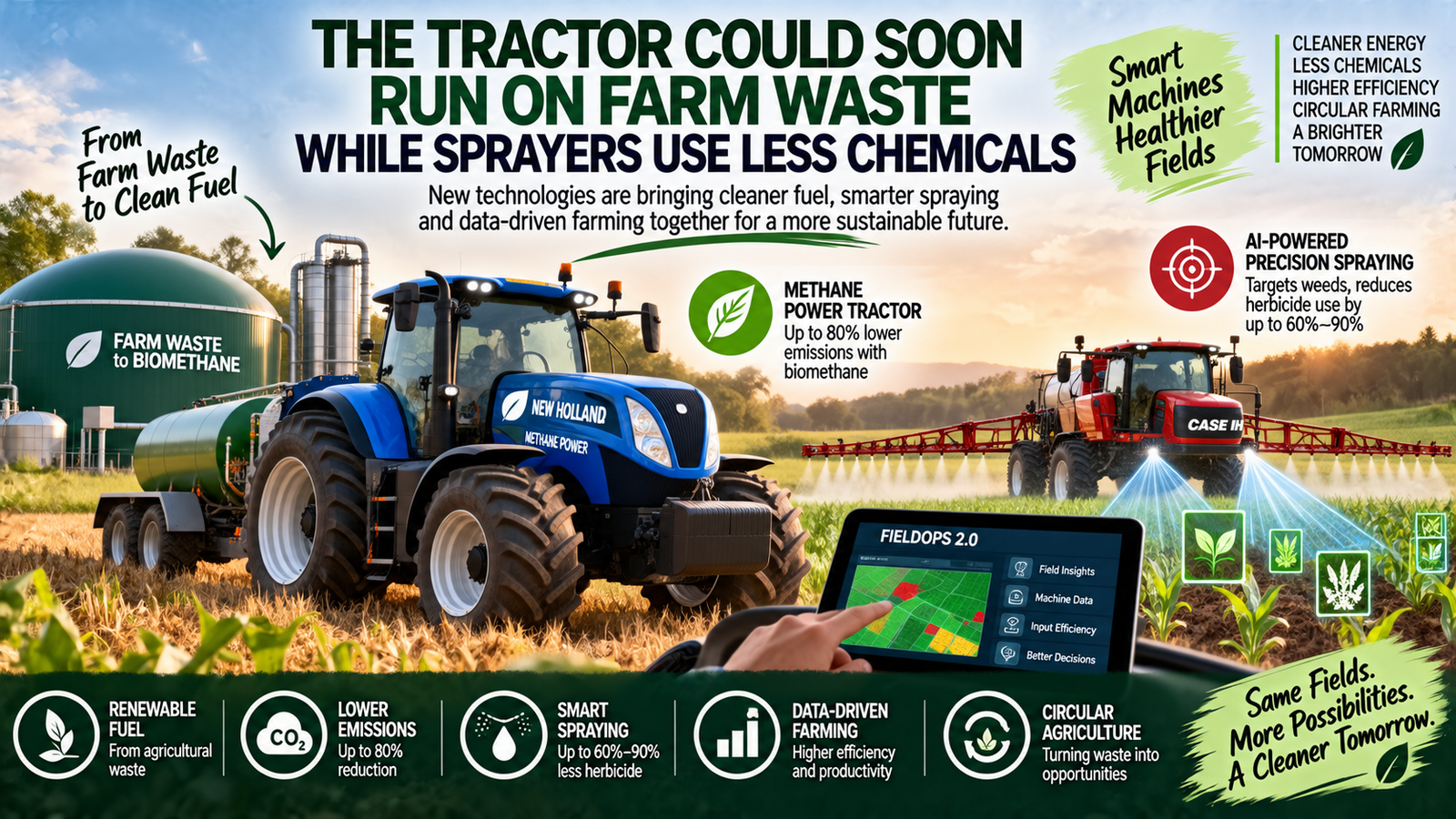
At a media event in Harbin, China, on September 23, CNH showcased a combination of technologies aimed at changing how agricultural machinery uses fuel, chemicals and field data. The lineup included a New Holland methane powered tractor, a Case IH sprayer capable of selectively targeting weeds and a new digital platform connecting machinery data with agronomic information.
What makes the development interesting is that these technologies attack different parts of the same problem.
Farmers need machinery to remain productive, but they also need to reduce wasted inputs and dependence on fossil fuels.
A Tractor That Can Run on Methane
The most striking machine at the event was the New Holland Methane Power tractor.
Unlike a conventional diesel tractor, it can operate using methane. When that methane comes from biomethane, produced from organic material such as agricultural waste, the system can become part of a circular farming model.
The basic idea is surprisingly simple.
Farm produces organic waste.
Waste goes into a biogas system.
Biogas can be upgraded into biomethane.
Biomethane powers the tractor.
The tractor returns to the farm to produce more crops.
Instead of treating agricultural waste purely as something that needs disposal, the farm can potentially turn part of that waste into an energy resource.
New Holland says its Methane Power technology can reduce overall emissions by around 80% compared with a conventional diesel tractor, while biomethane can bring the operation close to net zero carbon emissions under the appropriate conditions.
Those figures come from the manufacturer, so actual results depend on the fuel source, operating conditions and how the complete system is managed.
The Farm Could Become Its Own Fuel Supplier
This is where the concept becomes much more interesting.
A livestock farm already produces manure.
Crop farms generate residues.
Food processing operations produce organic by-products.
Instead of allowing these materials to remain a waste stream, anaerobic digestion can convert suitable organic matter into biogas.
That gas can then become a source of renewable energy.
In a sufficiently integrated system, the farm is no longer simply buying energy from outside.
Part of its own biological production system becomes the source of that energy.
New Holland has promoted this idea through its Energy Independent Farm concept, where biomethane produced from farm resources can return to the field as tractor fuel.
That creates a very different vision of agricultural sustainability.
The tractor is no longer just a machine consuming fuel.
It becomes one component in a larger circular system.
The Sprayer Is Tackling a Different Kind of Waste
The other technology demonstrated in Harbin tackles something farmers deal with every season: crop protection products.
The Case IH Patriot 3250 PRO sprayer uses a camera based system called SenseApply.
Instead of applying the same rate across an entire field, the system can analyse vegetation while the machine moves and adjust application rates in real time.
Its selective spraying function can also target weeds instead of spraying areas where weeds are absent.
CNH says this approach can reduce herbicide use by up to 60% to 90% in the relevant selective spraying applications.
That does not mean every farm will automatically cut herbicide use by 90%.
The actual reduction depends on weed pressure, crop conditions, field characteristics and the type of application.
But the principle is important.
Instead of asking:
“How much chemical should we spray over this field?”
the technology asks:
“Where does the field actually need it?”
That is a major shift in agricultural input management.
From Blanket Treatment to Targeted Treatment
Traditional spraying can cover large areas even when only part of the field requires treatment.
That creates several forms of waste.
Unused chemical costs money.
Excess application increases environmental pressure.
Spray drift can affect areas outside the intended target.
And repeated unnecessary applications can make crop protection more expensive.
Camera based systems attempt to make the application more selective.
Case IH says SenseApply can use a cab mounted multispectral camera to identify vegetation and adjust application rates while the machine moves through the field.
The technology therefore connects machinery with real time observations.
The machine does not simply follow a pre-programmed instruction.
It can respond to what it sees.
Then There Is the Digital Layer
CNH also showcased FieldOps 2.0, its agricultural data platform.
The system brings together machine operating information, field data and agronomic models to provide farmers with additional decision support.
It also covers areas such as fleet management, maintenance and machine performance.
This may sound less exciting than a methane tractor or a camera controlled sprayer.
But it could become just as important.
Modern agricultural machinery generates enormous amounts of information.
The challenge is turning that information into useful decisions.
If farmers can understand when machinery needs maintenance, where inputs are being wasted and how field operations are performing, they can potentially reduce downtime and unnecessary costs.
Why These Technologies Work Better Together
The real story is not one tractor or one sprayer.
It is the combination.
Imagine a farm where:
Crop residues and manure help produce biomethane.
Biomethane powers farm machinery.
Cameras identify where crops need protection.
Sprayers apply products only where necessary.
Machine data records what happened.
Agronomic data helps determine what should happen next.
Each technology solves a different problem.
Together, they begin to create a more circular and data driven agricultural system.
That is much more interesting than simply replacing a diesel engine with another type of engine.
There Is Still a Long Road Ahead
None of this means diesel tractors will disappear tomorrow.
Methane infrastructure costs money.
Farmers need access to sufficient organic feedstock.
Biogas and biomethane production require investment and careful management.
Precision spraying systems also require suitable machinery, sensors and technical support.
And digital agriculture creates its own challenges around connectivity, data management and farmer training.
Technology adoption will ultimately depend on whether the financial benefits justify those investments.
A sustainable machine that is too expensive or difficult to operate will struggle to reach widespread adoption.
The Bigger Change Is Happening Inside the Farm System
For decades, agricultural machinery largely followed a straightforward model.
Fuel entered the farm.
Machines consumed it.
Inputs were applied across fields.
Waste left the system.
The newer model looks different.
Waste can become fuel.
Sensors can determine where inputs are needed.
Machines can adjust their behaviour in real time.
Data can connect field operations with future decisions.
That is the more interesting direction for sustainable mechanisation.
The goal is not simply to build a cleaner tractor.
It is to make the entire farming system more efficient at using what it already has.
CNH’s latest showcase in China provides a glimpse of that transition.
And perhaps the most important question for the future of farm machinery will no longer be just:
“How powerful is the tractor?”
It may increasingly become:
“How little can the farm waste while still producing more?”
Leave a Reply