

A fruit and vegetable seller does not need a large cold storage facility to lose money to heat.
Sometimes, a few hours of exposure to high temperatures can be enough to turn fresh produce into unsellable waste.
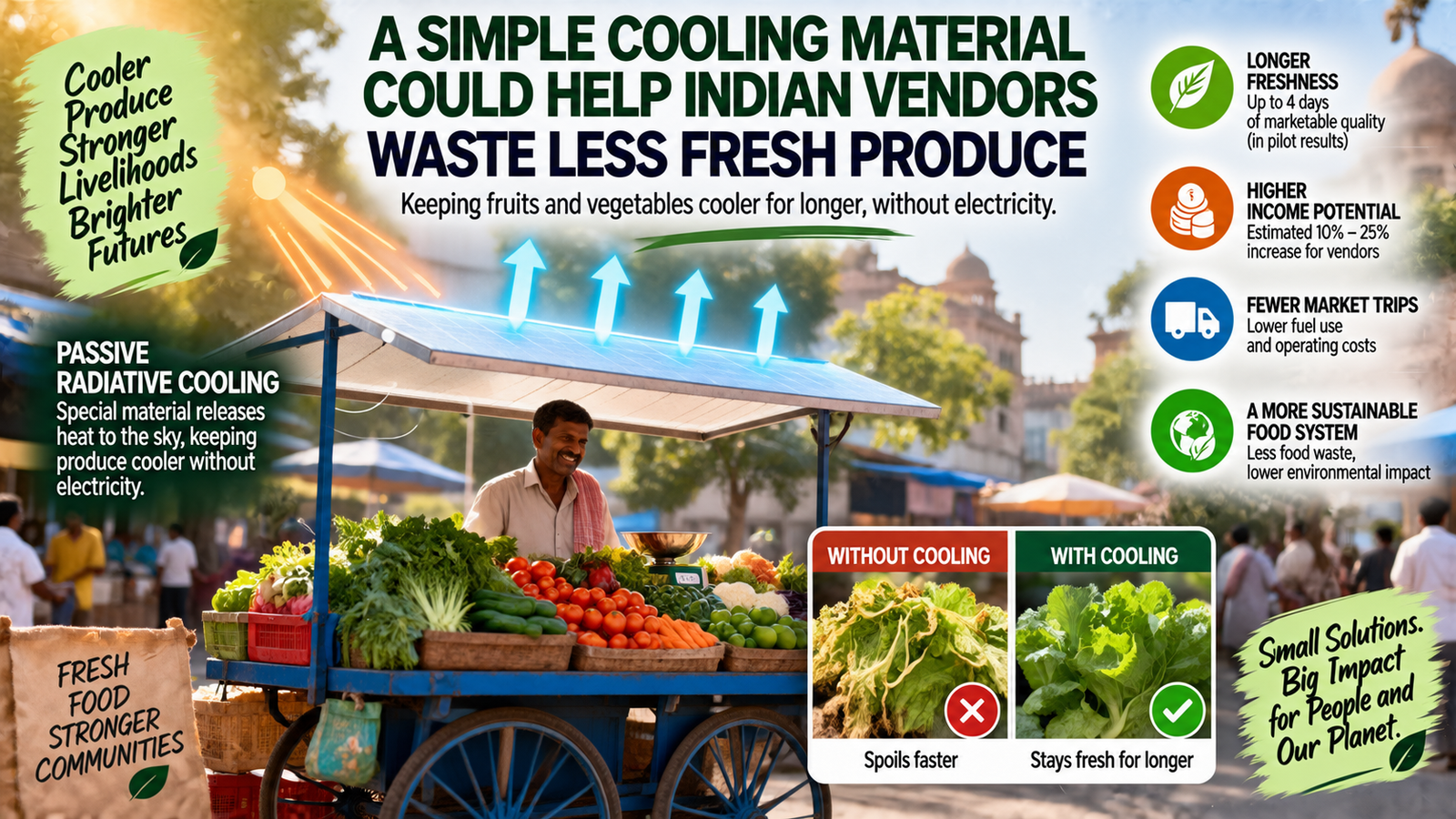
A new pilot in India is testing a surprisingly simple alternative: cool the vending cart itself without using electricity.
On September 25, Japanese company SPACECOOL Inc. announced the deployment of its passive radiative cooling material on fruit and vegetable vending carts in India. The project aims to keep produce cooler for longer, reduce spoilage and help small vendors protect their income during periods of increasing heat.
The technology does not use a compressor, battery or conventional refrigeration system.
That is what makes the story interesting.
The Problem Starts After the Harvest
Producing food is only half the challenge.
Once fruits and vegetables leave the farm, they remain vulnerable to heat throughout transportation, wholesale markets and retail.
Small vendors face an especially difficult situation. They may not have access to refrigerated storage, yet they still need to keep highly perishable products attractive and fresh throughout the day.
Leafy vegetables are particularly vulnerable.
When temperatures rise, they lose moisture and quality quickly. Anything that cannot be sold in time becomes a direct financial loss for the vendor.
The new cooling carts are designed around this very small but important point in the food chain.
Cooling Without Electricity
SPACECOOL uses radiative cooling, a passive technology that allows a surface to release heat as thermal radiation toward the sky.
The material can therefore cool surfaces without consuming electricity.
In the Indian pilot, the material has been incorporated into fruit and vegetable vending carts.
The objective is not to create a refrigerator on wheels.
Instead, it aims to reduce heat exposure around the produce enough to slow deterioration.
That distinction matters.
The technology is designed for places where conventional refrigeration may be too expensive, energy intensive or impractical.
Two Days Could Become Four
According to early results from the pilot, produce that would normally remain marketable for around two days under similar conditions has remained marketable for up to four days when stored using the cooling carts.
The strongest early benefits have appeared with green leafy vegetables, which are especially sensitive to heat.
That does not mean every type of fruit and vegetable will automatically gain four additional days of shelf life.
The result comes from an early pilot and depends on the surrounding conditions and produce involved.
The programme is continuing to monitor performance before wider commercial adoption.
But even a smaller improvement could matter considerably for a street vendor.
Less Spoilage Can Mean More Income
Food waste is often discussed at the household or supermarket level.
But for a small vendor, spoiled produce is also lost income.
If less stock goes unsold at the end of the day, the vendor can potentially keep more of the money already invested in purchasing that stock.
The project estimates that the cooling carts could contribute to a 10% to 25% increase in vendor income through reduced losses and improved business efficiency.
These are preliminary estimates rather than independently verified long-term income results.
The project will continue collecting evidence as more vendors use the technology.
There Is Another Benefit People May Not Notice
The cooling system could also reduce unnecessary trips to wholesale markets.
When produce lasts longer, vendors do not necessarily need to replace spoiled stock as frequently.
The project says participating vendors have reported fewer trips, which can reduce fuel consumption, travel time and operating costs.
This creates an interesting chain reaction:
Less heat → slower spoilage → less food waste → fewer replacement trips → lower operating costs.
A relatively small cooling technology can therefore influence several parts of a vendor’s business.
Why Passive Cooling Matters in India
India is experiencing increasing heat stress, and the impact extends beyond agriculture itself.
People who work outdoors or handle perishable products can face both health and economic risks when temperatures rise.
A conventional cooling system requires energy.
That can make it difficult to deploy across thousands of small businesses, particularly where electricity access, operating costs or maintenance create barriers.
Passive cooling works differently.
It tries to reduce heat without adding another electricity requirement.
The wider SPACES programme, under which the pilot operates, is specifically investigating affordable cooling technologies for vulnerable workers and micro-entrepreneurs across India and other emerging markets. It is supported by the Shell Foundation and the UK government’s Foreign, Commonwealth & Development Office through the Transforming Energy Access programme.
This Is Bigger Than a Cart
The technology could eventually have applications beyond street vending.
Passive radiative cooling materials can potentially be used in different outdoor and temporary settings where reducing heat without active refrigeration could provide an advantage.
That could include food handling, transportation, temporary storage and other parts of the agricultural value chain.
But the current Indian project is focused on something very practical:
helping small vendors keep fresh produce marketable for longer.
That makes it a useful test case.
Instead of beginning with a massive infrastructure project, the technology is being tested at the point where heat directly affects a person’s livelihood.
The Real Test Is Still Ahead
The current results are encouraging, but the project has not yet proved that the technology can transform India’s fresh produce supply chain.
The programme is now entering another monitoring phase.
Researchers and implementation partners will continue studying cooling performance, user comfort, productivity and income effects before wider adoption.
That evidence will matter.
A technology can work technically but still fail to scale if it costs too much, requires difficult maintenance or does not provide enough financial benefit to users.
The most important question therefore is not simply whether the material can cool a cart.
It is whether vendors find enough economic value in it to keep using it.
A Different Kind of Sustainable Innovation
Sustainable technology does not always need to look futuristic.
There is no autonomous robot here.
No giant AI model.
No complicated agricultural machine.
Instead, there is a material that uses a natural heat transfer process to solve a very ordinary problem.
That may actually be the most interesting part.
Millions of people around the world work with food in hot environments. If a relatively simple passive technology can help them reduce spoilage without increasing electricity consumption, its impact could extend far beyond one pilot.
The future of sustainable agriculture will depend not only on how we grow food.
It will also depend on how we keep that food valuable after it leaves the farm.
And sometimes, the solution may simply be to keep the food a little cooler.
Leave a Reply