
A Swiss agritech company has developed a technology that sounds almost too simple to be agricultural innovation.
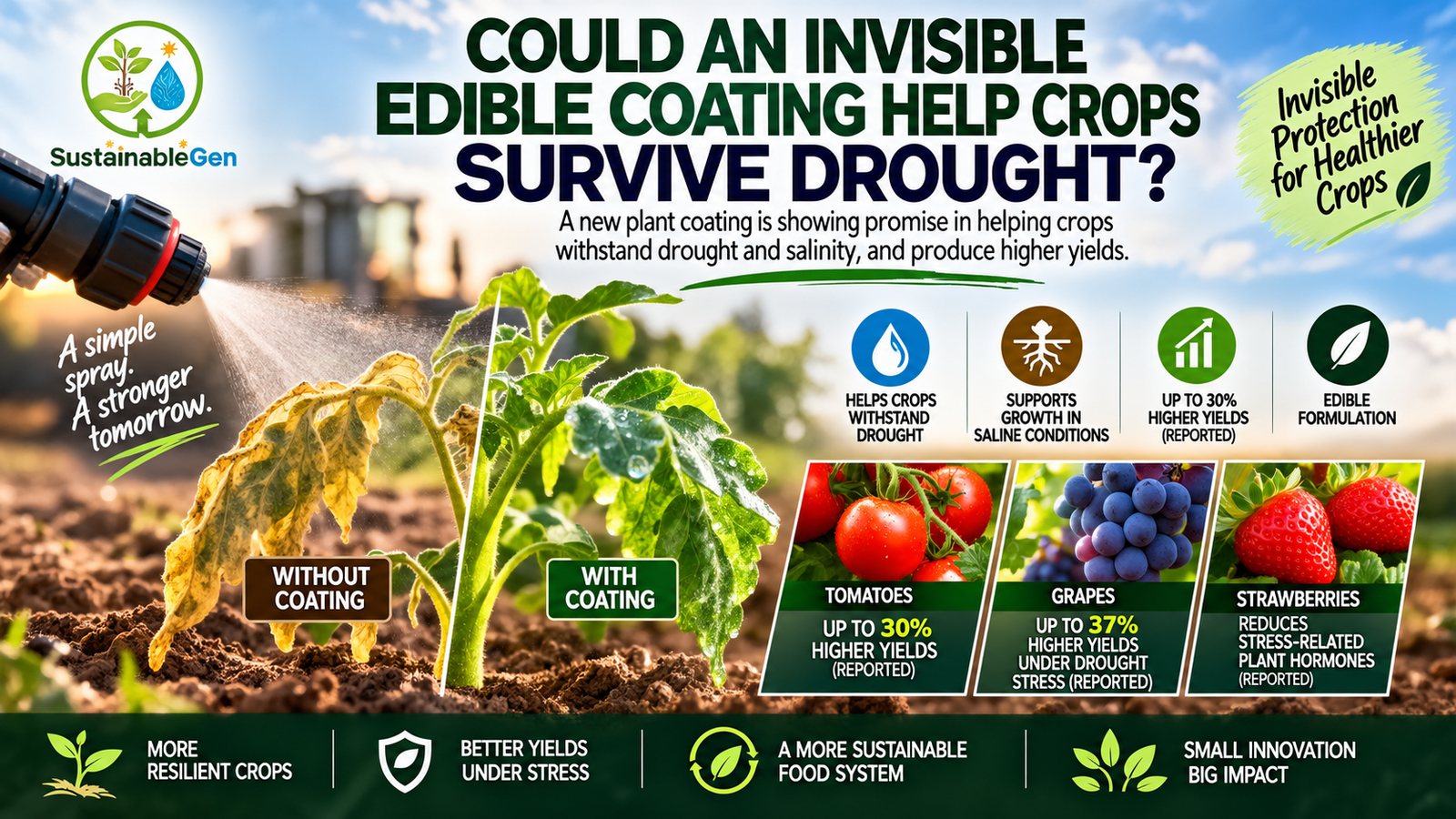
Spray a plant with an edible coating, and it forms an invisible barrier over the surface.
The technology, called Tornado, has just won the early-stage category of Tesco’s 2026 Agri-tech Challenge, announced on September 28. Developed by Swiss company AgroSustain, the coating is designed to help crops cope with environmental stresses such as drought and salinity. (tescoplc.com)
What makes this particularly interesting is that the technology does not try to change the plant.
It tries to protect the plant’s surface.
The Plant Gets Its Own Protective Layer
Plants already have a natural outer layer that helps control the movement of water and gases.
AgroSustain’s Tornado technology is designed to reinforce that protection.
When sprayed onto the crop, the formulation creates an invisible sealing layer over the plant surface. According to AgroSustain, this barrier can help plants cope with drought, salinity and other forms of environmental stress. (agrosustain.ch)
The company describes Tornado as a foliar sealing agent, meaning farmers apply it directly to the leaves and other above-ground parts of the plant.
There is no genetic modification involved.
There is no complicated machinery.
The concept is essentially about giving the plant a temporary additional layer of protection when growing conditions become difficult.
Why Would a Plant Need This?
During drought, plants lose water.
That sounds obvious, but the process becomes increasingly important as temperatures rise.
A plant has to balance water loss through its leaves with its ability to absorb water from the soil.
When the environment becomes hot and dry, that balance becomes harder to maintain.
Salinity creates another problem.
High salt concentrations around plant roots can make it more difficult for plants to absorb water and can interfere with normal physiological processes.
A technology that can reduce the stress experienced by the plant could potentially help crops remain productive during difficult periods.
That is the theory behind Tornado.
The important question is whether it works reliably in real fields.
Early Results Are Promising
AgroSustain says its trials have shown improvements in crop performance under stress.
The company reports that Tornado can increase yield by up to 30% in tomatoes, while its website reports an increase in grape yield of up to 37% under drought stress. It also reports reductions in stress-related plant hormones in strawberries. (agrosustain.ch)
These are company-reported results, not independent evidence that farmers everywhere should expect the same gains.
Crop response can vary with weather, variety, soil, irrigation and application conditions.
That distinction matters because agricultural technologies often perform differently once they move from controlled trials into commercial fields.
Still, the results were strong enough for Tornado to win Tesco’s early-stage competition.
Tesco Wants to See It on Farms
The prize is more than recognition.
AgroSustain will receive introductions to Tesco’s supplier network and an opportunity to conduct a trial with one of the retailer’s supply-chain partners. (tescoplc.com)
That could be important.
A technology designed to help crops withstand drought ultimately needs to prove itself under commercial growing conditions.
And Britain’s farmers have had plenty of difficult conditions to test it against.
Tesco’s latest farmer research found that 58% of surveyed farmers had adopted an innovation during the past year, up from the previous year.
But 76% said getting innovation onto farms remains difficult. (tescoplc.com)
That gap is significant.
Developing a technology is one challenge.
Getting farmers to actually use it is another.
The Timing Is Important
The technology arrives as farmers face increasingly unpredictable growing conditions.
Drought is not simply a problem for crops grown in deserts or traditionally dry regions.
Short periods of water stress during critical stages of growth can affect yields even in areas that normally receive substantial rainfall.
That makes technologies designed around stress management increasingly interesting.
Instead of trying to eliminate drought, the goal becomes helping the crop survive and remain productive when drought arrives.
That is a subtle but important change in agricultural thinking.
It Could Also Reduce Dependence on Other Treatments
AgroSustain says Tornado can reduce the need for some pre-harvest treatments while improving crop resilience. (agrosustain.ch)
But it would be premature to describe the product as a replacement for irrigation, fertiliser or crop protection.
A coating cannot create water where none exists.
Its value would come from helping the plant use the water it has more effectively or tolerate environmental stress for longer.
That makes it potentially complementary to other climate-adaptation practices rather than a standalone solution.
There Is an Interesting Food-Waste Connection Too
AgroSustain is also developing another technology called Afondo, an edible post-harvest coating.
Unlike Tornado, which is applied before harvest, Afondo is designed to protect harvested fruit and vegetables during storage and transport.
The company says the coating can reduce water loss and extend shelf life, helping reduce deterioration throughout the supply chain. (agrosustain.ch)
Together, the two technologies reveal an interesting strategy.
Protect the crop before harvest.
Then protect the food after harvest.
That tackles losses at two very different points in the agricultural system.
The Bigger Question Is Whether the Coating Can Scale
There is a reason today’s story is worth watching rather than simply celebrating.
Farmers need technologies that are affordable, easy to apply and reliable across different conditions.
A coating that works brilliantly in a controlled trial but performs inconsistently during unpredictable weather will struggle to gain adoption.
Farmers also need evidence about application frequency, long-term effects, compatibility with existing treatments and economics.
Tesco’s planned supplier trial could therefore be more important than the award itself.
It moves the technology another step toward the environment where it ultimately has to succeed.
Agriculture Is Learning to Protect Plants Differently
For decades, agricultural innovation often focused on giving crops more.
More water.
More fertiliser.
More pesticides.
More genetic traits.
Tornado represents a different idea.
What if we could help the plant hold on to what it already has?
That is a much smaller intervention, but potentially a powerful one.
The technology is still developing, and its commercial impact remains to be demonstrated at scale.
But if an edible, invisible coating can help crops withstand periods of drought and salinity without adding another major burden to the environment, it could become an interesting tool in the climate-adaptation toolbox.
Sometimes the future of farming does not look like a giant machine or a field full of sensors.
Sometimes it is something you cannot even see.
Leave a Reply