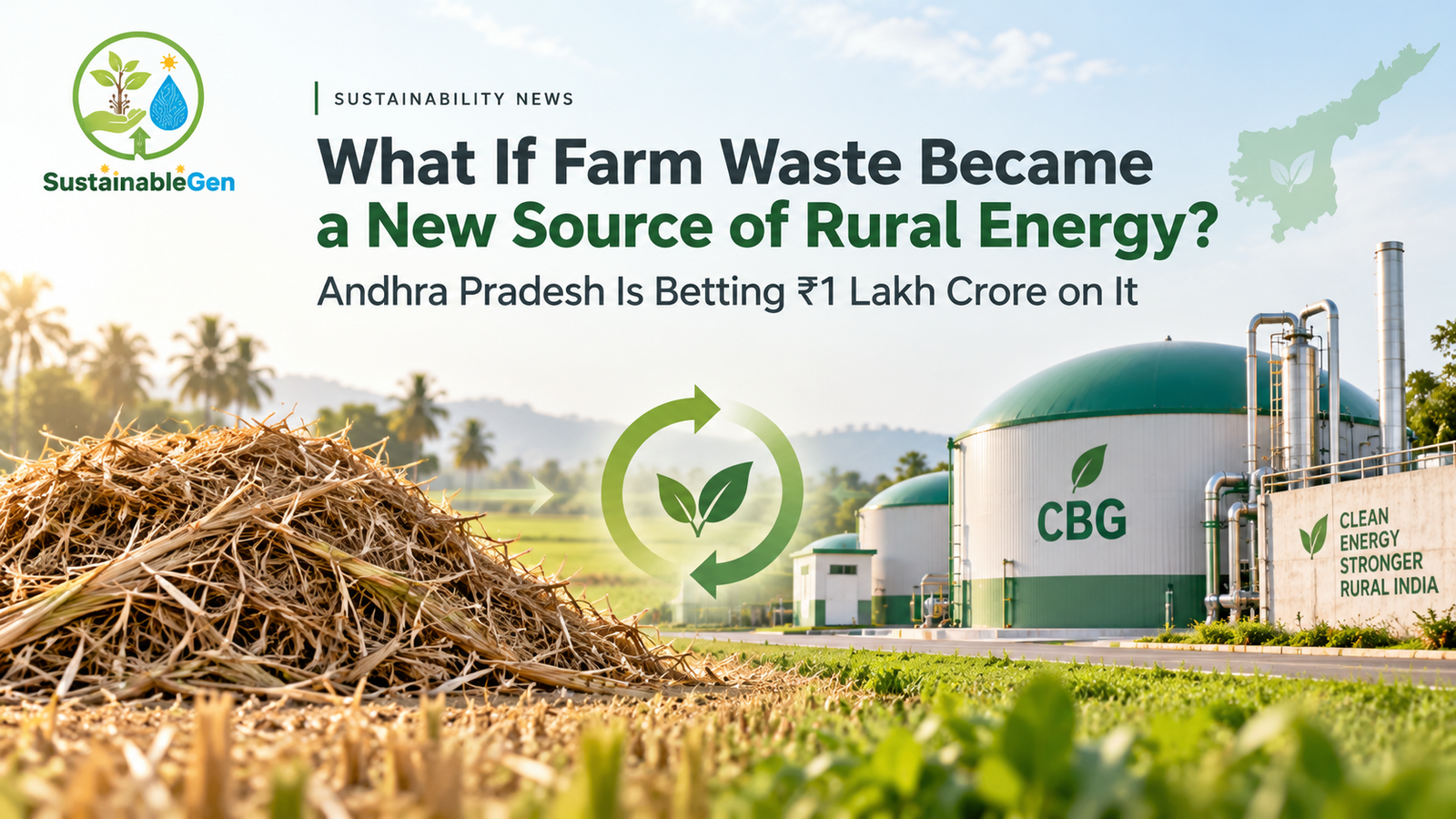
What if the stalks, crop residues, animal dung and other organic waste left behind after farming could become a fuel instead of a disposal problem?
Andhra Pradesh is preparing to test that idea on an enormous scale.
Reliance Industries has announced plans to invest ₹1 lakh crore in compressed biogas (CBG) plants across Andhra Pradesh, with the company saying the programme could create more than 3 lakh jobs and generate nearly ₹60,000 crore in state revenue over the coming decades. The announcement came on October 2 at the foundation stone ceremony for the Rayalaseema Horticulture Hub and Indian School of Agriculture in Madanapalle.
The interesting part is not simply the size of the investment.
It is the idea behind it.
Agricultural waste could become part of the energy economy.
Instead of seeing farm residues only as waste, the model aims to turn them into a commercial feedstock for renewable fuel.
From Farm Residue to Fuel
Compressed biogas is produced by processing organic material through anaerobic digestion.
Agricultural residue, animal dung, food waste and other biomass can be broken down to produce biogas. The gas can then be purified to create methane-rich compressed biogas that can serve as an alternative to conventional natural gas.
The process also produces a nutrient-rich by-product that can be used as bio-manure.
That creates an interesting loop:
Farm produces biomass → biomass becomes fuel → fuel replaces part of fossil gas use → digestion produces bio-manure → nutrients return to agriculture.
It is a much more circular way of looking at agricultural waste.
Why Andhra Pradesh?
The scale of agricultural activity in Andhra Pradesh gives the state a substantial biomass resource.
But the opportunity becomes particularly interesting in regions where agriculture and energy development can support each other.
Reliance has already been developing CBG infrastructure in the state.
Its earlier plan involved a network of 500 CBG projects, with an investment of ₹65,000 crore in Andhra Pradesh. The first project in Prakasam district received its foundation stone in 2025.
The new ₹1 lakh crore announcement therefore represents a significant expansion of the ambition.
It also fits into Reliance’s broader plan to build a large CBG platform across India. The company says it currently has dozens of plants under development and aims to expand to more than 500 CBG plants by 2030.
The Farmer Could Become Part of the Energy Supply Chain
This is where the story becomes more interesting for agriculture.
Farmers do not normally think of crop residue as an energy commodity.
A CBG network can potentially create a new market for biomass that otherwise has limited economic value.
That could give farmers another source of income while giving energy companies a locally available feedstock.
The model could also create demand for collection, transportation, storage and processing of agricultural residues.
That means the economic effect could extend well beyond the biogas plant itself.
It Could Also Address a Familiar Agricultural Problem
Crop residue management remains a major challenge in parts of India.
Farmers need to clear fields between cropping cycles, and burning residues can contribute to air pollution.
A reliable market for agricultural biomass changes the equation.
Instead of paying to dispose of residue, farmers could potentially sell it.
That does not automatically solve residue burning. Collection logistics, pricing, moisture levels and transportation costs all determine whether farmers actually find the system attractive.
But the creation of a large-scale buyer could change the economics.
CBG Is Not Just About Cars
Compressed biogas has properties similar to compressed natural gas and can potentially work within existing gas infrastructure.
It can serve transportation, industrial and commercial applications.
That makes the opportunity larger than simply producing electricity from agricultural waste.
The same feedstock can effectively enter the fuel market.
Reliance says its CBG already supplies green fuel to more than 40,000 vehicles daily through its retail network, while its bioenergy operations currently involve tens of thousands of farmers.
That existing experience could become important as the Andhra Pradesh programme expands.
There Is a Second Agricultural Transformation Happening at the Same Time
The CBG announcement came at the launch of the Rayalaseema Horticulture Hub and the Indian School of Agriculture.
The horticulture initiative aims to develop the drought-prone Rayalaseema region through modern agricultural infrastructure and technology.
The Indian School of Agriculture is intended to combine agricultural knowledge with newer tools such as AI, drones and digital technologies.
That creates an unusual combination.
One project is trying to modernise what farmers grow and how they grow it.
Another is trying to create value from what agriculture leaves behind.
If those systems eventually connect, agriculture could become both a food-producing system and a source of renewable industrial feedstock.
But ₹1 Lakh Crore Does Not Guarantee Success
The size of the announcement makes the story exciting, but it is important to separate a planned investment from money already deployed.
Reliance has announced the ₹1 lakh crore plan. The projected job creation and state revenue figures also come from the company’s announcement. They should therefore be treated as projections rather than guaranteed outcomes.
There are also practical questions.
Who will collect the biomass?
How far can it travel economically?
Who will own and operate the plants?
How much will farmers be paid?
Will removing crop residues affect soil health in some farming systems?
Can plants maintain reliable feedstock supplies throughout the year?
These questions will determine whether the circular-economy model works beyond the headline investment figure.
The Soil Question Matters
Not all crop residue should simply disappear from a field.
Some residues help return organic matter and nutrients to soil.
If farmers remove too much biomass without replacing those nutrients, the long-term health of the soil could suffer.
That means a successful biomass economy needs to distinguish between waste that can be harvested and material that should remain in the field.
This is where agricultural science becomes essential.
The goal should not be to remove every available stalk from a farm.
The goal should be to use the portion that can be sustainably collected while protecting the productivity of the land.
A Different Way to Think About Agricultural Waste
For years, agriculture has been described as part of the climate problem because of emissions, residue burning, livestock waste and resource consumption.
But agriculture also produces enormous quantities of biological material.
The real opportunity lies in deciding which of that material should be treated as waste and which can become a resource.
CBG offers one possible answer.
Waste becomes feedstock.
Feedstock becomes fuel.
Fuel creates a market.
The processing cycle produces another agricultural input.
That is the circular economy in a form that farmers can actually participate in.
Andhra Pradesh Could Become a Test Case
The coming years will show whether the model can work at the scale now being proposed.
If it does, Andhra Pradesh could demonstrate how agricultural communities can participate in India’s transition toward renewable fuels without moving away from farming.
If the economics fail, however, the enormous investment alone will not be enough.
The real measure of success will be much simpler:
Can a farmer make money from something that was previously treated as waste, while the soil, air and surrounding agricultural system remain healthier?
That is the experiment now beginning in Andhra Pradesh.
And if it works, the next energy resource for India’s rural economy may not come from somewhere underground.
It could come from the farm itself.
Leave a Reply