

A diesel truck can refuel in minutes. An electric truck, especially one carrying heavy cargo across long distances, may need considerably more time to recharge.
That difference has become one of the biggest obstacles to electrifying freight transportation.
Now, Chinese battery manufacturer CATL is introducing a solution that could change how electric trucks operate.
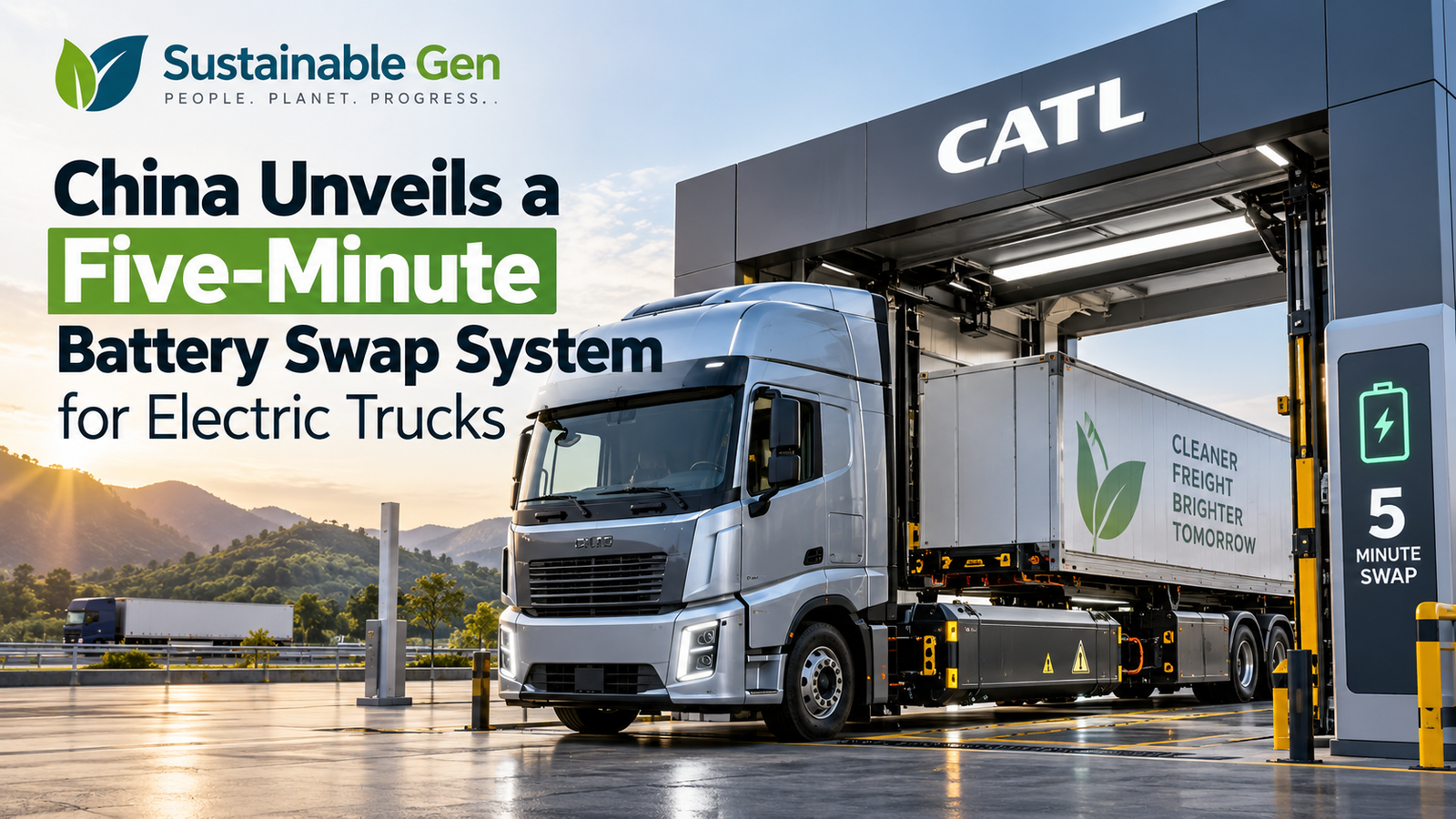
On 20 October 2026, the company unveiled a new dual-battery system for heavy-duty trucks alongside an upgraded battery-swapping network. The technology allows operators to replace a depleted battery in approximately five minutes, potentially reducing one of the biggest operational disadvantages of electric freight.
The announcement also includes an ambitious expansion plan, with CATL targeting 900 heavy-truck battery-swapping stations across China by the end of 2026.
The idea is straightforward but potentially significant. Instead of making truck drivers wait for batteries to recharge, why not replace the battery and let the vehicle continue its journey?
Why Heavy Trucks Are Difficult to Electrify
Electric cars have become increasingly common, but heavy-duty trucks present a different challenge.
A freight truck may travel hundreds of kilometres daily while carrying tonnes of goods. Its operators need reliable range, predictable schedules and minimal downtime.
Unlike passenger cars, commercial trucks cannot always afford to spend long periods charging between journeys.
Large batteries also add weight, which can reduce the amount of cargo a vehicle carries.
These challenges become even more important for logistics companies that operate large fleets across highways, ports and industrial regions.
Electric trucks already work well for certain applications, particularly where routes are predictable and charging infrastructure is available.
Long-distance transport remains more complicated.
CATL’s latest system attempts to address that problem by changing how trucks store and replenish electricity.
Two Batteries Instead of One
The company calls its new technology the Dual-Electric Range Extension Battery.
Rather than relying on a single battery pack, the system combines two independent batteries with different responsibilities.
The main battery sits beneath the truck chassis and can be removed and replaced at a swapping station.
A smaller 77 kWh battery remains installed behind the driver’s cab.
That second battery provides backup power when the main battery approaches depletion.
The system can switch between the two batteries rapidly, allowing the truck to continue operating while using more of the main battery’s available capacity.
This addresses an issue that fleet operators often face.
Drivers may return to charging or swapping stations while their batteries still contain substantial energy because they cannot risk running out of power before reaching the next station.
CATL says its dual-battery design allows operators to increase the usable discharge of the main battery from around 70% to more than 95%.
That could help companies make better use of the battery capacity they already pay for.
The Five-Minute Battery Swap
The other major development is CATL’s upgraded QIJI battery-swapping system.
At a compatible station, a truck can exchange its depleted battery for a charged one in approximately five minutes.
This means the driver does not need to remain parked while the same battery receives electricity.
The depleted battery can charge separately at the station, ready for another vehicle.
For commercial freight operators, this approach could help reduce downtime and make electric trucks easier to integrate into existing logistics schedules.
CATL has also introduced standardised swappable battery packs with capacities of 432 kWh and 513 kWh.
Standardisation is important because battery swapping becomes much more practical when different compatible vehicles can use the same infrastructure.
Without compatible battery designs, operators would need separate swapping equipment for different truck models, making the system more expensive and difficult to expand.
China Is Planning a Much Larger Network
The technology becomes more useful when drivers can find swapping stations along their regular routes.
That is why CATL’s infrastructure plans matter almost as much as the battery design itself.
The company aims to expand its network to 900 heavy-truck swapping stations by the end of 2026, followed by 2,000 stations in 2027.
Its longer-term ambition is to establish a network of approximately 10,000 stations across China with industry partners.
These are expansion targets, not stations that have all been completed.
CATL also announced agreements covering around 13,000 vehicles during the launch event, reflecting commercial interest in the technology.
If the network develops as planned, electric trucks could become a more practical option for companies operating between major industrial centres, warehouses and freight terminals.
Why This Matters for Sustainable Transportation
Road freight plays an essential role in the global economy.
Almost everything people buy travels by truck at some stage, whether it is food, construction materials, clothing or electronic equipment.
Much of this transportation still depends on diesel.
Diesel engines produce carbon dioxide and air pollutants, including nitrogen oxides and fine particles that affect air quality.
Electric trucks eliminate exhaust emissions during operation.
When charging electricity comes from increasingly cleaner power systems, they can also substantially reduce lifecycle greenhouse gas emissions.
Battery swapping could help accelerate that transition by addressing a problem that has limited electric truck adoption.
Rather than asking logistics companies to redesign their operations around long charging stops, the technology attempts to make electricity replenishment fit existing commercial schedules.
A New Business Model for Truck Operators
The development is not only about charging speed.
CATL is also promoting a model in which fleet operators can lease swappable batteries instead of purchasing every battery outright.
This could reduce the upfront cost of electric trucks, since large batteries represent a significant share of vehicle costs.
Fleet operators could also adjust battery arrangements according to transport demand.
For companies managing hundreds of trucks, even relatively small changes in downtime, battery utilisation and operating costs can influence whether electrification makes financial sense.
CATL says its new standardised battery components could also reduce costs compared with earlier designs.
However, actual savings will depend on battery rental prices, electricity costs, vehicle utilisation and the availability of suitable swapping infrastructure.
Could Battery Swapping Work Outside China?
China has become an important testing ground for electric heavy-duty transport.
Its large domestic battery manufacturing industry, extensive logistics networks and investment in electric vehicles provide conditions that can support technologies such as battery swapping.
CATL is also exploring international opportunities.
Reuters reported that the company has announced a preliminary collaboration with DHL Group to examine green freight corridors in Europe using electric trucks.
That could eventually help test whether similar solutions make sense in other markets.
But international expansion will require cooperation between vehicle manufacturers, battery suppliers, infrastructure operators and logistics companies.
Different vehicle designs, transport regulations and commercial conditions could make standardisation more difficult outside China.
The Challenges Are Still Significant
Battery swapping is promising, but it does not eliminate every problem associated with electric freight.
Building a large swapping network requires substantial investment.
Stations need reliable electricity connections, land, maintenance systems and enough charged batteries to serve demand.
Keeping additional batteries at swapping stations also increases the amount of battery material required by the system.
The environmental benefits will depend on how efficiently those batteries are used and how they are manufactured, maintained and eventually recycled.
Operators must also ensure that batteries remain compatible with different truck models and future technology generations.
A system that looks efficient on a busy freight corridor may be less economical on routes with relatively few vehicles.
These challenges will determine whether battery swapping becomes a mainstream logistics solution or remains concentrated in specific transport networks.
What Comes Next?
CATL’s immediate priority is expanding the QIJI network and bringing the new battery technology into commercial fleet operations.
The company’s agreements with logistics businesses suggest that the technology is moving beyond an isolated engineering demonstration.
However, its ambitious station targets will require rapid infrastructure development and sustained commercial demand.
The coming years will reveal whether battery swapping can compete effectively with increasingly powerful fast-charging systems.
Both approaches may eventually serve different types of freight operations.
What matters most is whether they make zero-exhaust-emission transport reliable and economically attractive enough for businesses to adopt at scale.
Key Takeaway
Electrifying freight transportation requires more than building trucks with bigger batteries.
Logistics companies need systems that minimise downtime, control costs and keep vehicles moving.
CATL’s five-minute battery-swapping technology offers an alternative to waiting for large batteries to recharge.
Its success will depend on infrastructure, economics and reliable commercial operation.
But the development points toward an important shift in clean transportation.
The future of electric trucks may depend just as much on how quickly they receive energy as on how far they can travel.
Leave a Reply