

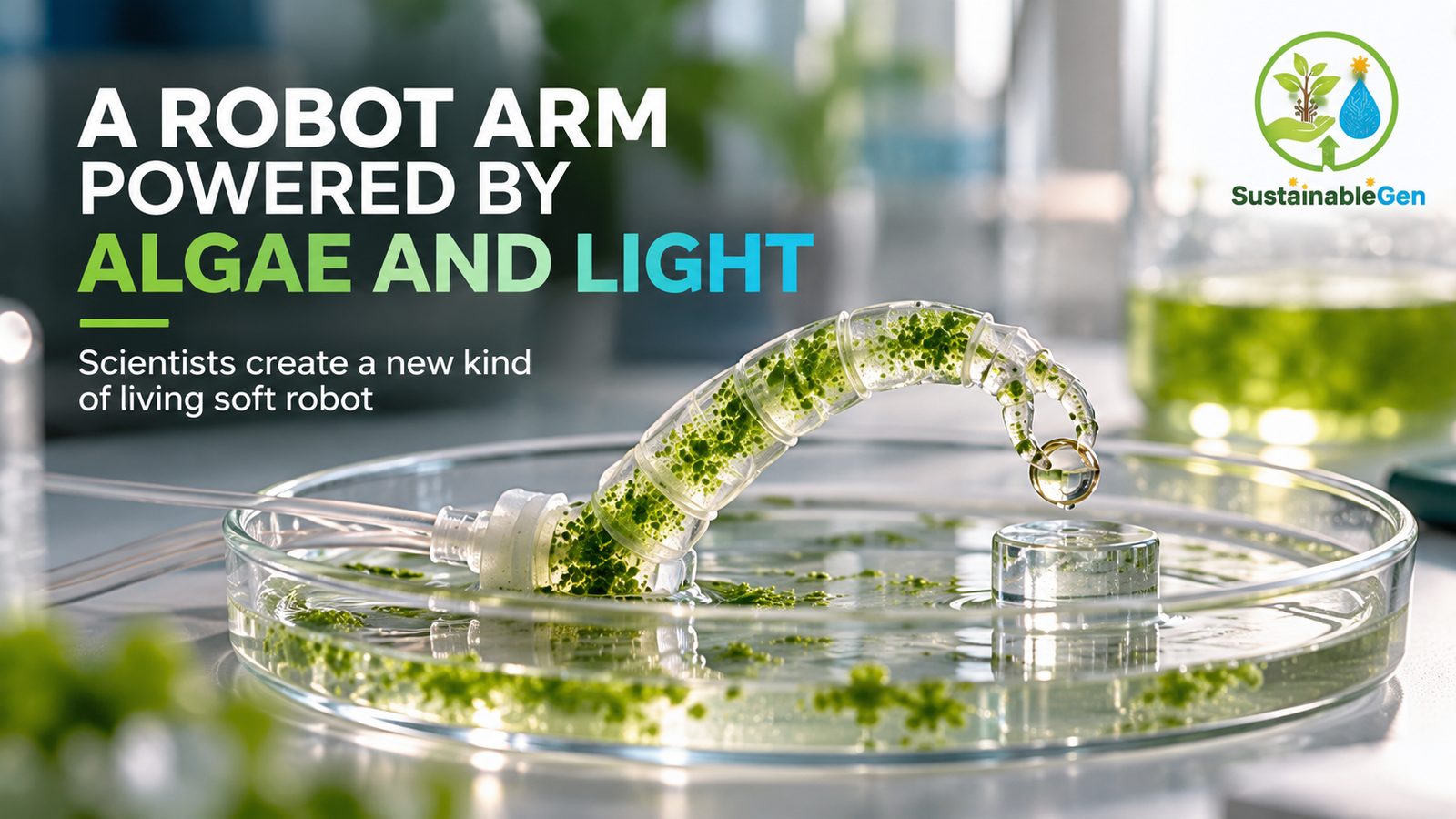
Imagine a robot that doesn’t need a conventional motor to move. Instead, it responds to sunlight, bends its body and gently picks up objects underwater.
It sounds like science fiction, but researchers in the Netherlands have demonstrated something remarkably close.
Scientists at Delft University of Technology (TU Delft) have developed a tiny robotic arm that uses living microalgae and light to generate movement.
The research, published in Nature Communications on 22 October 2026, introduces a new approach to soft robotics by combining living microorganisms with responsive materials.
The robot can grasp and lift small objects simply by changing the amount of light it receives.
Although the technology remains experimental, it raises a fascinating question: Could future machines use biological processes instead of conventional motors to perform certain tasks?
A Robot That Moves Without a Conventional Motor
Most robots depend on electrical motors, mechanical components and electronic control systems.
These components provide precise movement, but they can also make machines complex, rigid and energy intensive.
Soft robotics takes a different approach.
Instead of relying entirely on hard mechanical parts, researchers develop flexible structures that can bend, stretch and change shape.
TU Delft’s latest experiment goes one step further.
The researchers incorporated living algae into a flexible material, allowing the biological activity of microorganisms to control its movement.
The result is a small, green robotic arm that bends in response to changes in light.
The experimental device measures approximately two centimetres in length and just one millimetre in thickness.
Despite its small size, it can perform controlled bending movements and manipulate lightweight objects underwater.
The Secret Lies in Living Microalgae
The robotic arm contains two layers of hydrogel, a soft material capable of absorbing water and changing its shape.
Researchers placed microscopic algae on the material’s surface.
These algae use photosynthesis to produce energy from light, much like plants.
When light reaches the algae, their metabolic activity changes the surrounding chemical environment.
More specifically, the process alters the pH level inside the hydrogel.
The two hydrogel layers respond differently to this change.
One layer expands more than the other, forcing the material to bend.
When researchers switch off the light, the algae’s metabolism changes again. The pH begins to return toward its previous level, and the material bends in the opposite direction.
This creates a reversible movement that scientists can control using light.
The interesting part is that the movement comes from biological activity rather than a conventional electric motor.
The Robot Can Actually Pick Up Objects
The research team did not stop at demonstrating a bending strip.
Led by researcher Marie-Eve Aubin-Tam, with Fan Jiang as the study’s first author, the scientists designed experimental structures that could manipulate objects.
In one demonstration, the device hooked and lifted a small rubber ring.
In another, it grasped a small metal ball and released it when lighting conditions changed.
The experiments demonstrate how a biological response can translate into mechanical movement.
When researchers switched the light off, the actuator began bending in the opposite direction within approximately 10 seconds.
That does not mean the robot can complete every movement in ten seconds. The complete grasping demonstrations took longer and were shown in accelerated videos.
Still, the ability to trigger movement by simply adjusting light represents an interesting advance in biohybrid materials.
Why This Matters for Sustainable Technology
The development is exciting because it explores a different relationship between machines and energy.
Conventional robotic systems generally need an external energy source to operate their motors and control mechanisms.
This experimental actuator uses living algae that obtain energy through photosynthesis.
In principle, such systems could perform simple movements with relatively little external energy input.
The researchers believe this approach could eventually contribute to soft robotic systems that respond directly to their surroundings.
A material might change its shape when sunlight increases, for example, without requiring a conventional motor to produce that movement.
However, the study has not demonstrated that an algae-powered robot consumes less energy across its complete lifecycle than existing technologies.
That remains a question for future research.
Could Living Robots Find Applications in Agriculture?
Agriculture is one possible area where responsive materials could become useful.
Modern farms increasingly rely on sensors, automation and equipment that adjusts to changing environmental conditions.
A material that responds naturally to light could potentially help create agricultural devices that change their orientation or shape throughout the day.
Researchers have suggested applications such as light-responsive shading systems or other agricultural structures.
Imagine a protective covering that adjusts its position as sunlight changes, helping regulate exposure without relying entirely on motors.
That is a possible future direction, not something the current algae robot can already do.
For now, the team has demonstrated a small actuator in a controlled aquatic environment.
Turning the underlying mechanism into practical agricultural equipment would require extensive additional engineering.
Underwater Robotics Could Be Another Opportunity
Soft robots are particularly interesting for underwater environments.
Rigid robotic equipment can sometimes damage fragile objects when gripping or moving them.
Flexible materials offer the possibility of gentler interaction.
A small actuator that responds to light could eventually become part of devices that manipulate delicate underwater samples or work in environments where conventional mechanical systems are difficult to operate.
The Delft researchers have already demonstrated basic grasping and lifting.
But practical underwater applications would need improvements in movement speed, force, durability and control.
A two-centimetre laboratory device cannot yet replace conventional underwater robots.
The Biggest Challenge Is Keeping the System Alive
Using living organisms inside technology introduces a new set of problems.
Microalgae need suitable environmental conditions to remain active.
Their performance can depend on water chemistry, temperature, light availability and nutrient conditions.
A device that relies on living cells must maintain those cells throughout its operating life.
Researchers also need to understand how reliably the actuator performs after repeated movement cycles.
If the algae become unhealthy or the hydrogel loses its responsiveness, the robot’s performance could decline.
Scaling the technology into larger or more complex systems will create additional challenges.
These limitations mean the current research is best understood as a proof of concept rather than a commercially ready robotic product.
The Future of Robotics Could Be Partly Alive
What makes this discovery particularly interesting is the way it challenges our traditional understanding of a machine.
Robots usually imitate biological movement through mechanical engineering.
This technology incorporates living biology directly into the mechanism that produces movement.
Instead of building an artificial system that imitates photosynthesis, the researchers let actual photosynthetic organisms perform part of the work.
That opens possibilities for developing materials that respond to their environment in more natural ways.
Future research could explore living materials that react to changes in light, temperature or other environmental conditions.
Such systems might eventually contribute to environmental monitoring, soft robotics or adaptive structures.
But the science is still in its early stages.
Key Takeaway
TU Delft’s algae-powered robotic arm demonstrates how living organisms and engineered materials can work together to produce controlled movement.
The researchers have shown that a small hydrogel structure covered with microalgae can bend, grasp and release objects in response to light.
It is not yet a practical agricultural or industrial robot, but it provides an intriguing foundation for future biohybrid technologies.
The bigger lesson goes beyond robotics.
The next generation of sustainable technology may not always involve building machines that imitate nature. Sometimes, it may involve allowing nature to become part of the machine itself.
Leave a Reply