

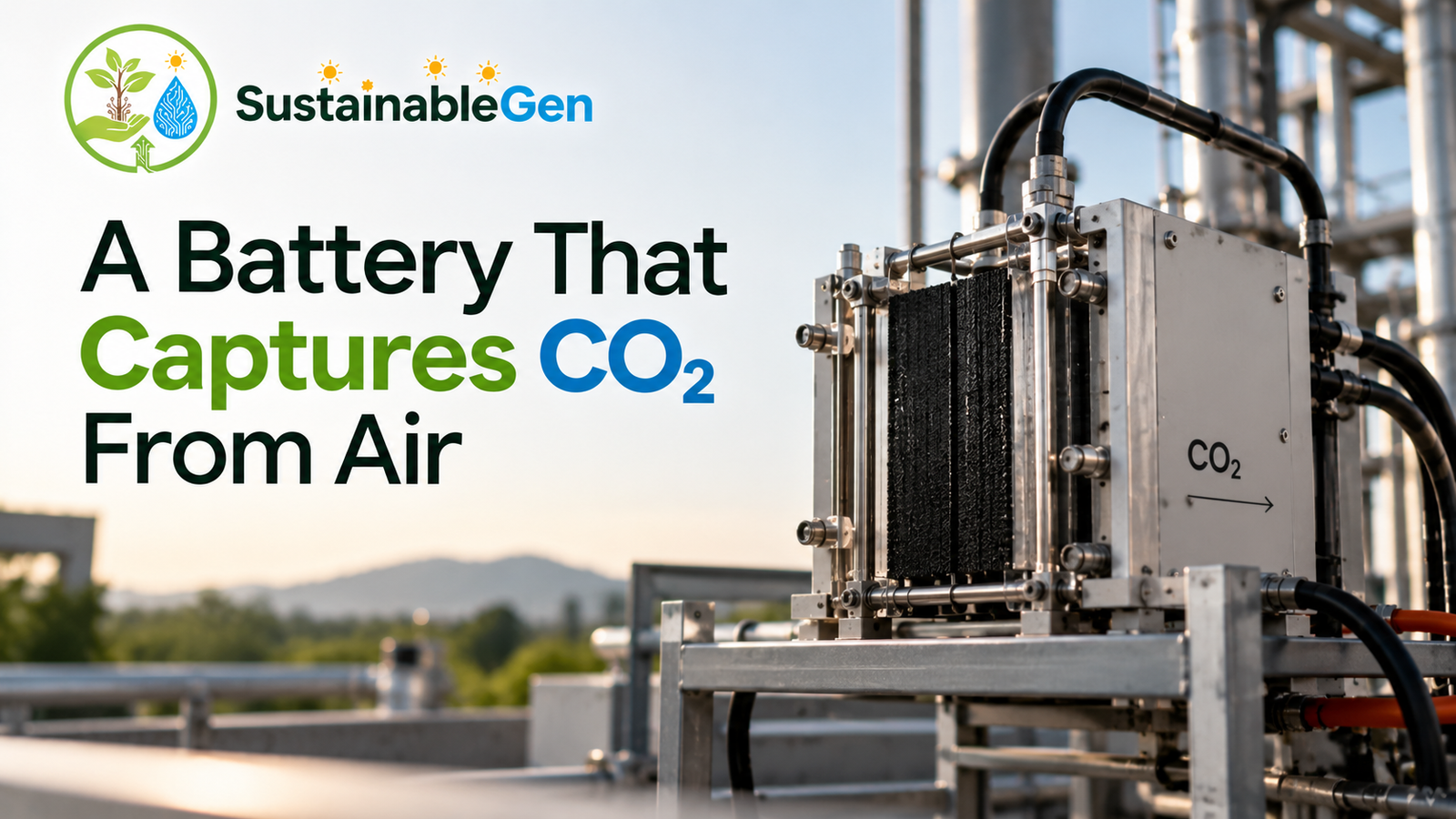
Imagine a machine that captures carbon dioxide from the atmosphere using the same basic chemistry found in rechargeable batteries.
Instead of relying on large amounts of heat to separate CO₂ from the air, the machine uses electricity to capture the gas and release it in a concentrated form.
Researchers at the University of Delaware, working with carbon-capture company RepAir Carbon, have demonstrated exactly this approach.
The team developed a battery-inspired carbon-capture system that uses approximately 50% less energy than conventional technologies, according to a university research update published on October 26, 2026.
The technology has already passed an important test: researchers operated a laboratory device for 5,000 hours and demonstrated a larger pilot-scale system.
It is not yet a commercial solution for removing carbon emissions at a global scale, but the development could help address one of carbon capture’s biggest problems: the energy required to make it work.
The Problem With Capturing CO₂ From Air
Carbon dioxide is one of the main greenhouse gases driving climate change.
Reducing emissions from electricity generation, transportation, industry and agriculture remains essential. However, scientists are also exploring ways to remove some of the CO₂ already present in the atmosphere.
One approach is called Direct Air Capture, or DAC.
These systems pull in ordinary air and separate carbon dioxide from the other gases.
The difficulty is that atmospheric CO₂ exists at a relatively low concentration.
Capturing it requires moving large quantities of air through specialised equipment, then using energy to separate and collect the gas.
Many existing technologies use heat to release captured CO₂ from chemical materials so those materials can be reused.
That heating process can consume substantial energy, making large-scale carbon removal expensive.
The Delaware researchers wanted to investigate whether electricity could perform the same job more efficiently.
How the Battery-Powered System Works
The new technology uses nickel hydroxide, a material already associated with rechargeable battery chemistry.
The researchers designed a device with two electrodes separated by a specialised membrane.
When electricity flows through the system, chemical reactions create conditions that allow carbon dioxide to enter the device and become temporarily trapped.
On the opposite side, the system releases a concentrated stream of CO₂ that operators can collect.
By reversing the electrical current, the device switches the roles of its electrodes, allowing the process to continue.
The important difference is that the system does not need the conventional heating step used by many carbon-capture technologies.
Instead, electrical energy drives the capture and release process.
That opens the possibility of operating carbon-removal systems using renewable electricity without requiring large amounts of additional thermal energy.
The Researchers Tested It for More Than 5,000 Hours
A promising laboratory experiment means little if the equipment stops working after a few days.
That is why durability became a major focus of the research.
Scientists operated a small battery-style carbon-capture cell for more than 5,000 hours, demonstrating that the system could continue functioning over an extended period.
The team also developed a larger arrangement containing nine electrochemical cells.
During a 48-hour pilot-scale test, the system consumed approximately 0.83 megawatt-hours of electricity per tonne of CO₂ captured.
That is significantly lower than the energy requirements reported for many conventional direct-air-capture systems.
The results appeared in the peer-reviewed journal Nature Energy in September 2026, while the University of Delaware released a detailed research update this week.
These figures demonstrate promising technical performance, although they do not represent the total energy use of a fully integrated commercial carbon-capture facility.
Why Lower Energy Consumption Matters
Carbon capture faces an economic challenge.
Even if a technology successfully removes CO₂, companies still need to pay for electricity, equipment, maintenance and the eventual transportation or storage of the captured gas.
Energy can represent a substantial share of those costs.
If researchers can reduce the electricity required to capture each tonne of CO₂, the technology could become more economically attractive.
The Delaware team believes its approach could eventually help bring direct-air-capture costs closer to $100 per tonne of CO₂.
That figure remains a future cost target based on technological development and scaling assumptions, not a price the system has already achieved commercially.
Lower costs could make carbon removal more accessible to industries that struggle to eliminate every emission through conventional measures.
Could the Captured Carbon Become Useful?
Once the system separates CO₂ from the air, operators need to decide what happens to it.
One possibility is permanent storage, where captured carbon dioxide enters suitable geological formations and remains isolated from the atmosphere.
Another possibility involves using the CO₂ as an industrial raw material.
Researchers are exploring applications ranging from chemical production to synthetic fuels and other carbon-based products.
However, using captured CO₂ does not automatically produce permanent carbon removal.
If a company converts the gas into fuel and burns that fuel, the carbon eventually returns to the atmosphere.
Permanent climate benefits depend on the full lifecycle of the captured carbon.
That distinction matters when evaluating any carbon-capture technology.
The Technology Is Moving Beyond the Laboratory
The research team has already taken steps toward commercial development.
RepAir Carbon, a company working with the University of Delaware, has developed the technology into a pilot-scale system in Israel.
The collaboration brings together university research with engineering work focused on manufacturing, durability and larger-scale operation.
This is an important transition.
Many carbon-capture technologies perform well in small laboratory experiments but encounter problems when developers scale them up.
RepAir and the university still need to demonstrate long-term operation in complete systems, including air handling, CO₂ purification, compression and storage.
Those additional processes influence both energy consumption and overall cost.
Carbon Capture Is Not a Replacement for Cutting Emissions
The technology offers an interesting opportunity, but it is important to understand its limitations.
Removing CO₂ from the atmosphere cannot replace reducing emissions from fossil fuels.
A carbon-capture system also needs energy, materials and supporting infrastructure.
Its environmental performance depends on where that energy comes from and what happens to the captured carbon afterward.
If the electricity comes from high-emission sources, some of the climate benefit could disappear.
That is why researchers see direct air capture as a potential complement to emissions reduction rather than a reason to delay it.
What Comes Next?
The next challenge is proving that the battery-inspired system can operate reliably and economically at much larger scales.
Researchers will need to demonstrate consistent performance across thousands of cells, reduce manufacturing costs and integrate the technology with systems that permanently store or responsibly use the captured CO₂.
The University of Delaware and RepAir have already made progress on durability and pilot-scale testing.
Whether that progress translates into commercially competitive carbon removal will become clearer as larger systems enter operation.
Still, the research highlights an important shift.
Scientists are no longer exploring only how to capture carbon dioxide.
They are also rethinking the fundamental chemistry behind the process to make it more efficient.
Key Takeaway
Carbon capture has long faced a difficult problem: removing CO₂ from the atmosphere often requires substantial amounts of energy.
The University of Delaware’s battery-inspired system offers a promising alternative by using electricity instead of conventional heating to capture and release carbon dioxide.
The technology remains under development, but its laboratory durability and pilot-scale performance suggest that electrochemical carbon capture deserves serious attention.
Sometimes, the next step in climate innovation comes not from building a bigger machine, but from finding a smarter way to make the chemistry work.
Leave a Reply