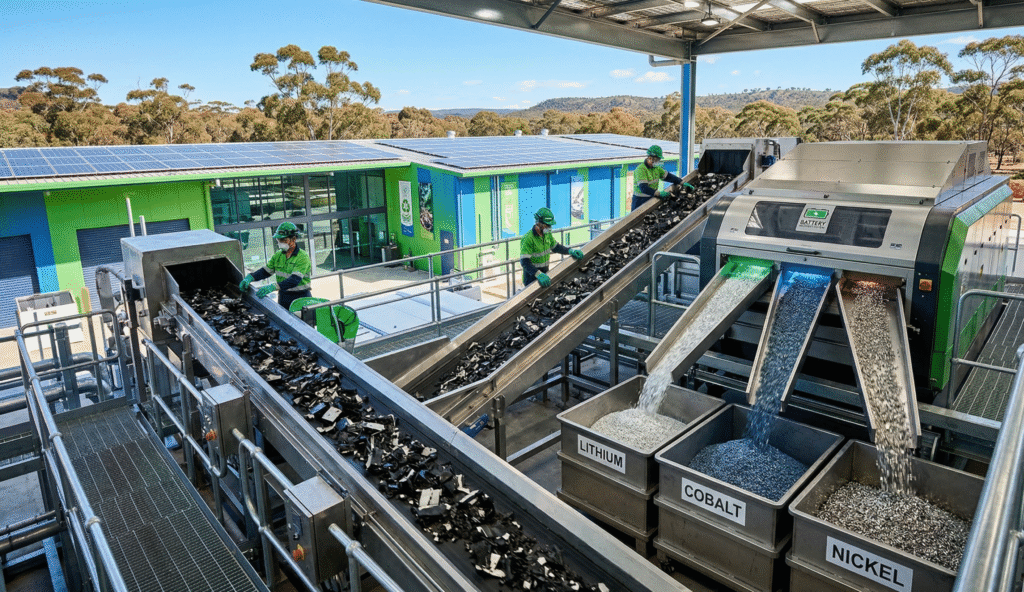
Australia is stepping up its response to a rapidly growing environmental challenge. With the rise of electric vehicles, renewable energy storage, and consumer electronics, lithium-ion battery use has surged. Now, researchers across the country are receiving significant funding to develop advanced recycling solutions that can manage this wave of battery waste in a sustainable way.
The Rising Challenge of Battery Waste
Lithium-ion batteries have become essential to modern life. They power everything from electric cars to solar energy storage systems. However, their relatively short lifespan means they quickly turn into waste once they reach the end of their use.
Australia is expected to generate nearly 180,000 tonnes of battery waste every year by 2036. This creates serious environmental concerns if not handled properly.
When disposed of incorrectly, these batteries can leak harmful chemicals into soil and water. At the same time, extracting fresh lithium and other metals puts pressure on natural resources and ecosystems. Recycling offers a practical solution by recovering valuable materials such as lithium, cobalt, and nickel, reducing the need for new mining.
Major Recycling Projects Driving Change
To address this issue, several research institutions and companies are working on innovative recycling technologies with the help of government funding.
At Griffith University, Dr. Zhenzhen Wu is leading a project supported by a 280,000 dollar AEA Seed Grant. The focus is on improving battery recycling technologies in collaboration with ENVIROforce.
The University of New South Wales is also playing a key role. A team led by Professor Guan Yeoh has received 2.7 million dollars to develop a micro-isolation process for extracting valuable materials from what is known as black mass. This project is being carried out in partnership with Oxleigh.
Another major initiative involves the Oxleigh CRC-P project, which has secured 2.75 million dollars to build local, sustainable recycling capabilities. This effort brings together UNSW and Envirostream to strengthen Australia’s recycling infrastructure.
Livium has also received 850,000 dollars in funding from the Western Australian Government. The company is developing a collection and sorting facility to improve how used batteries are handled and processed.
Together, these projects are helping scale up safe and efficient methods to process shredded battery materials.
Sustainability and Economic Benefits
Battery recycling is not only an environmental necessity but also an economic opportunity. By recovering critical materials, Australia can reduce its reliance on imported resources and strengthen its supply chain.
New facilities are already creating jobs in the green economy. For example, a recycling plant in Newcastle is expected to handle around 2,000 tonnes of battery waste each year while generating approximately 20 new jobs.
Advanced sorting technologies are also making a difference. They can increase material recovery rates by up to 30 percent, making recycling more efficient and cost-effective. This supports the development of a circular economy, where resources are reused instead of discarded.
The Road Ahead
Collaboration between researchers, industry leaders, and policymakers is key to solving the battery waste problem. Continued investment in technologies such as membrane separation and chemical processing will help bring these solutions to a commercial scale.
Government support through grants and funding programs is accelerating progress. With these efforts, Australia is positioning itself as a global leader in sustainable battery recycling.
Conclusion
Australia’s approach to lithium-ion battery waste shows how innovation and collaboration can tackle complex environmental challenges. As battery use continues to grow, developing efficient recycling systems will be critical for protecting the environment and ensuring long-term resource security.
Leave a Reply