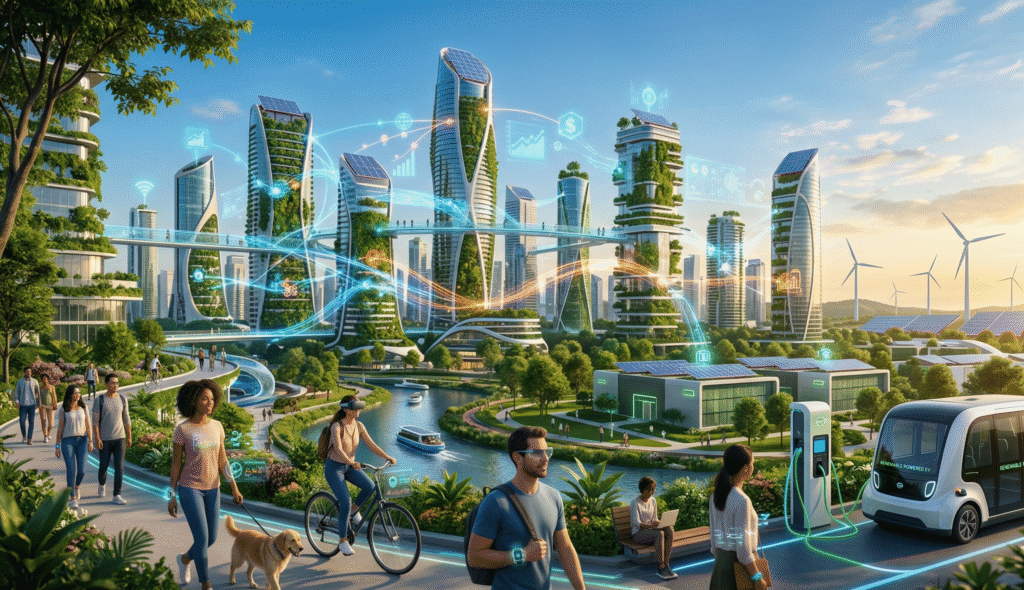
The transition toward a green digital economy is quickly becoming a practical solution for countries aiming to balance economic growth with environmental responsibility. By combining digital innovation with sustainable practices, it is possible to reduce energy consumption while improving public health and overall environmental quality.
Recent research focusing on China’s economic future shows that this transformation can deliver measurable benefits without slowing down development. Instead, it may even accelerate growth in a cleaner and more efficient way.
Understanding the Study Behind the Shift
A research team from Henan University of Urban Construction explored how digital technologies can work alongside green energy systems to shape future economic outcomes. They used a Dynamic Energy Computable General Equilibrium model to simulate different scenarios up to 2030.
This advanced modeling approach allowed researchers to examine how economic growth, digital infrastructure, and energy transitions interact with each other. The findings clearly show that digital tools can play a major role in building a sustainable and resilient economy.
Significant Energy Savings Through Digital Integration
One of the most important outcomes of this study is the potential reduction in energy consumption. With a green digital transition, total energy use could drop to nearly 250 million tons of standard coal equivalent by 2030.
This represents a reduction of about 20 percent compared to conventional projections. The decrease is largely driven by smarter systems, improved efficiency, and increased reliance on renewable energy sources. Technologies such as smart grids, automated systems, and data-driven energy management help minimize waste and optimize usage.
Cleaner Air and Better Public Health
Improved air quality is another major benefit of this transformation. The study suggests that PM2.5 levels could fall to approximately 22.36 micrograms per cubic meter. This is about 11.5 percent lower than expected under standard conditions.
Lower pollution levels directly contribute to better respiratory health and longer life expectancy. Cleaner air reduces the burden on healthcare systems and improves the quality of life for communities. In simple terms, a greener digital economy does not just protect the environment, it also protects people.
Economic Growth Without Environmental Trade-Offs
A common concern is that sustainability may slow down economic progress. However, the findings suggest the opposite. The green digital model shows stronger GDP growth compared to traditional approaches.
This proves that environmental responsibility and economic expansion can go hand in hand. By investing in digital infrastructure and clean energy, governments can create new opportunities, improve productivity, and build a competitive advantage in the global market.
A Practical Policy Roadmap for the Future
To unlock these benefits, policymakers need to focus on building infrastructure that connects digital systems with low-carbon energy sources. High-speed internet, cloud computing, and renewable energy must work together as part of a unified strategy.
Global trends support this direction. The rise of digital healthcare, remote services, and virtual operations is already helping reduce emissions in many sectors. Cities and countries around the world can adapt these insights to design their own low-emission and high-growth futures.
Conclusion
The shift to a green digital economy is not just an environmental necessity, it is a strategic opportunity. By embracing digital innovation and clean energy together, nations can reduce energy use, improve public health, and achieve sustainable economic growth.
As the world moves closer to 2030, adopting this integrated approach could define which economies thrive in a future shaped by sustainability and technology.
Leave a Reply