Introduction
Understanding how much carbon is stored in soil has become one of the most important challenges in modern agriculture. Soil plays a major role in reducing greenhouse gases, yet measuring soil carbon has traditionally been slow, expensive, and dependent on laboratory testing.
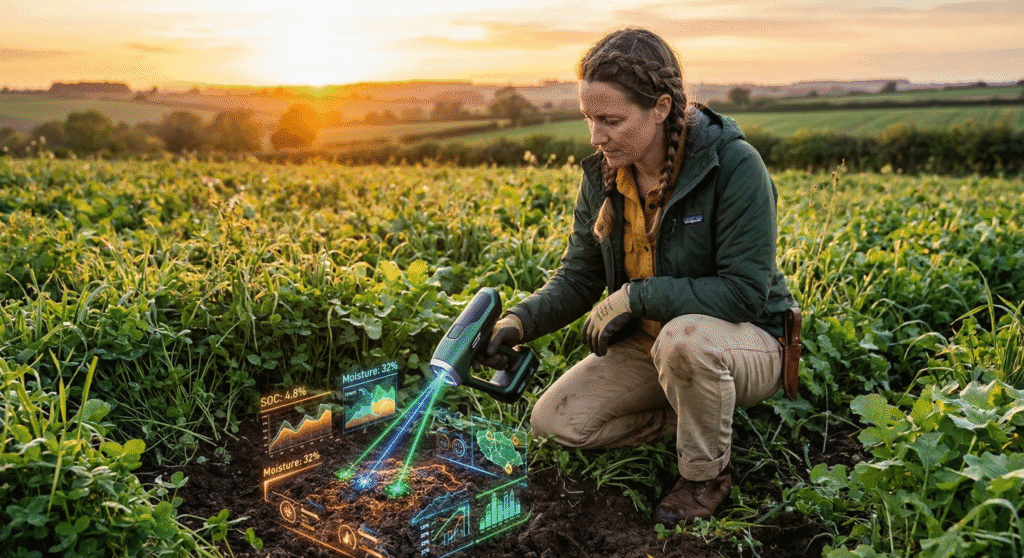
A new innovation from the Finnish company Cense Analytics is changing that process. Their portable laser-based device allows farmers and agricultural companies to measure soil organic carbon directly in the field with accuracy comparable to laboratory results. This breakthrough technology provides quick and affordable data that supports regenerative agriculture and helps tackle climate change.
Why Soil Carbon Matters in Agriculture
Soil is not just a medium for growing crops. It also acts as a natural storage system for carbon. When soil contains higher levels of organic carbon, it becomes healthier, more fertile, and better able to support plant growth.
Regenerative agriculture focuses on restoring soil health while improving farm productivity. Practices such as cover cropping, reduced tillage, and crop rotation help capture carbon from the atmosphere and store it in the soil.
However, verifying how much carbon is actually stored has always been difficult. Farmers and organizations often need reliable data to prove that these practices are working.
The Challenge With Traditional Soil Testing
Until recently, measuring soil carbon required a long and expensive process. Farmers had to collect soil samples and send them to laboratories for analysis. The results could take weeks to arrive and the testing costs were often too high for frequent monitoring.
This system created a barrier for farmers who wanted to adopt regenerative practices but needed proof of their environmental impact. Without fast and affordable testing, tracking soil carbon at scale remained a challenge.
A New On-Site Soil Carbon Measurement Tool
Cense Analytics has introduced a laser-based measurement device that can analyze soil organic carbon directly in the field. The tool uses advanced photonics technology to deliver precise measurements without the need for laboratory testing.
Farmers can now obtain accurate data about carbon storage and carbon dioxide emissions within minutes. This makes soil monitoring much easier and more practical for everyday agricultural use.
By removing the need for shipping samples and waiting for lab reports, the technology significantly reduces both time and cost.
From University Research to a Commercial Innovation
The technology behind this device was originally developed at Tampere University in Finland. Researchers were working with photonics tools designed to detect chemicals in mine water.
Around 2019, the research team recognized that the same technology could be adapted for agricultural use. With support from grants and collaborative projects such as the Carbon Action Project led by the Baltic Sea Action Group, the research moved toward real-world applications.
In 2024, the spin-off company Cense Analytics was officially launched. The company was founded by researchers Juha Toivonen and Jan Viljanen, who brought the technology from the laboratory to the agricultural market.
Today, the company is already working with major organizations in the food and agriculture sector, including Nestlé and Valio.
Real-World Benefits for Farmers and Companies
The new soil carbon measurement technology offers several practical benefits for agriculture and sustainability efforts.
Faster Carbon Monitoring
Farmers can measure soil carbon instantly in the field instead of waiting for lab analysis. This allows more frequent monitoring and better decision making.
Support for Carbon Credit Programs
Accurate soil carbon data helps farmers participate in carbon credit markets. Verified measurements make it easier to prove carbon sequestration and earn environmental incentives.
Reduced Costs
By eliminating laboratory testing and sample transportation, the technology significantly lowers the cost of soil carbon analysis.
Improved Soil Health and Productivity
Better monitoring encourages farming practices that restore soil health. Healthier soil improves crop yields, water retention, and resilience against climate stress.
A Major Step Forward for Carbon Farming
Experts believe that reliable soil carbon measurement is essential for scaling carbon farming worldwide. Governments, food companies, and environmental organizations increasingly require verified data to support climate commitments.
By making soil carbon data accessible and affordable, this technology could accelerate the adoption of regenerative agriculture on a global scale. It allows farmers to clearly see the environmental impact of their practices while helping companies verify sustainability claims.
Company Snapshot
| Aspect | Details |
|---|---|
| Founders | Juha Toivonen, Jan Viljanen, Tuomas Siltala |
| Team | Around 10 employees, mostly alumni from Tampere University |
| Location | Rusko Industrial District, Tampere, Finland |
| Funding | Support from Tiina and Antti Herlin Foundation, Research Council of Finland and other programs between 2019 and 2023 |
Conclusion
The ability to measure soil carbon quickly and accurately is becoming a critical tool in the fight against climate change. Innovations like the laser-based soil carbon analyzer developed by Cense Analytics are making this process simpler and more accessible for farmers.
As regenerative agriculture continues to grow, technologies that provide reliable environmental data will play an important role in building a more sustainable food system. By giving farmers practical tools to track soil health, this breakthrough could help unlock the full potential of carbon farming around the world.