Tag Archives: business strategy

Global Sustainability and ESG Insights: March 2026

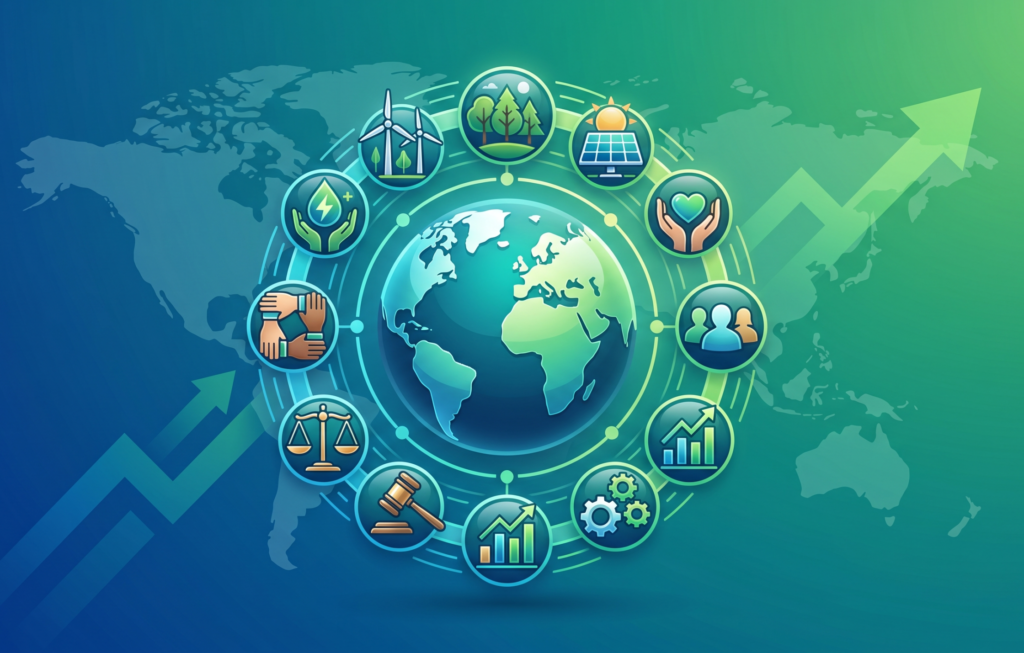
give me the alt text for this image A professional digital illustration of a glowing globe encircled by icons for ESG themes: wind turbines and forests for environment, diverse hands linking for social responsibility, and scales with charts for governance. Blue-green gradient background with faint world map and upward arrows, conveying global sustainability compliance and growth.
generated by google gemini

Sustainability and ESG regulations are evolving at a rapid pace, and March 2026 stands out as a month of significant global movement. Businesses across industries are being pushed to rethink how they approach environmental, social, and governance frameworks. Staying compliant is no longer enough. Companies now need to adapt quickly and strategically to remain competitive in a changing regulatory landscape.

A Snapshot of Recent Developments

According to the latest insights from Eversheds Sutherland, the March 2026 report marks two years of tracking more than 590 sustainability regulations worldwide. This milestone highlights just how quickly ESG expectations are expanding across regions.

Recent updates show a strong focus on energy policy reforms, climate disclosures, and cross-border environmental accountability. In the United Kingdom, consultations around energy infrastructure are shaping future investment decisions. At the same time, Europe is moving forward with mechanisms that directly impact global trade emissions.

Major Regional ESG Updates

The UK is actively consulting on energy infrastructure policies. These discussions are expected to influence how large-scale energy projects are approved and financed, especially those tied to renewable energy expansion.

European Union

The European Union has reinforced its commitment to the Carbon Border Adjustment Mechanism. This policy will affect import costs by factoring in carbon emissions, pushing global suppliers to align with stricter environmental standards.

United States

In the United States, the House of Representatives has advanced major climate legislation. This signals a move toward stronger federal oversight and more structured climate disclosure requirements for businesses.

Hong Kong

Hong Kong has launched consultations on its biodiversity strategy. Businesses operating in the region will need to consider nature-related risks and integrate environmental protection into their long-term planning.

Emerging Global ESG Trends

Several global patterns are becoming clear:

  • The Global Reporting Initiative has introduced updates to labor disclosure standards, encouraging companies to provide deeper insights into workforce practices and conditions.
  • China is setting a strong example in Asia with its national climate reporting standard, raising expectations for transparency across the region.
  • The UAE has taken steps to address human rights concerns by ratifying protocols aimed at eliminating forced labor.
  • Europe has finalized stricter corporate sustainability reporting and due diligence rules, requiring companies to conduct detailed audits of their supply chains.

These developments reflect a global shift toward accountability, transparency, and measurable ESG performance.

What This Means for Businesses

For companies, the message is clear. ESG is no longer a side initiative. It is becoming a core part of business strategy.

Organizations should focus on:

  • Building robust compliance systems that adapt to changing regulations
  • Strengthening internal processes for climate and labor disclosures
  • Using scenario planning to manage risks related to sustainability claims and human rights
  • Exploring innovation opportunities created by new regulations

With emerging leadership in regions like China and parts of Africa, businesses that act early can gain a competitive advantage. The key is to move beyond basic compliance and develop resilient ESG frameworks that support long-term growth.

Conclusion

March 2026 highlights how quickly sustainability regulations are transforming the global business environment. Companies that stay informed and proactive will be better positioned to navigate these changes. By aligning strategy with evolving ESG standards, businesses can not only reduce risk but also unlock new opportunities for innovation and responsible growth.

Sustainability Becomes Core to Business Strategy in 2026

A large pile of discarded household garbage and waste materials sits on a dirt field under an overcast sky, illustrating the environmental impact of poor waste management.
Royalty free image via pexels.

Sustainability is no longer treated as a side initiative in 2026. It has become a central part of how businesses operate, plan, and grow. Companies across sectors are integrating sustainability into everyday decisions to improve efficiency, manage risks, and strengthen long-term resilience. This shift reflects a broader understanding that sustainable practices directly support business performance and stability.

Organizations are focusing on areas such as energy efficiency, supply chain resilience, and smarter risk management. Innovations like circular business models and artificial intelligence are helping companies reduce waste, lower costs, and respond more effectively to changing market conditions.

Sustainability as a Strategic Priority

Businesses are now embedding sustainability into both short-term actions and long-term strategies. Rather than treating it as a reporting exercise, companies see it as essential to daily operations. Global sustainability reporting frameworks, including those developed by the International Sustainability Standards Board and the European Sustainability Reporting Standards, are becoming more aligned. This alignment is making compliance clearer and more manageable for large organizations.

As a result, transparency is improving across industries. Around 91 percent of major companies now disclose sustainability data, helping them track performance, reduce operational costs, and adapt to regulatory and market changes more efficiently.

Growing Focus on Circular Design

Circular design is shaping how products are created and delivered. Businesses are rethinking material choices, manufacturing methods, and packaging to reduce waste and extend product life. The goal is to design items that can be reused, repaired, or recycled rather than discarded.

Digital tools such as digital twins are playing a key role in this transition. These tools allow companies to simulate product lifecycles before production begins, helping teams identify improvements early. Many leading organizations now apply circular principles to all new products and packaging, making sustainability more practical and scalable.

Advancing Energy Systems for Resilience

Energy systems are undergoing significant upgrades to meet rising demand and improve reliability. Large infrastructure projects are being combined with local solutions like microgrids and smart buildings. These systems provide more stable power while supporting energy efficiency at the community level.

Advanced networking technologies are enabling better monitoring and performance optimization. By reducing energy losses and improving system reliability, these innovations help utilities and businesses prepare for future challenges related to energy security and climate risks.

Managing the Energy Impact of AI

The rapid growth of artificial intelligence is increasing electricity demand, particularly in data centers. Energy use in these facilities is expected to rise sharply by 2030. To address this challenge, companies are investing in more efficient networks and smarter load management systems.

These improvements allow infrastructure to handle complex AI workloads without placing excessive pressure on energy resources. Preparing for AI-driven growth is now a critical part of sustainable energy planning.

Preparing for the Quantum Era

Quantum technology is moving from theory to practical preparation. Businesses and governments are beginning to focus on quantum-ready infrastructure, especially in areas such as secure communication and cryptography. Strong partnerships are helping advance fault-tolerant systems that could support future applications in energy optimization and climate modeling.

Early planning is helping organizations build trust, security, and adaptability as quantum technologies continue to develop.

Looking Ahead

Success in 2026 depends on collaboration, smart technology choices, and a strong focus on security and scalability. By integrating sustainability into core operations and embracing innovation, businesses can build resilience while supporting long-term economic and environmental goals.