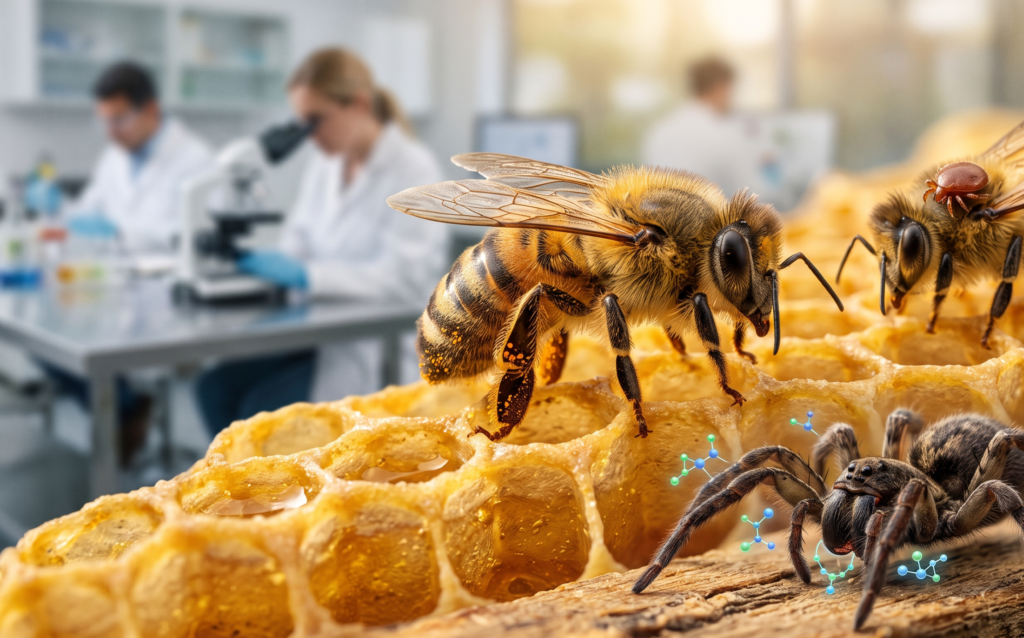
Honeybees are among the most important pollinators in the world, yet their populations continue to face serious threats from disease, habitat loss, pesticides, and harmful parasites. One of the biggest challenges for beekeepers is the Varroa mite, a tiny parasite that has devastated bee colonies worldwide.
Now, Australian scientists have made an exciting discovery that could help change the future of beekeeping. Researchers have found that compounds extracted from spider venom may offer a safe and environmentally friendly way to eliminate Varroa mites without harming honeybees.
Scientists Turn to Spider Venom for a New Solution
The research was carried out by a team at the University of the Sunshine Coast in Australia. Scientists examined venom collected from dozens of spiders and scorpions to identify natural compounds that could target Varroa destructor, the parasitic mite responsible for weakening honeybee colonies.
Their investigation involved testing approximately 50 venom samples. During the study, two spider species stood out because their venom showed remarkable effectiveness against the destructive mites.
After further analysis, researchers isolated tiny protein fragments known as peptides. Laboratory tests showed these peptides successfully killed Varroa mites while leaving honeybees unaffected.
Why This Discovery Is Important
Finding a treatment that targets parasites without harming bees has been a long-standing challenge for researchers and beekeepers.
Many of the chemical products currently used to control Varroa mites have become less effective over time because the parasites have gradually developed resistance. In addition, some treatments may have unwanted effects on the environment or beneficial insects.
The newly discovered venom-derived peptides appear to work differently. They naturally break down in the environment and specifically attack the mites rather than the bees. This makes them a promising alternative for sustainable pest management.
The Growing Threat of Varroa Mites
Varroa destructor is widely recognized as one of the most damaging parasites affecting honeybee populations. These mites feed on developing and adult bees, weakening their immune systems and increasing the spread of harmful viruses.
Infested colonies often become less productive and may eventually collapse if left untreated.
The decline of honeybee populations has become a global concern because bees play an essential role in pollinating crops that produce fruits, vegetables, nuts, and many other foods. Protecting bees is therefore important not only for biodiversity but also for global food security.
What Happens Next?
Although the results are highly encouraging, researchers say more work is needed before the treatment becomes available for commercial use.
The next phase of the project will involve testing the peptide compounds inside active beehives to determine how well they perform under real beekeeping conditions. Scientists will also evaluate the long-term safety, effectiveness, and practicality of using these compounds on a larger scale.
The research team has secured additional funding to continue developing this promising technology.
A Step Toward Sustainable Beekeeping
Natural, targeted pest control methods are becoming increasingly important as agriculture looks for safer alternatives to conventional chemicals.
If future trials are successful, spider venom-derived peptides could provide beekeepers with a powerful new tool for controlling Varroa mites while reducing environmental impact. Such an innovation could improve colony health, strengthen pollinator populations, and support more sustainable farming practices around the world.
Final Thoughts
The discovery that spider venom contains compounds capable of controlling Varroa mites represents an exciting development in agricultural and environmental research. While commercial use is still some years away, the early findings offer hope for protecting honeybees from one of their greatest threats.
Healthy bee populations are essential for ecosystems and food production. Advances like this demonstrate how studying natural compounds can lead to innovative solutions for some of the world’s most pressing environmental challenges.