Introduction
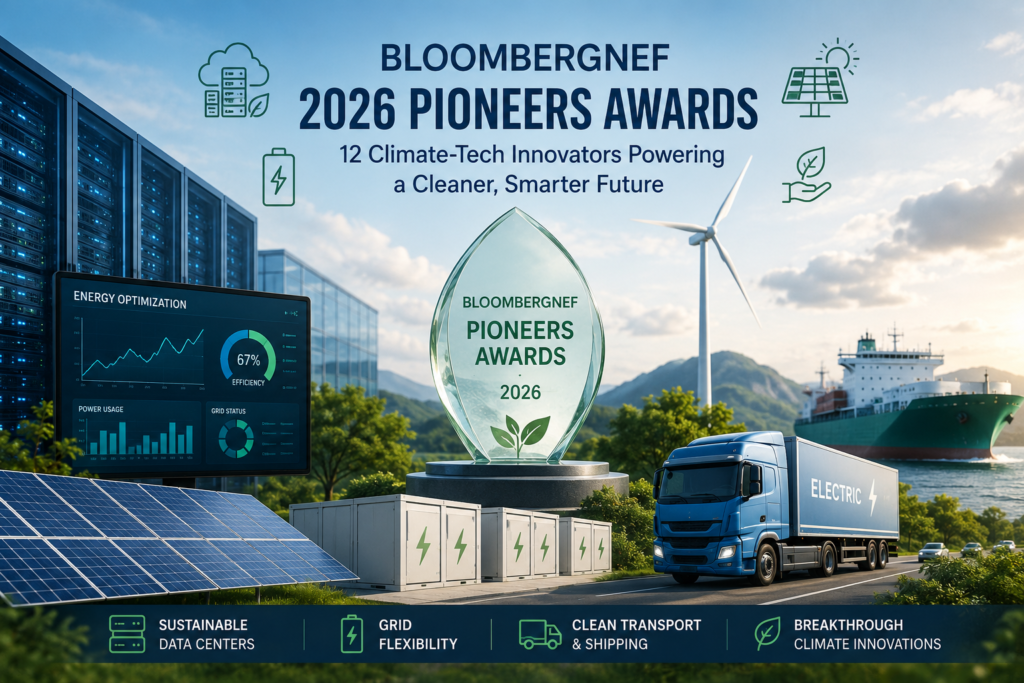
BloombergNEF has officially announced the winners of its 2026 Pioneers Awards, recognizing 12 emerging climate-tech companies that are working on solutions for a cleaner energy future.
These startups are focused on building practical technologies that improve energy efficiency and reduce carbon emissions. Their work supports the ongoing global transition toward more sustainable energy systems.
At the same time, global electricity demand is increasing at a rapid pace. This surge is largely driven by artificial intelligence, cloud computing, and expanding digital infrastructure. Because of this, the need for innovative climate solutions has become more urgent than ever.
Why the 2026 Pioneers Awards Are Important
The Pioneers Awards are designed to highlight early-stage companies with strong potential for real-world impact. BloombergNEF evaluates these startups based on scalability, environmental benefit, and practical implementation.
Earlier, the focus was mainly on renewable energy production. However, the scope has now expanded significantly.
Today, the energy transition also includes digital systems, transport networks, and industrial processes. As a result, climate innovation is becoming more interconnected across multiple sectors.
Key Focus Areas for 2026
This year, BloombergNEF identified three major challenges shaping the global energy landscape.
The first is the growing energy demand from data centers. AI-driven workloads are increasing electricity consumption at a fast pace.
The second challenge is grid stability. Since solar and wind energy are variable, balancing supply and demand has become more complex.
The third area involves hard-to-decarbonize industries such as shipping and heavy transport. These sectors still depend heavily on fossil fuels and require new technological solutions.
Additionally, the program also included wildcard innovations that deliver climate benefits across different industries.
Making Data Centers Smarter and More Efficient
Several winning startups are working to improve how data centers use energy.
Some are building intelligent software systems that adjust electricity consumption in real time based on grid conditions. This helps reduce pressure during peak demand hours.
Others are focusing on hardware improvements. These include advanced cooling technologies and energy-efficient semiconductor designs. Together, these innovations help reduce overall power usage in computing systems.
Improving Stability in Renewable Energy Grids
Another group of innovators is focused on strengthening power grids.
As renewable energy expands, electricity generation becomes more unpredictable. Because of this, storage and balancing solutions are becoming essential.
Some companies are developing distributed battery storage systems that store excess energy and release it when demand increases.
In addition, smart energy systems for homes and buildings are gaining popularity. These systems automatically adjust consumption during peak hours to improve efficiency.
Long-duration energy storage technologies are also emerging as a key solution for ensuring reliable power supply during periods of low solar or wind generation.
Decarbonizing Transport and Shipping
Heavy transport remains one of the most difficult sectors to decarbonize. However, several startups are making steady progress.
Many winners are working on electric freight systems and cleaner logistics platforms that help reduce fuel consumption.
In addition, integrated solutions are being developed that combine charging networks, fleet management, and route optimization. This makes large-scale electric freight more practical and cost-effective.
Wildcard Innovations Driving New Possibilities
Beyond the main categories, BloombergNEF also recognized several unique innovations.
These include electric bus networks expanding in developing regions, biotechnology solutions for recovering critical minerals from low-grade sources, and new battery materials designed to be safer and more recyclable.
Together, these developments show that climate technology is expanding beyond energy generation into materials science and sustainable infrastructure.
The Growing Importance of Climate Innovation
BloombergNEF has supported climate innovation for nearly 20 years. Many previous winners have gone on to scale successfully and attract significant investment.
This year’s selection reflects a broader global shift. Climate technology is no longer just about reducing emissions. It is also becoming central to economic growth, energy security, and industrial transformation.
Conclusion
The 12 winners of the BloombergNEF 2026 Pioneers Awards represent a new wave of climate innovation.
Their work spans energy systems, transportation, digital infrastructure, and advanced materials. Together, these sectors highlight how deeply connected the clean energy transition has become.
As global energy demand continues to rise, these innovations will play a vital role in shaping a cleaner, more resilient future.