Tag Archives: sustainable growth

Circular Economy and Sustainable Development: Why This Approach Is Gaining Global Attention

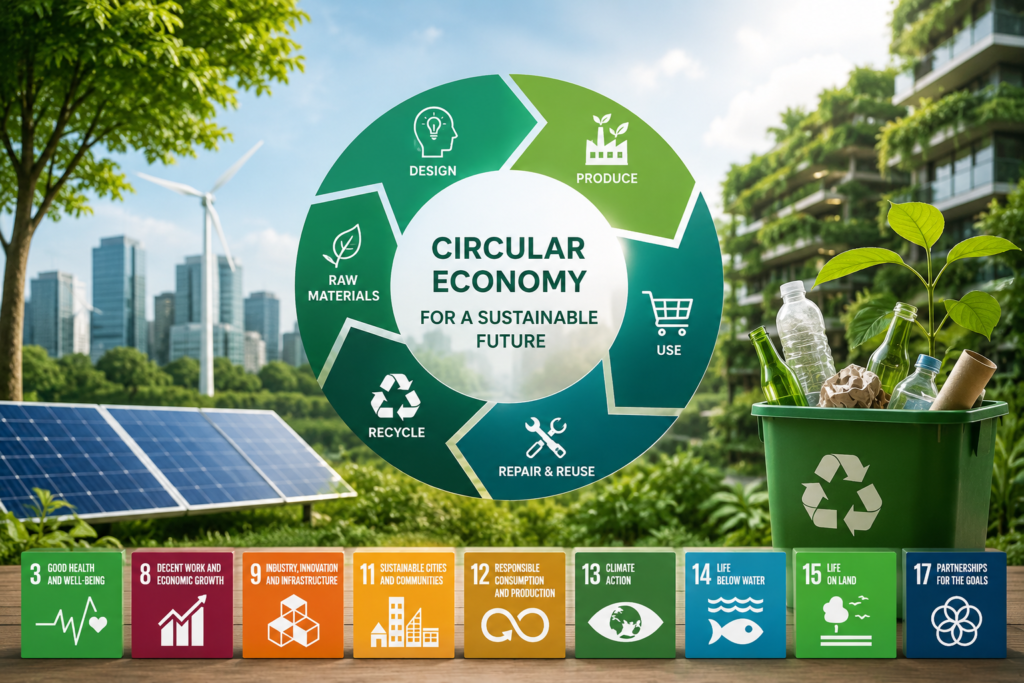
Circular economy infographic showing resource reuse, recycling, renewable energy, sustainable cities, and Sustainable Development Goals supporting long term environmental and economic development.
generated by ChatGPT

Introduction

Across the world, conversations about sustainable development are evolving. While environmental goals remain important, governments, businesses, and researchers are increasingly looking for solutions that also support economic growth and social progress. One approach receiving growing attention is the circular economy.

As countries deal with climate challenges, limited natural resources, rising waste, and economic pressures, the circular economy is being seen as a practical framework that could help create long term and measurable impact.

What Is a Circular Economy?

A circular economy is built around the idea of making better use of resources instead of following a system based on producing, consuming, and discarding.

Traditional economic models often rely on continuous extraction and short product lifecycles. In contrast, circular systems encourage extending the life of products, recovering materials, reducing unnecessary waste, and designing processes that keep resources in use for longer.

The objective is not simply recycling. It is creating an economic structure that reduces pressure on natural systems while supporting productivity and innovation.

Why the Circular Economy Matters for Sustainable Development

Progress toward global sustainable development goals has slowed in many regions due to environmental and economic pressures. Circular strategies are gaining attention because they can support multiple priorities at the same time.

For example, repair, reuse, and resource recovery sectors can generate employment opportunities and encourage local economic activity. At the same time, reducing waste and improving production systems may lower environmental impact.

Agriculture is another area where circular practices can make a difference. Smarter use of materials and more efficient farming approaches can strengthen food systems while reducing resource consumption.

These changes show that sustainable development does not need to come at the cost of economic progress.

Connecting Economic Growth With Environmental Responsibility

One of the strongest arguments in favor of the circular economy is that it challenges the idea that economic growth and sustainability must compete with each other.

Instead of separating environmental action from development planning, circular models aim to integrate both. Businesses can improve efficiency, communities can gain access to more affordable and durable products, and governments can work toward long term resilience.

Supporters believe this shift could also help reduce emissions, encourage innovation, and protect ecosystems across supply chains.

What Needs to Happen Next?

Moving toward circular systems requires more than individual action. Policies, investment, collaboration, and clear standards will play a major role in enabling broader adoption.

Many experts argue that successful implementation will depend on making the transition inclusive so workers, businesses, and communities all benefit from the change.

As global development priorities continue to evolve, the circular economy is increasingly being viewed as more than an environmental concept. It is becoming part of a wider conversation about how economies can grow while remaining resource conscious and socially responsible.

Conclusion

The growing interest in the circular economy reflects a larger shift in how sustainable development is being approached worldwide. Rather than focusing only on reducing harm, this model encourages smarter use of resources while creating opportunities for economic and social progress.

Whether circular principles become central to future development strategies remains to be seen, but their influence on policy and long term planning is becoming increasingly difficult to ignore.

Sustainable Innovation as a Driver of Business Growth

A glowing light bulb rests on a wooden table, symbolizing innovative ideas and sustainable energy solutions.
Royalty free image via pexels.

Sustainable innovation has become a powerful force for business growth while safeguarding the environment and supporting communities. Instead of relying on copied ideas or existing frameworks, companies can develop original strategies that deliver long-term value. By embedding sustainability into innovation, businesses strengthen resilience, improve trust, and unlock new growth opportunities.

Modern organizations are discovering that responsible innovation is not a limitation. It is a competitive advantage that aligns profitability with environmental and social responsibility.

Core Principles of Sustainable Innovation

At its foundation, sustainable innovation brings together three essential pillars: environmental responsibility, social impact, and economic performance. Successful businesses aim to reduce waste, lower emissions, and shift toward renewable resources while maintaining ethical and fair practices across operations.

This balanced approach ensures that growth does not come at the expense of natural resources or communities. Instead, it creates lasting value by aligning business success with long-term planetary health.

Key Strategies for Sustainable Business Innovation

Effective sustainable innovation begins with clearly defined goals. These goals should be connected to measurable outcomes such as reduced carbon emissions, improved energy efficiency, or lower material consumption.

Sustainability targets must be integrated into core business functions from the earliest stages. This includes product design, sourcing decisions, manufacturing processes, and supply chain management.

Building diverse teams is equally important. When technology experts, strategic planners, and ethics-focused professionals collaborate, businesses are more likely to develop innovative and responsible solutions.

To ensure real impact, companies can rely on tools such as lifecycle assessments. These tools help measure environmental and social effects across a product’s entire lifespan, from raw materials to end use.

Practical Steps Businesses Can Take

Organizations can begin by redesigning products using environmentally friendly materials and reducing unnecessary packaging. These changes significantly lower environmental impact while meeting consumer demand for sustainable products.

Strong supplier partnerships are another critical step. Transparent and ethical sourcing, combined with circular systems that reuse materials, helps create more resilient and responsible supply chains.

A culture of innovation also plays a major role. Encouraging employee participation through idea-sharing platforms, innovation labs, and continuous learning initiatives helps sustainability become part of everyday decision-making.

Success should be tracked using clear performance indicators. Metrics such as carbon footprint reduction, resource efficiency, and market adoption rates provide valuable insights into progress and impact.

Real-World Approaches to Sustainable Innovation

Many businesses are finding success by adopting circular economy models that prioritize recycling, reuse, and renewable inputs. Others use digital tools to increase supply chain transparency or develop products using plant-based and low-impact materials.

These real-world approaches demonstrate how sustainability challenges can be transformed into opportunities for innovation, differentiation, and growth.

How to Get Started with Sustainable Innovation

Business leaders should begin by setting realistic and measurable sustainability targets. Investing in green technologies and fostering cross-functional collaboration creates a strong foundation for innovation.

Staying adaptable is equally important. Emerging trends such as eco-design, digital optimization, and data-driven sustainability offer new ways to improve efficiency and reduce impact. By remaining flexible and forward-looking, companies can thrive in an increasingly resource-conscious global economy.